Magda
Bridget Jones: Mad About the BoyMagda is Bridget Jones’s oldest friend and one of the few people in her long-standing social circle whose support is both affectionate and practical. First met at Bangor University, she remains a steady presence when Bridget feels alienated by other people’s assumptions about widowhood, age, and dating. Her friendship is marked not by perfect agreement but by an ability to defend Bridget, acknowledge her pain, and offer somewhere to turn when life becomes difficult.
Identity and Social Circle
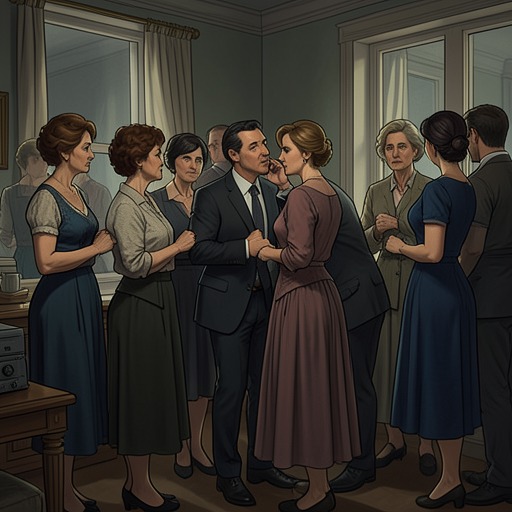
Magda appears at a gathering in the familiar sitting room, where she waves cheerfully from the drinks table. Bridget recognizes the other guests as people she has known since her early twenties, members of the original Sloane Rangers whose marriages have endured while Bridget’s life has taken a different course. Although she is the oldest friend in this group, Magda’s presence does not erase Bridget’s sense of being out of step: Bridget feels as if her life is happening years behind the couples around her. The contrast establishes the particular value of Magda’s friendship. She belongs to the old circle, but her loyalty is not conditional on Bridget matching its expectations.
The gathering also exposes the social habits Magda sometimes has to resist. When Cosmo tells Bridget that she cannot wear widow’s weeds forever, Magda tells him to stop. Woney then generalizes about the difficulty facing middle-aged women who become single, and Cosmo imagines that a newly single man will seek someone younger. Their remarks turn Bridget’s bereavement into a prompt for unsolicited judgments about when she should move on and what makes a woman desirable. Magda is present within that conversation, but does not let it pass without objection.
Candour and Care
Magda’s support is clearest after Bridget withdraws from the conversation, saying she needs to go to the toilet. On her way to the kitchen, Magda finds Bridget again and tells her not to listen to Cosmo and Woney. She explains their conduct by pointing out that their son Max has left for university and that Cosmo is close to retirement; the couple, she suggests, are facing a long stretch of life together across their Conran Shop table. The remark gives Bridget a welcome reversal: instead of treating her as the problem, Magda recognizes the unhappiness behind the others’ intrusive advice.
Her comfort does not stop at taking Bridget’s side. Magda tells her that she must begin moving on as a woman, find someone, and stop feeling as she does, adding that she has known Bridget for a long time and believes she can do it. Bridget is not immediately persuaded; later that evening, she cannot see a way out of her feelings. The exchange therefore presents Magda’s friendship as candid encouragement rather than a cure for grief. She offers faith in Bridget’s future while the diary records that Bridget cannot yet share it.
Bridget’s own judgment of Magda is unusually direct: Magda has never stopped being kind. That kindness appears in more than one register. She intervenes when other friends speak carelessly, comforts Bridget without pretending that the pain has vanished, and is willing to make decisions and arrangements on her behalf when she is overwhelmed. Her friendship is not merely a shared history; it remains active in moments when Bridget needs help.
A Refuge at Christmas
When Christmas plans threaten to leave Bridget managing two children alone, she calls Magda. Magda firmly invites her to Gloucestershire, arguing that Bridget cannot reasonably attempt the proposed activities with the children or depend on a neighbour she has only just met. She has a concrete plan: the couple next door can come over from the farm with children of the same age, and the house has Xboxes. Since there is little there for the children to spoil, the visit need not become another test of Bridget’s capacity to keep everything under control.
Magda also helps resolve the wider family logistics. She tells Bridget to reply quickly with a child-friendly plan and to promise her mother a special Christmas at St Oswald’s House after the cruise. Bridget later records that Christmas has been perfectly fine; her mother accepts the post-Christmas arrangement and enjoys the cruise. Magda’s intervention cannot be credited with every part of that outcome, but it gives Bridget a workable alternative at the moment she is afraid she has let people down.
Narrative Significance
Magda’s scenes set dependable friendship against the social scrutiny that repeatedly surrounds Bridget’s widowhood and later life. At the gathering, she protects Bridget from remarks that make grief sound like a deadline and singleness like a personal failure. At Christmas, she turns concern into hospitality, identifying practical needs and arranging a setting in which Bridget and the children can be welcomed. Across these moments, her role is less to remove Bridget’s sadness than to keep her from facing every difficulty alone: first by standing beside her in an uncomfortable room, then by making space for her in Gloucestershire.