Mr Wallaker
Bridget Jones: Mad About the BoyMr Wallaker is a teacher at Billy Darcy’s school, first noticed by Bridget Jones as a striking, whistle-wielding presence among the school’s sporting activities. His defining trait is an insistence that children earn achievements through practice and effort, even when that candor unsettles their parents. Across repeated encounters, the stern educator proves more complicated than his severe manner suggests: he can organize a schoolyard with brisk authority, but also respond to Bridget’s embarrassment with a flicker of amusement.
Identity and Introduction
Bridget first sees Mr Wallaker amid the school mothers’ discussion of an Area of Concern. Nicolette Martinez is complaining that he has kept her son Atticus in the football Ds despite the boy coming home in tears. The scene introduces Wallaker indirectly, through a parent’s grievance, before he appears in person: tall, fit, slightly younger than Bridget, crop-haired, and reminiscent in appearance of Daniel Craig. He watches a group of unruly boys, blows his whistle, and orders them into the cloakroom, warning that he will give them a Caution. The boys form a disorderly line and jog back toward the school, while Wallaker keeps time with his whistle. His authority is practical and conspicuous, and it immediately makes him the focus of both parental disapproval and admiration; Farzia Seth, another school mother, observes that he is attractive.
Standards, Discipline, and Teaching
Wallaker’s strictness is not limited to sport. When Billy tells Bridget that he was not selected for chess, Bridget tries to reassure him that winning matters less than who he is. Wallaker counters that selection does matter: Billy must practise and earn it. He mutters about what he sees as the mothers’ sense of entitlement, making clear that his disagreement is not only about one disappointed child but about the expectations parents bring to the school. Bridget answers with exaggerated politeness and asks whether he uses his whistle in the chess class. His reply—that he teaches chess—exposes her mistaken assumption that his authority belongs only to the Sports Department. The moment gives his severity a wider scope: he is not simply a sports disciplinarian but also a teacher responsible for intellectual effort.
The same emphasis on work and preparation shapes his response to Billy’s school performance. After Billy describes a spelling test as an epic failure, his anxious form teacher, Mr Pitlochry-Howard, hurries over to reassure the family that Billy is bright and needs something more. Wallaker arrives to listen and supplies a less comforting diagnosis: Billy needs more organization at home. His bluntness contrasts with the form teacher’s gentler reassurance and with Bridget’s own difficulty keeping the children’s scattered homework materials in order. In Wallaker’s view, encouragement cannot substitute for the habits that help a child succeed.
At another school drop-off, he organizes boys into lines crouching behind imaginary snow walls and throwing imaginary snowballs. The invented battle turns a routine morning into a coordinated game, showing that his command of the children can produce play as well as compliance. When he greets Bridget as Mrs Darcy and jokes about whether she will be climbing trees again, he refers to her earlier encounter with him beneath a tree. Bridget smoothly evades the reference and asks where the snow is. His teasing suggests that he has not forgotten the incident, while the imaginary snowball fight places his authority in a lighter, more playful register than the football and chess disputes.
Encounters with Bridget Jones
Their early exchanges are marked by friction. When Bridget challenges his advice to Billy, she uses sweetly barbed compliments and questions whether the whistle belongs in the chess class. Wallaker’s cold blue gaze and brief disconcertion register the discomfort of being mocked, but he does not escalate the exchange. Instead, he turns to a dog in a flower bed and gives it a sharp order to get out. His attention returns immediately to the practical task at hand, a small demonstration of how little he indulges Bridget’s performance.
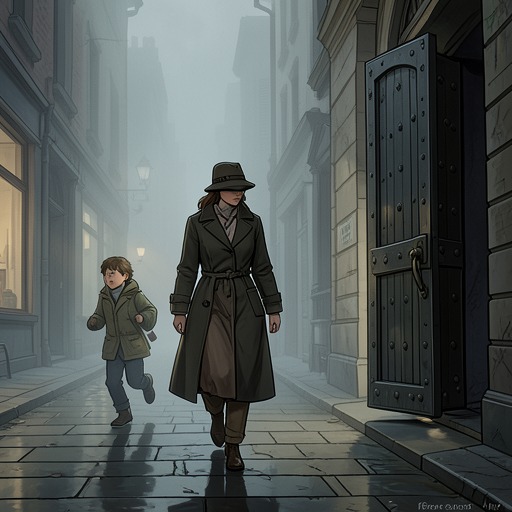
The tree episode reverses their usual positions. Bridget is above him with the children; Wallaker runs up in sweatpants and a grey T-shirt, looking as though he is on an assault course. He stops beneath them to check whether everything is all right. Bridget is conscious of his judgmental stare and of her jeans slipping low enough to reveal her black lace thong. When she insists that everything is fine and explains that they are climbing a tree, he accepts the answer without comment beyond acknowledging the obvious. He then says he will be off. The encounter offers no rescue or confrontation: its awkwardness comes from Bridget imagining the school gossip that might follow, while Wallaker simply checks on the situation and leaves.
Their accidental meeting at Boots is similarly brief but revealing. Bridget has bought condoms after dropping the children at school, and Wallaker is at the next till. He stares ahead, but the slight twitch at the corner of his mouth shows that he has noticed what is in her basket. Bridget responds by bringing up the weather for the rugby match. He answers that mud can sometimes be enjoyable, picks up his bag, and gives a tiny snort of amusement. The exchange turns a potentially mortifying discovery into dry, shared humor without suggesting any intimacy beyond that moment.
Presence in School and Narrative Role
Wallaker recurs at the points where Bridget’s home life meets the school’s standards and routines: selection for chess, sporting groups, snow-day excitement, Billy’s spelling, and the paperwork for bassoon lessons. At pickup, while Bridget is searching through her handbag for a form, the school secretary announces his arrival. He looks down at the mess and asks whether everything is going well. Among the papers are leaflets about syphilis and gonorrhoea and a sexual-health guide. As with the condoms at the till, an ordinary school errand becomes an occasion for Bridget to feel exposed, while Wallaker’s smirk supplies the understated comic turn.
These scenes build his character through contrast rather than explanation. Parents may see his standards as harsh, especially when a child is upset, but he repeatedly treats practice, effort, and organization as consequential rather than optional. Against Bridget’s improvisation—her disordered bag, her anxious attempts to comfort Billy, and her impulse to conceal awkwardness—he represents the school’s unsentimental demand for preparation. Yet the whistle, the snowball game, and his restrained amusement keep him from becoming only a stern authority figure. His role is to make the school’s expectations tangible, while his recurring encounters with Bridget let discipline and embarrassment repeatedly meet on comic ground.