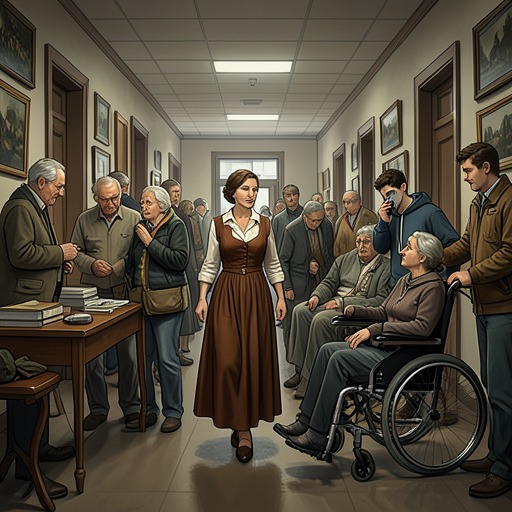
Una
Bridget Jones: Mad About the BoyUna is a long-standing friend of Bridget Jones’s parents and, after losing her husband Geoffrey, shares a home at St Oswald’s House with Bridget’s Mother. The novel presents her through family calls and domestic arrangements rather than through an independent account of her life, but those glimpses give her a clear presence: she is part of a close, durable friendship group, a companion in widowhood, and an active participant in the carefully organized social life of the retirement community.
Identity and Background
Una and Geoffrey had been Bridget’s Mother and Bridget’s Father’s closest friends for fifty-five years. They had known Bridget Jones since she was a small child running naked across the lawn, a family memory that places Una inside Bridget’s history well before the events of the diary. She is not merely an acquaintance who appears in the present-day plot: her relationship with Bridget’s parents has lasted across decades and carries the familiarity of shared family life.
Geoffrey’s death from a heart attack changed the shape of that friendship. Bridget’s Mother had already lost her husband, and Una’s loss meant that both women were widows. The text gives no extended account of Geoffrey or of Una’s private grief, but the fact of their shared bereavement helps explain why Una and Bridget’s Mother now live together and why they appear as a unit in Bridget’s family arrangements.
Life at St Oswald’s House
After moving to St Oswald’s House, near Kettering, Una and Bridget’s Mother make calls that are full of the establishment’s schedules and amenities. The place is presented as an upscale community built around a grand Victorian mansion, with a lake, grounds, several restaurants and cafés, guest suites, and houses and bungalows. Its fitness and beauty complex, VIVA, adds a pool, spa, gym, salon, hairdresser, and classes to the residents’ daily options. For Una, the setting is not simply accommodation: it provides the stage for appointments, exercise, grooming, and companionship.
One call catches the pair amid a tightly timed round of activities. Bridget’s Mother wants to settle Christmas plans while Una is due for a cranio-facial treatment at the spa in fifteen minutes; Una would rather not have it because she has just had her hair done. Aqua-Zumba is also part of the schedule for the following morning. The small collision between a beauty treatment and a freshly styled hairdo gives the scene its comic precision, while the timetable conveys a life in which leisure is organized as actively as work.
Bereavement and Companionship
Una’s friendship with Bridget’s Mother is grounded in shared history and reinforced by shared loss. Bridget Jones remembers that her mother went through a dark period after Bridget’s Father died of lung cancer, which took him from diagnosis to funeral in six months. He did, however, live long enough to hold newborn Billy. The account contrasts that grief with the later circumstances of Una, who still had Geoffrey when Bridget’s Father died. After Geoffrey’s fatal heart attack, both women had experienced the loss of a spouse, and neither, Bridget observes, now tends to display grief openly.
Bridget interprets their composure as part of the wartime generation’s capacity to keep going cheerfully, even if she jokes about powdered eggs and whale-meat fritters as a possible explanation. That observation belongs to Bridget’s perspective, not to a direct account of Una’s feelings. Una’s inner life remains largely unspoken; what the novel shows instead is her continuing presence beside Bridget’s Mother and their shared ability to carry on with ordinary plans after bereavement.
Family Plans and Characterization
The two women’s approach to widowhood is markedly more energetic than Bridget Jones’s own state of mind at this point. Bridget’s Mother urges her not to mope, says that she should have fun, and suggests that she come to St Oswald’s House to join her and Una in the sauna. The invitation is kindly meant, but Bridget cannot imagine abandoning the children, driving for an hour and a half, and joining them for a spa visit. The difference is not that Una’s loss is denied; rather, the older women’s routine of shared activities offers one possible response to widowhood, while Bridget is still unable to feel that she can simply step into it.
Christmas planning reveals the practical limits of their family arrangements. When Bridget raises the question of Una’s grandchildren, Bridget’s Mother explains that the in-laws have the turn that year. The exchange places Una within an extended family network, while showing that even a major holiday is governed by the rotation of visits between relatives. Her presence in the conversation is brief, but the detail complements the earlier picture of a life organized around both companionship at St Oswald’s House and obligations beyond it.
Una’s narrative role is therefore modest but consequential. She is a continuing link to Bridget Jones’s childhood and to the long friendship between the older generation; she is also the companion with whom Bridget’s Mother shares widowhood, leisure, and Christmas arrangements. The book does not supply a full biography or give Una a separate plot arc. Instead, it makes her legible through durable relationships and vivid practical details: fifty-five years of friendship, a move to St Oswald’s House, a spa appointment threatened by a newly styled hairdo, and an invitation to the sauna. Together, these moments suggest a social world that persists after loss, even when Bridget Jones is not yet able to join it.