Head Lice Scandal and Celebrity Lice Removal Journey
Bridget Jones: Mad About the BoyThe head-lice crisis and celebrity-treatment outing turn an ordinary infestation scare into a running interruption to Bridget Jones’s work and a test of how readily her circle’s worries become her own. It begins as a tally of lost time and possible exposure, then moves from Mabel’s distress to Talitha’s hair extensions and finally to a costly group treatment whose theatrical equipment promises more certainty than its results provide.
An outbreak becomes everyone’s problem
On 23 April 2013, Bridget’s diary measures the disruption with mordant precision: she has spent no minutes writing her script and 507 minutes dealing with other people’s nits. Her list of people who might have been exposed includes Tom, Jude, Jude’s recent dates, Talitha, Roxster, Arkis, Sergei, Grazina the Cleaner, Chloe, Brian the Agent, and the entire Greenlight Productions team. The tally reaches 23, not counting the people those contacts might themselves have infested. The comic arithmetic makes a private inconvenience feel like a social network expanding by the minute; even the possibility that lice could travel down a phone receives a place in Bridget’s reckoning.
The timing matters because Bridget has just begun her first official rewriting day on The Leaves in His Hair. The work feels newly real, but already difficult: setting Hedda Gabbler on a yacht in Hawaii has changed the mood and meaning of the script compared with its former setting in a Queen’s Park terrace house. The outbreak does not cause those creative problems, but it competes for the same scarce attention. In the diary’s account, the script and the infestation occupy one crowded day, with the supposed workday measured less by pages written than by time diverted elsewhere.
Mabel’s letter and Talitha’s extensions
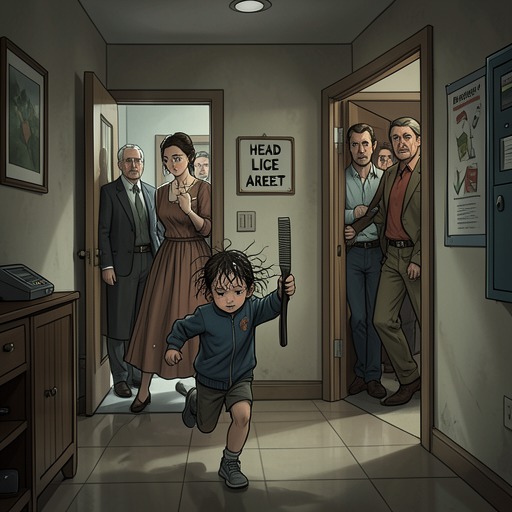
The scare becomes personal when Mabel rushes in holding a school letter and sobs on the sofa. The notice says that a child in Briar Rose has been found to have head lice and asks parents to check their children before sending them to school. Mabel takes the wording literally and fears that she is the child who brought the lice into the class. Bridget hugs her, acknowledging that the embrace may itself pass lice between them, but reassures her that no lice were found on Mabel and suggests the notice may refer to more than one child. She identifies Cosmata as having head lice. The episode shows how an impersonal school circular, without naming the affected child, can become a source of acute worry for a young reader who believes its words point directly to her.
Talitha’s problem is distinct: a hair-extension salon refuses to remove her extensions because it does not want to risk infecting the premises. She seeks a Celebrity Nit Nurse in Notting Hill, and her texts supply Bridget with a running account. At first the nurse has found nothing; then Talitha reports that she has head lice and questions whether a £130 treatment is worth believing in. Her predicament shifts the episode from checking children to the costly practical consequences of treating an infestation while wearing extensions.
Bridget feels she has helped ruin Talitha’s life, career, and character, and offers to remove the extensions herself. Talitha instead proposes that they all visit the Celebrity Nit Nurse, presenting the outing as a way to ease Bridget’s worries as well as a pleasant group activity. Later, Bridget and Talitha undertake the painstaking removal together: oil must be rubbed into the glue, the extensions pulled out, and the hair inspected. The work brings moaning and crying, but no insects are found in the extensions because the nurse has already removed them. They do find numerous dark dots in the glue. Bridget offers to pay for replacement extensions, which will cost hundreds of pounds, taking responsibility even though the evidence does not establish that she caused Talitha’s difficulty.
The treatment expedition
By 27 April, the nit-nurse expedition has become a group outing. Billy calls it extreme fun, and Bridget records that everyone enjoyed themselves until the bill arrived. Assistants dressed entirely in white vacuum everyone’s hair, report finding nothing, and then blast them with a very hot hairdryer. The contrast between the group’s enjoyment and the £275 charge gives the episode its sharpest turn: Bridget calculates that the money could have paid for a trip to Euro Disney if the family had searched online at the right moment.
The treatment’s elaborate presentation invites practical skepticism. Bridget asks whether the process could be reproduced at home with a mini-vacuum and a very hot hairdryer. The nurse dismisses the idea by stressing that the equipment is specially designed: the vacuum comes from Atlanta and the Heat Destroyer is made in Rio de Janeiro. Those distant origins and capitalized product names make the procedure sound almost industrial, yet the assistants have just said they found nothing. The account does not establish whether the equipment was necessary or whether any lice remained; it records Bridget’s question, the nurse’s answer, and the bill rather than resolving the dispute.
Interruption, care, and comic accounting
The episode’s recurring form is accounting: minutes not spent writing, possible contacts counted across a social circle, a £130 treatment questioned, hundreds of pounds anticipated for replacement hair, and a final £275 bill. These figures convert the vague anxiety of infestation into measurable costs, while each new calculation exposes another demand on Bridget’s attention. The numbers do not make the crisis easier to control; they show how quickly it spreads from fear of transmission to appointments, labor, and expense.
The care at the center of the episode is practical rather than solemn. Bridget comforts Mabel, follows Talitha’s messages, helps remove the extensions, offers to cover their replacement, and joins the family treatment outing. That generosity coexists with exasperation at the time and money consumed. The final contrast—an expensive, specialized process that reports finding no lice, followed by a suggestion that a household vacuum and hairdryer might do—leaves the episode suspended between reassurance and doubt. For Bridget, the infestation is both a literal nuisance and a comic measure of how readily other people’s emergencies overrun the work she has only just begun.