It Takes a Whole Village to Raise a Child
Bridget Jones: Mad About the BoyIt Takes a Whole Village to Raise a Child is the model of family life Bridget Jones longs for: children playing while adults gather, talk, and share the work of looking after them. Its importance lies in the distance between that warm, communal picture and the fragmented reality of raising two children after Mark Darcy’s death. The idea offers Bridget a way to imagine companionship and practical help, but the story also shows that a village is not summoned by a slogan: it has to be built through friendship, negotiation, and mutual care.
An Answer to Isolation
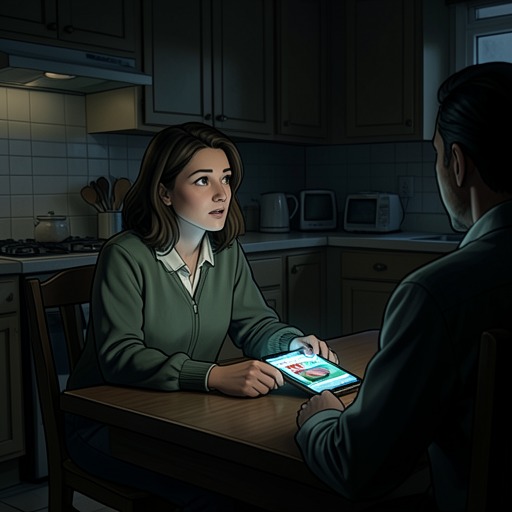
The wish first takes shape during an evening when the children are asleep and Bridget feels lonely, hungry, and overwhelmed by her obesity products. She sets herself a three-month list of goals: lose 75 pounds, gain 75 Twitter followers, write 75 pages of a screenplay, learn to operate the television, and find a nearby friend with children of similar ages. The variety of the list makes the need plain. Bridget wants personal achievement and a less chaotic domestic life, but she also wants someone nearby with whom she can share an ordinary evening.
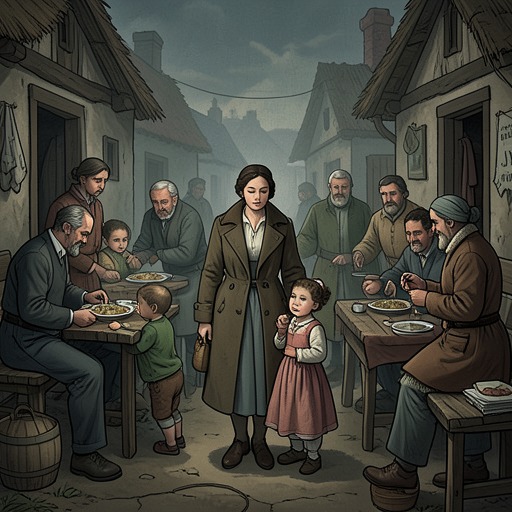
Her reasoning is explicitly social. She worries that children are isolated in individual houses with one or two adults concentrating too intensely on their happiness, while fear of paedophiles keeps them from playing in the street. In contrast, she imagines adults drinking wine and talking spontaneously as children play, like an extended Italian family dining beneath a tree. The saying she adopts for this vision is, "It takes a whole village to raise a child." Here, the village means more than additional hands: it promises a wider, less anxious setting for childhood and relief from the belief that one parent must organize every moment.
Rebecca and the First Shared Table
Bridget soon acts on the hope by accepting an invitation from Rebecca, her bohemian neighbour. Rebecca’s kitchen and garden seem to open onto a different domestic world: a long communal table, a huge bear statue, brick paths, tall grass, a crowned cow, a motel sign, and chandeliers hanging in the trees. The children gather there while the adults drink wine and eat pizza. The girls dress Rebecca’s cat in scarves and doll’s dresses; the boys resist being pulled away from the Xbox. The evening is not an image of effortless perfection. It is noisy, slightly unruly, and enjoyable precisely because the children and adults occupy the same space without Bridget having to engineer every minute alone.
Rebecca’s bluntness makes the new friendship feel usable rather than idealized. When the boys refuse to leave the Xbox, Rebecca eventually shouts at them herself, then admits that she sometimes feels afraid to tell her own son to stop. Bridget recognizes the comfort in a friend who presents her own children as worse behaved than someone else’s. Their exchange turns solidarity into something concrete: neither woman has to maintain the appearance of perfect competence.
The two women also trade competing theories of child-rearing. Bridget describes the family gathering beneath a tree; Rebecca jokes that parents should behave as badly as possible so children will rebel and turn out like Saffron in Absolutely Fabulous. They make plans for casual kitchen suppers and improbable Greek-island ferry holidays, imagining adults and children travelling with little more than a toothbrush, swimsuit, and sarong. The plans matter less as practical itineraries than as a shared language of possibility. For Bridget, the neighbour who once seemed strange becomes a potential companion in the work and comedy of family life.
Support Is Practical, Not Frictionless
The limits of a newly imagined village emerge when Rebecca asks about Christmas. Bridget has no plan, but her enthusiasm for the neighbour’s invitation is checked by Magda, who warns her not to rely on someone she has only just met for a holiday with two children. Magda instead invites Bridget and the children to Gloucestershire, offers to bring in the neighbouring farm couple, whose children are the same age, and reassures her that the children will have company and Xboxes. Bridget’s mother is to have a separate post-Christmas celebration at St Oswald’s House. The episode does not reject neighbourhood friendship; it distinguishes its promise from the security of an established support network. Care depends on people who can make specific arrangements, not merely on a pleasing picture of communal life.
Bridget’s daily arrangements make the amount of that work visible. On one June day, her list runs from washing, emails, and a missing bank card to coordinating Billy’s African drumming party, Mabel’s Build-A-Bear party, football, pickups, and help from several other parents and carers. The schedule involves Chloe, the nanny, Grazina, and the mothers of Billy’s friends; even the handover between adults has to be negotiated around other commitments. Bridget’s exasperation that child-rearing has become so complicated follows from this accumulation. She feels that children must be kept on a permanent high of engagement and happiness, and momentarily blames the whole system on Roxster, while recognizing that she herself wanted the childcare-intensive mini-break. The joke exposes how easily a desired social life becomes another project to organize.
The school year supplies further examples of family life sustained by many small tasks. The end-of-year calendar brings plays, trips, pyjama days, teacher gifts, and the mass emails surrounding Billy’s summer concert, where he is to play a solo on his bassoon. At the same time, Bridget has still not made dental appointments for Billy and Mabel; postponement intensifies her fear that their teeth will be full of holes and that the neglect will be her fault. The village ideal does not erase the parental sense of individual responsibility. It exists alongside it, offering help with the work without automatically removing the mother’s anxiety about what she has missed.
Care as Mutual Dependence
That anxiety has a history. Five years after Mark’s death, Bridget recalls the police at the door, Billy running through the house saying that he had lost his father, and the caption confirming Mark’s dates on television. She describes mornings when grief returned after sleep, followed by nappies, bottles, and the effort to keep functioning until she could be alone and cry. Bereavement counsellors and therapists helped the children with manageable versions of the truth, honesty, and a secure base, but Bridget found that keeping the household going often mattered more than a carefully managed process of grief. Her phrase for continuing is Keep Buggering On. The village she seeks responds to a life in which stopping is not a realistic option.
The relationship with Chloe shows that support is not simply a service flowing from a capable helper to a struggling mother. After Chloe’s partner, Graham, tells her that he is moving to Texas to be with someone he met online, Chloe breaks down. Bridget embraces her and tries to reassure her, then admits that she does not know what she would do without Chloe’s help. She also confesses that Chloe’s apparent perfection had made Bridget feel inadequate and even frightened of her. In that exchange, practical dependence becomes honest friendship: Bridget needs Chloe, but Chloe also needs to be seen as a person who can be hurt and imperfect.
The concept’s force is therefore double. It challenges the isolation of the single parent by imagining children, neighbours, friends, relatives, carers, and other parents sharing daily life. Yet the novel refuses to make that sharing effortless or uniformly available: a friendly evening does not replace trusted holiday care, a crowded calendar still demands coordination, and the person who helps may herself need help. The village is less a ready-made solution than a practice of noticing dependence, asking for support, and returning it. Bridget’s hope for children playing beneath a tree survives, but it becomes most credible when grounded in the imperfect people who actually gather around her family.