Rebecca
Bridget Jones: Mad About the BoyRebecca is Bridget Jones’s across-the-road neighbour: a bohemian mother whose eccentric clothes and forceful independence first make her an object of curiosity, then a friend and source of practical solidarity. She opens her crowded household to Bridget and the children, punctures Bridget’s anxiety about the conventional nuclear family, and helps her make sense of the mysterious Mr Wallaker. Rebecca’s role is not simply to offer an alternative domestic ideal; she makes community tangible through invitations, shared childcare, frank talk, and the knowledge that even an apparently exuberant household can be overwhelmed.
Identity and Introduction
Bridget first notices Rebecca from a distance, trying to work out the shape of the household across the road. Rebecca appears amid a changing procession of children, teenagers, possible carers and lovers, a baby, and a ruggedly handsome man whose relationship to her is uncertain. Her distinctive presence is already unmistakable: a mane of black hair decorated with objects that seem more suited to a garden centre or pet shop. The crowded, unconventional household gives Bridget the impression of a family organized by a different set of rules, though at this stage she knows little about its members.
That impression sharpens when a pair of Xbox remotes suddenly flies from Rebecca’s upstairs window and smashes by the dustbins. Rebecca follows in fluffy pink mules, a Victorian nightdress, and a small bowler hat, carrying laptops, iPads, and iPods to throw away. Her son and two friends trail after her, wailing that they have not finished their game. Rebecca declares that she did not sign up to be ruled by devices and children demanding constant technical service; having raised her children, she insists, she has changed her mind about what she is willing to put up with. She tells the boys to sit outside and use their brains to persuade her to let them back in, warning them away from the dustbin and threatening to enter them in the Hunger Games.
The episode is more than a comic display of parental exasperation. It shows Rebecca resisting the expectation that a mother must endlessly accommodate her children, and it gives Bridget an immediate glimpse of the candid, unruly confidence she admires. When Rebecca later introduces herself, Bridget is so delighted that she launches into a nervous stream of questions about whether their children are the same age, how old they are, and Rebecca’s hat. Their friendship begins with Bridget’s eagerness to cross the road and Rebecca’s straightforward recognition of a neighbour.
A Household Open to Others
Rebecca makes that crossing literal at Christmas. Wearing tartan knickerbockers, a low-cut frilly top, a heavy leather belt decorated with chains and studs, and a robin-in-a-nest decoration in her hair, she invites Bridget and the children over. The house initially seems to Bridget like an unexpected world: a dark, Downton Abbey-like kitchen with a rough-beamed ceiling, old school table, photographs, hats, paintings, and a huge bear statue opens onto brick paths, long grass, a crowned life-size cow, a motel vacancy sign, and chandeliers among the trees. Rebecca’s home extends the eccentricity of her dress into its surroundings, but it also offers space for children and visitors to gather.
That hospitality becomes especially meaningful when Bridget feels abnormal beside the imagined picture of everyone else spending Saturday in a complete nuclear family. Rebecca listens to Bridget’s worries and dismisses the idealized picture with lived experience. Jake, Rebecca explains, is away on gigs or tours and may be absent for a month; when he does appear, he can feel like another teenage stoner in the house. Her answer does not claim that her own domestic life is effortless. Instead, it punctures the idea that a household with a partner is necessarily a stable, constantly present unit.
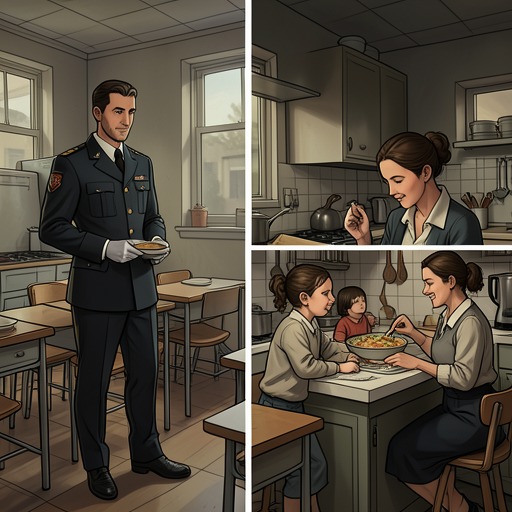
The evening moves between the two homes rather than remaining a formal visit. The children run around Rebecca’s kitchen; later they all return to Bridget’s house, where Bridget microwaves popcorn while the children watch Britain’s Got Talent. Billy and Finn are across the road, while Mabel and Oleander are at Bridget’s. These ordinary exchanges make the friendship a working arrangement of shared company and child-watching, not merely a sympathetic conversation. Rebecca’s household gives Bridget a nearby community in which children move between houses and adults can sit together without pretending to have perfect family lives.
Candour and Mutual Support
Rebecca is also willing to appear when her own composure has given way. One afternoon she falls into Bridget’s hallway wearing a tiara, with mascara smeared beneath her eyes, a list in one hand, and a plastic bag of egg sandwiches in the other. In a strange, distant voice, she asks whether Bridget wants a cigarette and says she cannot go on. Downstairs, the two women slump together and smoke, while Rebecca names the annual Latin play as part of the problem. Bridget adds the burden of staff presents and the prospect of zombie apocalypses, then coughs because she has not smoked for years apart from two puffs at a party.
Rebecca says that she thinks she is having a full-on breakdown without anyone noticing. Bridget responds not with polished reassurance but by leaping up, stubbing out her cigarette, and thrusting a quadrant sheet in front of her. The exchange reverses their earlier pattern of Rebecca offering the household welcome: now Rebecca brings her exhaustion into Bridget’s home, and Bridget tries to convert it into a manageable plan. The comedy of the lists, cigarettes, and school obligations does not erase the admission of distress. Their friendship allows each woman to be seen in an unpresentable moment, rather than requiring either to maintain the appearance of coping.
Rebecca and Mr Wallaker
When Bridget becomes troubled by her encounters with Mr Wallaker, she takes the confusion to Rebecca. Rebecca does not simply endorse Bridget’s interpretation. She says that the details do not add up and asks whether Bridget has a photograph or other information. Looking at a picture from the school concert, she recognizes the man as Scott, a college friend of Jake’s. She explains that he had gone to Sandhurst, spent a great deal of time abroad, and remained in touch with Jake only intermittently. Jake had recently run into him after his return from Afghanistan, where something bad had happened; Scott had said he was back and keeping things simple.
Rebecca’s information changes the context in which Bridget reads his presence at the school. Teaching at a London private school may sound simple to him, she observes, but it is not how Bridget experiences her own life, with its elaborate quadrant chart. She also corrects Bridget’s assumption that Scott is married: as far as Rebecca knows, he was married before, has two boys at boarding school, and is no longer married. Her knowledge is partial and explicitly based on Jake’s connection with him, but it supplies facts Bridget could not get from interpreting kindness and awkward encounters alone. Rebecca serves as an informal investigator, asking for evidence before offering a conclusion.
Narrative Role and Community
Rebecca’s appearances repeatedly turn the idea of neighbourliness into action. She throws out the children’s devices when she decides their dependence has gone too far, invites Bridget’s family into a house full of unexpected objects and spaces, shares the complications of her own relationship with Jake, and lets Bridget witness her own exhaustion. In return, she receives Bridget’s unvarnished company and advice. Their friendship makes room for frustration as well as hospitality, and neither woman is presented as the perfect solution to the other’s difficulties.
After a later school crisis, Rebecca arrives at Bridget’s house with tiny LED Christmas lights woven into her hair. She has heard what happened and asks for an account; on seeing Mr Wallaker, she greets him by his first name, Scott. Finn, Oleander, and Jake soon join the gathering, and the house fills with noise, chocolate, Hellvanians, Xbox, and children running about. The scene gathers the elements associated with Rebecca throughout the story: eccentric festive dress, a wide household circle, school connections, and children whose lives overlap across neighbouring homes. Her decisive significance lies in that overlap. Against Bridget’s recurring fear that she and the children are alone, Rebecca helps make a usable community from imperfect homes, absent partners, school pressures, shared crises, and the simple fact of an open door.