The First Greenlight Screenplay Meeting for The Leaves in His Hair
Bridget Jones: Mad About the BoyThe First Greenlight Screenplay Meeting for The Leaves in His Hair is a turning point in Bridget Jones’s precarious screenwriting career: her adaptation reaches a film company, but the meeting exposes a sharp divide between the tragedy she intends and the comedy Greenlight believes it has acquired. On Monday, 22 April 2013, Bridget enters with no prepared ideas for the discussion and leaves with a rewrite deadline. The opportunity remains open, but its terms have changed.
Preparation and Competing Pressures
The meeting begins against the strain of Bridget’s overfilled day. Her diary records a weight of 132 pounds, five sexual encounters, and no time spent preparing thoughts or possible talking points. At 11:30 a.m. she is waiting in a film-company reception area; by 12:07 she is trying to reassure herself that she is calm and poised, and that she needs to remember what is actually in her script. Her mind briefly escapes into an imagined BAFTA acceptance speech, in which she thanks Talitha, Sergei, Billy, Mabel, and Roxster before returning to the task at hand.
Bridget’s understanding of the screenplay is specific, even though she has not organized it into a meeting-ready argument. She sees its update of Hedda as a feminist tragedy about a woman dissatisfied with her circumstances. In her account, Hedda settles for a sensible but dull academic husband, is disappointed by a Florence honeymoon that offers intellectual refinement when she wants Ibiza, and is unhappy with both the sex and the rainy, dingy house in Queen’s Park. Her rejected desire for her hot alcoholic lover culminates in suicide. For Bridget, that ending is not incidental: it completes the tragic design.
The Boardroom and the Pitch
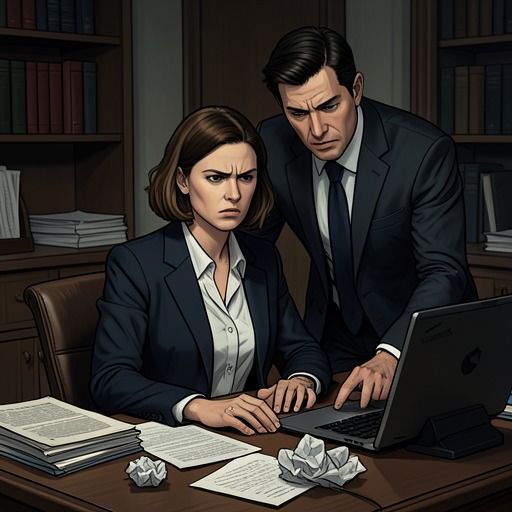
At five o’clock, Bridget is introduced to Imogen and Damian, then taken by lift into a boardroom overlooking London’s rooftops. She tries to create the air of a power breakfast by taking coffee and a croissant. The gesture becomes more awkward when George, the head of Greenlight Productions, arrives in a hurry, announces a conference call, and asks where the discussion has got to. As he is introduced, Bridget’s handbag begins quacking loudly because Billy has apparently changed her text alert.
Imogen opens by saying that Greenlight likes the tone and the updating of the Hedda story. George immediately narrows the praise to the Hedda character. Imogen then describes the appeal as a woman torn between a sensible-choice husband and a wildly creative alternative. Bridget tries to agree and connect the story to women’s continuing choices, but her phone vibrates. Roxster asks what she is wearing and how the film meeting is going. Bridget glances at the message while trying to follow the room, and the small interruption compounds her uncertainty about who is leading the conversation and what the company wants.
A Conflict of Genre and Setting
The decisive divergence arrives when George proposes setting the film in Hawaii. Bridget reacts with alarm: her own account of the story has been anchored in Queen’s Park, Florence, and Hedda’s tragic dissatisfaction, not in the setting Greenlight now suggests. The meeting becomes more than a discussion of location. Bridget is trying to defend an interpretation in which the character’s choices and suicide are essential to the work, while the company is testing whether the material can be reshaped into something more commercially legible.
The pressure is intensified by a separate family emergency unfolding through messages. Bridget learns that children in the group have head lice, that Billy has been sick at school and needs collecting, and that the adults available to help are constrained by infection worries and other commitments. She puzzles over a tangle of children’s names and pickup arrangements while wondering what a power mother would do. The crisis does not merely distract her: it makes sustained attention to a complicated professional negotiation harder, even as she tries to remain present in the boardroom.
George eventually states the company’s preference plainly: no Kate Hudson shooting herself; it is a comedy, and the comedy is what Greenlight likes. Bridget is aghast. If the suicide is fundamental to her conception of The Leaves in His Hair, the company’s response threatens to turn the story into something other than the tragedy she believes she wrote. She tries to support Imogen’s position in the ensuing disagreement, but also recognizes that she has become entangled in a power struggle she does not fully understand. Meanwhile, she continues to receive messages from Roxster, including a question about whether there is food at the meeting.
An Improvised Compromise and Its Consequence
A message from Roxster suggests making Nits as a Pixar-style animation. Bridget combines that idea with a previously raised Pink Panther concept and suddenly proposes Tom and Jerry as a model: a comedy in which terrible things happen to its characters, who nevertheless return. Imogen responds by extending the comparison to resuscitation, and Damian enthusiastically offers a mash-up of Fool’s Gold, ER, and The Passion of the Christ, with a qualification about avoiding Jewish controversy. The exchange gives the room a way to imagine comic treatment without simply pretending that terrible events disappear.
The improvised idea changes the meeting’s outcome, but does not settle the underlying dispute. George, who has started to leave, stops and tells Bridget to try the approach, rewrite the screenplay, and send it by Thursday so the company can see how it works on the page. He then leaves for another conference call. Greenlight has not accepted the tragedy on Bridget’s terms, nor has it rejected her outright; it has made the next step conditional on a new draft. After enthusiastic farewells and hugs, Bridget sits in reception reading her latest messages, still trying to keep her head at an angle because of the lice concern.
Significance
The meeting brings two kinds of instability into the same scene. Professionally, Bridget must decide how much of her tragic conception can survive a company’s preference for comedy. Personally, the school emergency and Roxster’s texts keep intruding on the focused attention that the pitch demands. The contrast is not resolved by a polished presentation: Bridget begins with no prepared points and finds her possible solution in a text message, an animated-louse suggestion, and a familiar cartoon pattern.
The ending is therefore a provisional opening rather than a triumph. Bridget has secured a concrete deadline and a chance to demonstrate the rewrite, but the requested change puts the screenplay’s genre and ending at stake. The meeting shows her adapting under pressure without establishing whether the new comic framework can preserve the feminist tragedy she set out to write.