Alan Lowell
Broken Rejected MateAlan Lowell is defined by the tension between instinct, affection, and duty. He experiences the werewolf world through the exhilaration of running, yet his decisive identity is not built only on heightened senses or physical power. It is formed through his recognition of Sierra as his mate, his refusal to abandon her when the pack condemns her, and his eventual willingness to lead the Blue Blood Pack after its succession crisis. His arc transforms the meaning of strength: protection begins as a personal promise and ends as a public responsibility.
Identity and Introduction
Alan is introduced as a werewolf for whom running is the greatest privilege of his nature. He rejects the idea that smell, sight, or power are the best parts of being a werewolf; for him, the essential experience is the freedom of the run itself. This establishes him as a character attuned to movement, instinct, and embodied identity rather than merely to the social privileges of rank.
His family and pack position place him close to authority. When he returns to the main house after being out in the woods, Uncle Ronald receives him with the low growl that demands immediate submission, a sound only the Alpha can make. Alan responds nervously but recognizes the established hierarchy. He has heard Ronald’s explanation of the Alpha’s responsibilities since he was fifteen: the leader must manage pack members, expenditures, diplomatic problems, and every matter affecting the pack’s safety and well-being. Alan therefore grows up under a model of leadership that combines command with administration, even before he is forced to judge whether Ronald has honored that model.
Mate Recognition and Protective Duty
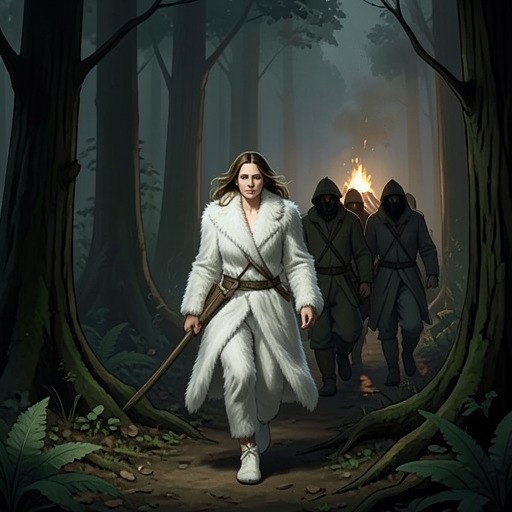
Alan’s first-shift mate vision reveals Sierra to him. He sees her blonde hair, sunlike glowing eyes, pale skin, and the recognition in her face before the vision ends. He understands that she is his mate and initially reasons that she must therefore be a werewolf, because he has never heard of a werewolf mating with a human. The vision gives him knowledge before it gives him certainty, making Sierra both a revelation and a problem that he does not yet know how to interpret.
When Alan tells Sierra, “Sierra, you’re my mate,” the declaration shocks her. Her response is immediate withdrawal: she drops the hand he is holding and steps away, barely able to whisper her question. The bond therefore does not erase fear or impose instant emotional harmony. Alan’s truth creates a crisis for Sierra, while also committing him to the consequences of having recognized her.
That commitment becomes explicit when Alan protects Sierra after her Dysomnia identity makes her vulnerable to the pack. He tells his companions, “She’s my mate,” and follows the statement with the obligation that comes with it: he has to protect her. Later, when pack members arrive at Sierra’s home, he keeps his hand in hers and promises that anyone who wants her will have to go through him, even if defending her costs him his life. The declaration is not romantic ornament. It places his body between Sierra and collective violence, converting the Mate Protection Obligation into action.
Alan’s protectiveness can also become restrictive. When Sierra announces that she wants to join guard duty, he immediately refuses. He reasons that his primary duty is protecting his mate, while Sierra argues for her own participation. The disagreement exposes a central contradiction in Alan’s character: he recognizes courage in Sierra but initially expresses love by deciding what risks she may take. His protective instinct is sincere, yet it must learn to coexist with her agency.
Love, Conflict, and Moral Choice
Alan’s relationship with Sierra develops through reassurance as well as conflict. During a period when she is overwhelmed by pain connected to her father, he urges her to try going out rather than remaining isolated. He lifts her onto his lap and tells her, “You have to at least try. For my sake.” His appeal is intimate but purposeful: he wants her to have sunlight, distraction, and a temporary break from grief. The scene presents him not only as a guardian against supernatural danger but also as someone trying to keep Sierra connected to ordinary life.
His affection reaches a more vulnerable expression after the two run together. Sierra has learned to control her shifting, and her wolf and human consciousness are finally attuned. Alan’s wolf catches her, tackles her, and plays with her before both return to human form. In the aftermath, while they lie alone on the ground, Alan tells her, “I love you, Sierra.” He waits when she cannot immediately answer, tucking a strand of hair behind her ear rather than forcing a response. His patience matters because the moment reverses the earlier shock of the mate revelation: what began as a supernatural certainty now becomes an emotion Sierra must freely meet.
Alan’s loyalty is tested most severely by the truth about Ronald. Sierra is told that Alan’s uncle killed his parents, and Alan eventually confronts Ronald with the direct statement, “You killed my parents.” The accusation is presented as fact rather than speculation, turning Alan’s inherited relationship to his uncle into a moral and familial rupture. Ronald’s authority is no longer simply the authority of an Alpha who raised or instructed him; it is implicated in the destruction of Alan’s family.
The revelation drives Alan toward violence. As the confrontation intensifies, he is consumed by rage over his cousin’s death and advances on the larger wolf who stands as his uncle. When loyal werewolves shift and attack him, Alan fights through them, tearing flesh from Lukas and throwing another wolf into a tree. His strength is undeniable, but the scene also shows the danger of a protective ethic collapsing into vengeance. Sierra is warned that Dysomnias were not made to be killers and that their powers must be used responsibly; her mate does not need her to end the battle, but needs her to remain safe. Alan’s corresponding challenge is to survive his rage without allowing Ronald’s violence to determine what kind of leader he becomes.
Leadership and Succession
The Blue Blood Pack’s political crisis follows the loss of its Alpha. At a pack meeting, an elder explains that the pack cannot survive indefinitely without a leader and would remain vulnerable to attack. The pack has already approached Alana, mate of the last Alpha, but she has no interest in governing until her son returns. Alana also promises that Anthony Lowell has no desire to become the next Alpha. With that path closed, the pack turns to the only other wolf among them with Alpha blood: Alan Lowell.
The nomination is both hereditary and earned. The elder acknowledges that Alan would be the youngest Alpha in the pack’s history, but describes him as strong, courageous, merciful, and fair. The pack has watched him endure trials and mature, and the elder emphasizes that Alan also has a strong mate who could help form a formidable Alpha pair. Alan’s claim therefore rests on bloodline, character, witnessed suffering, and the partnership represented by Sierra.
Leadership initially conflicts with the couple’s private plans. Alan and Sierra had intended to leave for Rome, Italy, together. Accepting the position would mean remaining with the pack, while Sierra would become its Alpha female. Alan asks whether she truly wants that role, recognizing that his ambition cannot simply be imposed on her. Sierra accepts the adjustment because she sees that Alan wants to honor his father’s promise and become an Alpha. Her consent turns succession from Alan’s solitary elevation into a shared decision.
By nightfall, Alan and Sierra are officially the Alphas of the Blue Blood Pack. Alan never expected to belong to a pack, much less lead one, but he interprets their arrival at this position as fate and understands that the title carries practical work: they must labor to protect the pack and avoid failing it. His promotion does not conclude his development by granting him power; it begins a new test in which the private values of loyalty, mercy, and protection must govern an entire community.
Narrative Role and Significance
Alan functions as the story’s protective bridge between intimate mate-bond romance and pack-wide political responsibility. His relationship with Sierra gives abstract rules a human cost: the Mate Protection Obligation is expressed through hand-holding, physical defense, arguments over guard duty, and the promise to fight to the death. At the same time, Sierra’s presence prevents his role from remaining purely patriarchal or martial, because she insists on becoming involved and ultimately accepts the position of Alpha female beside him.
His trajectory also gives the novel an ascent structure complicated by betrayal. Alan begins beneath Ronald’s command, learns that the authority he respected is tied to his parents’ deaths, survives a violent confrontation, and inherits the leadership Ronald corrupted. The succession is therefore not merely a rise in status. It is an attempt to replace domination with a more ethical form of rule, one grounded in courage but tempered by mercy and responsibility.
Alan’s final significance lies in the way his identities accumulate rather than replace one another. He remains the wolf who lives for the run, the mate who recognizes Sierra, the protector willing to fight for her, the grieving nephew confronting his uncle, and the young leader who accepts the Blue Blood Pack’s future. The Alpha title matters because it gathers all those commitments into one public role; it does not erase the personal bonds that made him worthy of it.