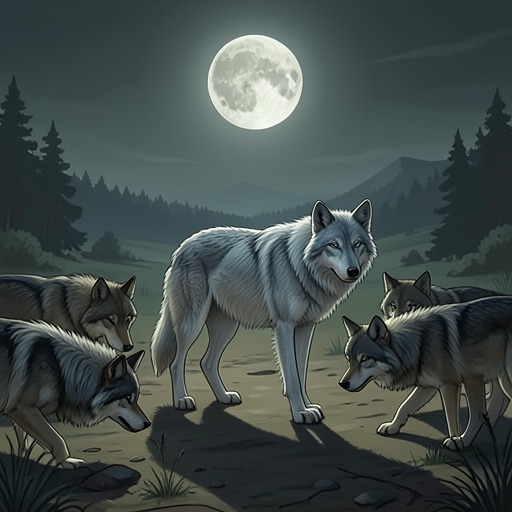
Full moon
Broken Rejected MateFull moon is the novel’s central supernatural time and one of its most important instruments of transformation. It intensifies werewolf bodies and emotions, summons first shifts, reveals fated mates, gathers the pack for its traditional run, and turns private change into public belonging. The same moon that initially threatens to expose and overwhelm the characters ultimately becomes the setting in which Sierra completes her bond with Alan and is accepted as part of the pack.
Nature and Supernatural Function
Full moon affects every wolf by making the body stronger and more powerful, while sometimes increasing aggression. Before the first major transformation, the pack has been able to pass through full moons without serious harm or disruption. The sudden difference on this occasion therefore carries a precise meaning: Sierra and her cousins are undergoing their first shifts. Because all three members of the alpha family are changing on the same night, the moon also interrupts the usual logic of succession. None of them can establish superiority by shifting first, leaving no natural winner among the cousins and temporarily easing the competition that otherwise defines their relationship.
The first shift is not merely a physical change. It requires the body to break every bone, and the process takes hours rather than moments. It may also bring a vision of the wolf’s mate, the person to whom the wolf is destined to be bonded for life. The vision does not impose an immediate marriage or require the wolf to search at once; mates may belong to another pack or live in another state, and some wolves ignore the revelation until fate brings them together. Full moon therefore operates as both biological force and instrument of disclosure, exposing a future relationship before the characters are ready to inhabit it.
The First Shift and Mate Vision
The first transformation is organized as a communal threshold. Sierra and her cousins leave for the middle of the woods while pack members watch, recognizing the occasion as a historic one: three wolves from the alpha family will be born that day. Sierra’s aunt and uncle escort them, fulfilling the family’s customary role, while the rest of the pack waits to join the run. At seven in the evening, as the moon begins to rise, Sierra feels its call before it reaches its apex. Energy travels down her spine and gathers across her skin, making the coming change a bodily certainty rather than an abstract prediction.
The cousins stand several feet apart and reassure one another before surrendering control to their wolves. Their simultaneous transformation makes family solidarity possible even within a culture of rivalry. The moon’s effects are painful, but the resulting wolf form brings heightened senses: Sierra can smell more intensely and see more clearly. After nearly an hour of running, the wolves reach a clearing of bare earth and dust, where they rest in the moonlight to recover and renew their strength. The clearing becomes a temporary sacred space, separated from ordinary life by darkness, bodily change, and the collective presence of the pack.
The decisive revelation comes when searing pain blinds Sierra. She understands that the time has arrived for her mate vision. In the darkness she sees a blonde woman with pale skin and eyes glowing like the sun. When the woman turns toward her, recognition immediately follows: Sierra knows who she is. The vision ends at once, leaving the moon associated not only with agony and metamorphosis but with an image of destined intimacy whose consequences will unfold later.
Recurrence and Private Anxiety
The full moon repeatedly creates tension between ordinary human schedules and supernatural obligation. Before one later full moon, Sierra conceals her real thoughts by claiming to be worried about a chemistry test. In reality, she is thinking about what the moon will mean for her. The lie shows how thoroughly the lunar cycle governs her inner life: school remains the visible surface of normality, while the approaching moon represents the identity she cannot safely explain.
Alan tries to soften that fear by suggesting that Sierra may not have to shift. His optimism cannot withstand her pointed look, because both understand that the moon’s call is stronger than reassurance. Later, Alan takes her to a secluded part of the forest with only one path in and dense weeds and trees blocking the other exits. He spreads out a blanket, brings sandwiches, and holds her while they wait an hour for the moon. Around them, the agonized howls of newly shifting wolves announce that the transformation has already begun elsewhere. The enclosed woodland offers privacy, but it cannot remove the lunar pressure gathering inside Sierra.
The moon also returns at moments when the pack’s meaning has changed. After the pack survives upheaval and Anthony Lowell wakes from his unconscious state, he rises in time for the traditional run two days later. It is Sierra’s first opportunity to run with the entire pack, and she is both nervous and excited. The anticipation becomes physical: while eating lasagna, she taps her feet so persistently that the table rattles, with her increased strength magnifying the movement. Full moon thus marks not only danger but the approach of a longed-for social initiation.
Ritual, Bond, and Belonging
The traditional pack run converts the moon’s solitary power into communal ritual. Wolves shift, run together, and gather under the lunar light, transforming an involuntary biological cycle into a repeated expression of pack identity. Sierra’s later participation matters because she has already been treated as a possible threat. When she is introduced to the pack, some members frown and glare, surprised that she does not immediately change into wolf form and attack them. Once they are convinced that she is not dangerous, their suspicion gives way to warmth, and the group proceeds to run.
The moon’s ritual significance culminates in Sierra and Alan’s completed mating bond. They must mate as wolves and consummate the union, and neither hesitates before shifting. When the act is complete, they are joined in body and soul. That union gives the full moon’s earlier mate vision a fulfilled form: what began as an involuntary revelation during Sierra’s first shift becomes a chosen and embodied relationship. Later that same night, Sierra runs with the rest of the pack and experiences an almost euphoric happiness. The pack accepts her as its own, giving her a sense of belonging she has never had before.
Death, Continuity, and Narrative Significance
Full moon also frames the werewolf community’s relationship with death and continuity. After Sierra’s father dies, he receives a ceremonial werewolf funeral in which a shroud is burned. Only Sierra and Alan among those who truly knew him attend, though some of Sierra’s friends are present as well. The funeral does not erase her grief, but it places personal loss within a werewolf tradition, just as the full-moon run places personal transformation within communal custom.
Across these linked ceremonies, the moon functions as a measure of passage. It exposes the body, reveals the mate, summons the run, and returns the individual to the group. For Sierra, its meaning changes most dramatically: first it is the approaching force she fears and tries to hide behind a chemistry test, then the power that awakens her wolf, and finally the light under which she completes her bond with Alan and discovers a new family. Full moon is therefore not background scenery but the recurring threshold through which the novel makes identity visible, turns destiny into relationship, and converts survival into belonging.