Full-Moon Shifting Rule
Broken Rejected MateThe Full-Moon Shifting Rule is the supernatural and communal law that links the full moon to werewolf transformation. On a full moon, wolves become stronger and more powerful, sometimes more aggressive, and a first shift is expected to occur under its influence. The rule is not merely biological: it governs a carefully witnessed passage into wolf identity, introduces the possibility of a mate vision, and culminates in participation within the pack. Its apparent certainty is later unsettled by Sierra’s anomalous transformation and by the lethal consequences of shifting while poisoned.
Definition and Conditions
The full moon affects every wolf, but its intensity varies. Before the first transformation of the three cousins, full moons had caused no serious disruption among them; on this night, however, all three are unmistakably affected. The simultaneous increase in strength, power, and aggression signals that their first shifts are beginning. Because the cousins transform together, none gains an automatic advantage in the competition to become Alpha: the timing of their changes removes the possibility that the first to shift will emerge as the natural stronger contender.
A werewolf’s first shift is physically extreme. The body breaks every bone, and the process takes hours rather than moments. Because the transformation is a public turning point for members of the Alpha family, the novice is escorted into the middle of the woods, where pack members watch. The first shift is therefore both ordeal and ceremony: the individual leaves ordinary human life under family supervision and enters wolf society before the assembled pack.
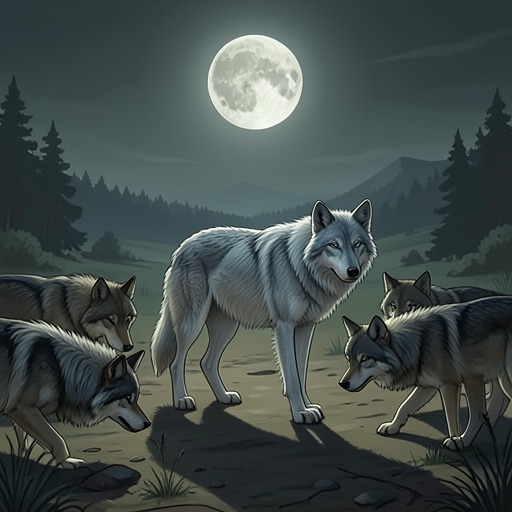
The setting and timing reinforce the rule’s ritual character. At seven in the evening, the moon is only beginning to rise and has not yet reached its apex, but the approaching moon is already felt as a call. The cousins stand several feet apart, exchange an assuring look, and prepare to surrender their human bodies to their wolves. Later, the wider pack joins them for the traditional run, turning private transformation into collective belonging.
First Shifts and Mate Visions
The rule includes a second possible effect beyond physical transformation: a first shift may bring a vision of the werewolf’s destined mate. The vision does not require immediate marriage, and the mate may belong to another pack or live in another state. Some wolves actively search for the person revealed to them; others wait, trusting that fate will eventually bring the pair together. The vision identifies the lifelong bond without dictating its immediate social form.
During the first run, the transformed wolves reach a clearing of bare earth and dust and stop to bask in the moonlight, which rejuvenates them. Amid mock fighting and other wolves celebrating with their mates, a searing pain overtakes the narrator’s eyes and darkness follows. The mate vision then reveals a blonde woman with pale skin and eyes glowing like the sun. Recognition is immediate, and the vision ends as quickly as it began. The moon thus functions as an agent of disclosure: it exposes a relationship before the characters have chosen or enacted it.
The rule’s ritual sequence continues after the vision. Sierra’s later union with Alan Lowell requires both partners to shift as wolves and consummate the bond in that form. Once they do so, they are joined in body and soul; afterward, they take part in the traditional pack run, where the pack accepts Sierra as one of its own. The full-moon transformation therefore moves from physical rupture, through supernatural revelation, to sexual and communal integration.
Exceptions and Limits
The rule is treated as a firm boundary when Sierra begins to transform unexpectedly. She asks for a basement because she is turning, and Alan Lowell insists that it is impossible to experience a first shift without a full moon. Her glowing eyes and guttural growl immediately contradict his understanding. Sierra’s transformation consequently marks her as an exception to the established order rather than a normal case within it.
Her difference becomes clearer when she learns to control her wolf unusually well. During a run with the pack, she shifts in front of the twins and discovers that the change has become almost as easy as putting on new clothes. The pack members initially expect a Dysomnia to transform and attack them, but they relax once she proves that she is not a threat. Her control raises the possibility that Dysomnias may possess a similar ability, challenging the assumptions used to justify their persecution.
The rule also has a dangerous negative boundary. When Sierra is injected with yellow wolfsbane, she is told that shifting would kill her because exertion would make the poison move more quickly through her body toward her heart. In this condition, the full-moon or wolf transformation is no longer a source of strength but a fatal risk. The supernatural law does not cancel the poison’s physical consequences; instead, the established cost of transformation becomes a weapon against her.
Ritual, Community, and Consequences
The rule binds individual bodies to pack history. Three members of the Alpha family being born as wolves on the same night is described as a significant moment, and family members traditionally escort a first-time shifter to the woods. The pack’s observation gives the change witnesses, while the run gives it a public conclusion. What begins as pain and uncertainty becomes a recognized place within the group.
Sierra’s later experience reveals that communal acceptance remains conditional. The pack is surprised that she does not immediately change into wolf form and attack them, reflecting the fear attached to Dysomnias. Yet once she demonstrates control, most members return to their warmth and kindness. Her successful shift and subsequent run transform suspicion into membership, showing that the ritual can absorb an outsider when her conduct contradicts the prejudice surrounding her bloodline.
The rule’s emotional consequences extend beyond initiation. After Doherty Langford is killed, Sierra’s grief destabilizes the control she had developed over her wolf. She can shift easily, but her wolf has been prowling and waiting to be released rather than grieving in the same controlled way. The resulting loss of control shows that mastery is not permanent: the body retains its own response to bereavement, and the full-moon system gives that buried violence a physical form.
Narrative Significance
The Full-Moon Shifting Rule makes transformation a recurring test of identity, kinship, and power. It begins as a predictable inheritance shared by the Alpha family, establishes the mate vision as a mechanism of fate, and creates a communal route into pack membership. Yet Sierra’s first shift outside the full moon, her unusual control, and the danger of shifting while poisoned expose the rule’s limits. The story therefore uses the moon not as an inflexible explanation for every change, but as the standard against which Sierra’s Dysomnia nature becomes legible.
The rule also produces a sharp contrast between power and vulnerability. Under the moon, wolves gain strength and sharpened senses; in the wrong physical condition, that same transformation can carry death. Sierra’s body becomes the site where inherited law, Dysomnia difference, grief, poison, and social prejudice collide. Its deepest function is consequently structural: it turns a change in form into a contest over who may belong, who may control their own body, and whether the pack’s inherited laws are capable of accommodating someone they were built to fear.