Insei
Broken Rejected MateThe Silver Sword is a specialized hunter weapon that exposes the physical vulnerability of werewolves and turns an otherwise manageable injury into a crisis. Its significance lies not only in its ability to cut and kill, but also in the substances applied to it: silver, wolfsbane, and an unidentified poison combine to defeat healing and force the characters to confront the limits of their abilities.
Construction and Harm
The sword’s danger comes from the interaction of several toxic elements. Noah explains that the wound it caused was difficult to heal because the weapon was silver and had also been infused with wolfsbane and another poison whose identity he could not determine. For someone with Noah’s healing ability, restoring the injured person should ordinarily have been easy; the sword’s composition transforms that expected recovery into an uncertain medical problem.
The unidentified poison is especially important because it prevents Noah from treating the wound with confidence. Until he can determine what the substance is, he cannot apply the most effective remedy. The Silver Sword therefore functions as more than a blade: it carries a concealed chemical threat that remains active after the physical attack has ended, extending the hunters’ violence into the aftermath of the stabbing.
The Stabbing and Its Consequences
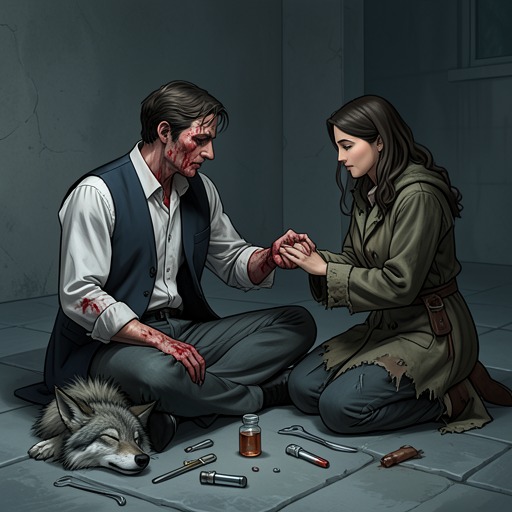
The sword is used by hunters to stab Anthony Lowell, leaving him unconscious and seriously poisoned. The injury becomes a continuing source of distress for Noah, whose abilities are powerful enough to make healing him seem straightforward under normal circumstances but are obstructed by the silver and poisons. Alan Lowell asks about Anthony Lowell’s progress with visible concern, while Noah responds sadly and sounds deeply upset by his inability to identify the additional toxin.
This medical crisis gives the sword a recurring presence even when it is not physically on the page. Its effects are measured through the delay in Anthony Lowell’s recovery, the uncertainty surrounding the poison, and the emotional strain placed on those attempting to save him. The weapon’s violence therefore has two stages: the initial stabbing and the prolonged struggle to reverse its consequences.
The Sword in Combat
The Silver Sword later appears in direct combat against Sierra Langford after she transforms into her wolf form. As the confrontation escalates, the sword is used to threaten her life rather than merely restrain her. The attacker swings it at her head, and she narrowly dodges the strike, making the blade’s killing capacity unmistakable.
The fight reverses the usual relation between weapon and target. Sierra Langford advances with the speed and force of her wolf form, while the swordsman relies on the blade to compensate for the danger posed by her transformation. When he declares that it is a pity she must die and notes that Ronald Lowell never required her to be brought in alive, the sword becomes an instrument of execution rather than capture.
Sierra Langford eventually catches the sword with her paw as it is swung at her again. She pulls it from the attacker’s hand using all her strength, converting the object from a threat into evidence of her physical superiority in that moment. The weapon’s significance consequently changes across the combat: it first nearly kills her, then becomes the object through which she disarms her opponent.
Narrative Function
The Silver Sword creates a sharp contrast between supernatural healing and material resistance. Noah’s ability suggests that injury can be rapidly repaired, yet the sword’s silver and poison make the body refuse easy restoration. The object exposes a boundary within the supernatural world: power is not limitless when confronted with a weapon designed specifically to exploit werewolf weakness.
Its appearances also connect separate forms of danger. In Anthony Lowell’s case, the sword leaves behind a hidden, lingering threat that medicine cannot immediately decode. In Sierra Langford’s case, it produces immediate physical peril in a close-range fight. Across both scenes, the same weapon links hunter violence to bodily vulnerability, while its removal from the attacker’s hand marks a decisive shift in control.