Julie
Broken Rejected MateJulie is a warm, established member of Alan Lowell’s pack who becomes one of Sierra’s first points of contact with its communal life. Her importance lies not in command or combat, but in the practical care she extends to a newcomer: she welcomes Sierra, explains the pack’s history, and later survives the destructive consequences of Sierra’s uncontrolled power. Through Julie, the pack is presented as a social world capable of tenderness even while its supernatural conflicts make ordinary trust dangerous.
Identity and Introduction
Julie first appears among the pack women who approach Sierra after Alan Lowell introduces Sierra as someone who has recently joined the pack. A middle-aged woman with red hair, Julie reacts before the others, grinning and walking toward Sierra with immediate familiarity rather than suspicion. She tells Sierra that everyone already knows who she is and asks how she is feeling. The women then embrace Sierra one by one, and their kindness is unexpectedly comforting to her. Julie therefore functions as the first recognizable face of collective acceptance: she does not merely acknowledge Sierra’s membership but helps make that membership emotionally tangible.
Alan Lowell entrusts Sierra to Julie for the remainder of the day, explicitly placing her in Julie’s care. That arrangement reveals Julie’s standing within the pack. She is sufficiently trusted to supervise and accompany a newly integrated member, and her role is presented as protective and social rather than disciplinary. Sierra’s startled reaction to being left with her also emphasizes the contrast between Julie’s reassuring presence and Sierra’s continuing uncertainty about pack customs.
Knowledge of Pack History
Julie becomes an informal historian when Sierra asks about Alan Lowell’s parents and the succession of the pack’s Alpha. The women lead Sierra to chairs and sit together while Julie explains the former Alpha couple. Her account is personal rather than merely institutional. She remembers Alan Lowell’s mother as kind, graceful, approachable, and always ready to help, describing her as someone beloved by everyone. Julie also recalls that Alan Lowell’s mother helped her through her first period after Julie’s own mother had died. This detail gives the former Alpha female a maternal significance within the pack and shows that Julie’s loyalty is rooted in lived care rather than abstract admiration.
Julie describes Alan Lowell’s father as resembling his son both physically and behaviorally. She associates both men with honesty, loyalty, hard work, and charm, and concludes that Alan Lowell would make a great Alpha just as his father did. Her judgment helps explain why Sierra is puzzled by the apparent possibility that the twins’ father might become the next Alpha instead. Julie’s testimony thus supplies Sierra with a moral and familial standard for leadership: succession is not only a matter of current authority, but also of character, resemblance, trust, and remembered service.
The Shifting Incident and Its Cost
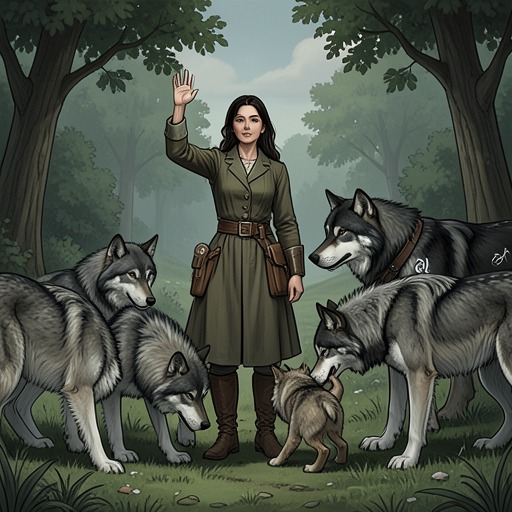
Julie participates in the women’s attempt to help Sierra shift safely. The women morph first, after which Sierra undresses and changes into her wolf form. The transformation initially seems manageable, but Sierra then realizes that her wolf has not been grieving passively after Doherty Langford’s death. Instead, the wolf has been prowling and waiting to be released. The emotional injury caused by Doherty Langford’s death breaks through the control Sierra has practiced, turning the gathering into a crisis.
When Sierra loses control, energy builds beneath her skin, becomes blinding and painful, and erupts in a flash of white light. The force throws everything within a mile backward. The wolves are scattered across rocks and against trees, and Julie is among those harmed: her wolf’s hind leg is bent at an unnatural angle. The injury is one of the clearest measures of the event’s severity because it transforms Sierra’s inward struggle into bodily damage suffered by an innocent pack member. Julie’s earlier welcome and later injury create a sharp reversal. The same communal setting that offered Sierra comfort becomes the scene in which her power endangers the people who accepted her.
Julie’s injury also intensifies Sierra’s fear of rejection. After the incident, Sierra avoids Julie and the other women because she worries that they will be angry with her. Noah later tells Sierra that Julie kept talking about how awesome she was and that the women are not angry; they even feel guilty for having convinced Sierra to shift. Julie’s response therefore restores the relationship without erasing the harm. Her forgiveness does not make the injury insignificant, but it demonstrates that pack solidarity can survive a frightening failure of control.
Relationships and Narrative Function
Julie’s relationship with Sierra develops from immediate welcome to vulnerable mutual trust. She treats Sierra as someone worth comforting before Sierra has fully learned how to inhabit her wolf identity. Later, by continuing to speak positively about Sierra after being injured, Julie becomes evidence that acceptance need not depend on supernatural perfection. Sierra’s guilt is answered not with exclusion but with an acknowledgment that the women themselves helped create the circumstances of the shift.
Julie also helps connect Sierra to the older history of the pack. Her memories of Alan Lowell’s parents make the pack’s past intimate and embodied, linking leadership to kindness, grief, and everyday assistance. This is especially important because the wider plot increasingly questions who deserves power and whether authority can be corrupted by hidden violence. Julie’s recollection of the former Alpha female’s care and the former Alpha male’s integrity offers a communal memory against which later leadership can be judged.
Significance
Julie represents the ordinary social bonds that make pack membership more than a supernatural status. She welcomes Sierra through touch, conversation, and practical guardianship; she gives history a human voice; and she absorbs the consequences of a power she did not cause. Her injured hind leg stands for the danger of Sierra’s Dysomnian nature, while her refusal to turn against Sierra preserves the possibility that belonging can be rebuilt after violence.
Within the larger conflict, Julie’s importance is therefore relational rather than strategic. The pack is repeatedly organized around protection, command, warfare, and succession, but Julie’s scenes show what those structures are meant to protect: people who remember one another, care for one another, and remain connected after fear and injury. Her welcome and forgiveness make her a quiet counterweight to the hunters’ murderous hostility and to Ronald Lowell’s nefarious designs, affirming that the pack’s deepest strength is not simply its ability to fight, but its capacity to continue receiving its wounded members as part of the community.