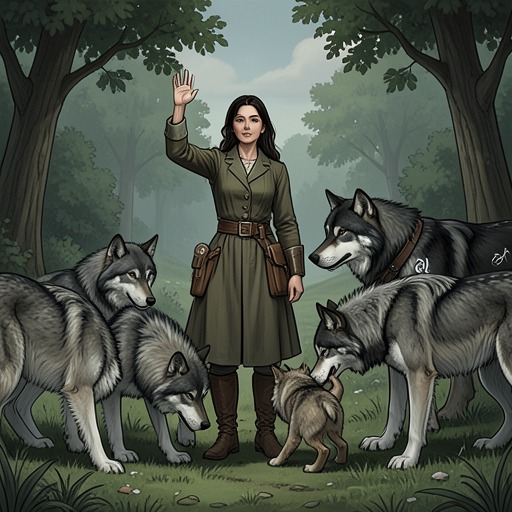
Malcolm
Broken Rejected MateMalcolm is a close friend and pack mate of Sierra within the Blue Blood Pack, first associated with the ordinary fellowship of pack life and later with the dangerous question of whether that fellowship can survive fear. His role is modest in rank but important in emotional structure: he embodies the pack’s familiar, social face, and his changing responses help reveal the difference between knowing Sierra as a person and judging her as a feared Dysomnia. By the later conflict, he stands among those willing to defend Sierra and tries to restrain Alan from turning grief into an uncontrolled killing spree.
Identity and Introduction
Malcolm appears when the preparations for the full moon are bringing members of the pack together. Sierra greets him as one of her pack mates and close friends, and the two exchange a hand slap and a bro hug. The physical ease of the greeting places him inside the family-like network Sierra has known while growing up. He has brown eyes and a dark-toned complexion, details that distinguish him within the gathering without separating him from it.
Malcolm is also already further along in the werewolf life cycle than Sierra and the other young wolves facing their first shift. He experienced his own first shift the previous month. Because he has passed through the ordeal of having every bone in his body break during transformation, his reassurance that Sierra and the others will do well carries practical authority rather than empty optimism. The scene balances his confidence against the fear surrounding the Full-Moon Shifting Rule: the pack looks forward to the ritual, but the physical pain and danger remain real.
Place in Pack and School Life
Malcolm belongs to the circle surrounding Alan, Andrew, Anthony, and the other young pack members. When Alan brings Sierra to the lunch table and formally introduces her, Malcolm is identified as the dark-skinned, physically strong-looking friend seated beside Alan. Unlike Tony, whose hostility is marked by a clenched jaw and a glare, Malcolm responds with a nod and a kind smile. His first reaction to Sierra is therefore one of uncomplicated social welcome.
That welcome matters because Sierra is trying to conceal both her werewolf identity and the more dangerous truth that she is a Dysomnia. She has been repeatedly displaced, has learned to remain invisible, and expects that the werewolves at Domina High would not accept her if they knew what she was. Malcolm’s presence at the table initially offers the opposite possibility: a pack member can meet her through ordinary friendship before inherited fear dictates the terms of the relationship.
Fear and the Exposure of Sierra
Malcolm’s attitude changes sharply after Sierra’s nature becomes known. When unfamiliar men arrive under orders from the Alpha to take her to pack grounds, Malcolm tells Alan not to make the situation harder than necessary. He looks weary and refuses to meet Sierra’s eyes. The day before, he had laughed and talked with her in the cafeteria; now he is terrified of her. The contrast turns Malcolm into a precise emotional indicator of the crisis. His fear does not arise from a personal betrayal by Sierra but from the history attached to the Dysomnia name.
That history is explained as centuries of persecution. Dysomnia wolves were once revered for their strength and intelligence, perhaps even treated as a form of wolf royalty, but all of them later became feral and hunted other werewolves without reason. The resulting terror has made the remaining Dysomnias nearly extinct, with no more than twenty believed to exist in the entire world. Malcolm’s retreat from Sierra thus reflects a collective memory that has been converted into suspicion. His silence and averted gaze show how quickly social familiarity can be overwhelmed by a category imposed on the body.
Loyalty During the Pack Conflict
Despite his moment of fear, Malcolm remains within the network that supports Sierra and Alan. When Alan prepares to confront Ronald, the arrangement includes Malcolm, Caroline, Shawn, and Sheila, along with Alan himself. Sierra initially objects because involving all her friends seems to expose them to unnecessary danger, but Malcolm is explicitly counted among the people whose loyalty and experience matter to the plan.
During Ronald’s attempt to seize control, Malcolm helps carry out the twins’ strategy of gathering werewolves who know Sierra and understand that she is not dangerous. When Ronald sends Lukas toward Sierra, the assembled allies stop Lukas from advancing. Malcolm is therefore not merely a passive sympathizer: he is part of the collective resistance that turns personal knowledge into a defense against Ronald’s plan to exploit Sierra’s power.
His loyalty is also tested from another direction. Alan, enraged by his cousin’s death, moves toward Ronald with the intention of killing him. When Ronald’s Alpha power forces the surrounding werewolves to submit and his loyalists begin shifting, Alan attacks several opponents, tearing flesh from Lukas and hurling another wolf into a tree. Malcolm tries to get between Alan and the larger wolf to stop him, but Alan pushes him away. The gesture shows Malcolm acting as a restraining presence even when physical authority and grief have made restraint nearly impossible.
Narrative Function and Significance
Malcolm’s trajectory moves through three distinct states: familiar friend, frightened witness, and active ally. The sequence gives the pack’s prejudice a human scale. The story does not present fear only as an abstract rule or a historical explanation; it shows that fear can enter the body of a friend who had just shared laughter and conversation with Sierra. At the same time, Malcolm is not fixed permanently in that reaction. His return to the group defending Sierra demonstrates that knowledge and attachment can contest inherited terror.
He also provides a contrast with Sierra’s feral wolf state. Sierra learns that her wolf may be emotionally weak despite being among the strongest alive, because repeated losses have taught it to treat danger and attachment alike as threats. During training, Alan and Andrew are selected as the safest companions, while Sierra’s friends gradually become recognizable to the wolf as nonthreatening. Malcolm belongs to that wider circle of people whose acceptance helps create a boundary between Sierra’s controlled identity and indiscriminate bloodlust.
In the final confrontation, Malcolm’s attempt to stop Alan completes his most important function. He protects the possibility that the pack can oppose corruption without reproducing the violence it condemns. His kindness at the school table, his fear after Sierra’s revelation, his participation in the defense of her, and his effort to restrain Alan together make him a supporting character defined not by a single unwavering response but by the difficult movement from instinctive fear back toward chosen loyalty.