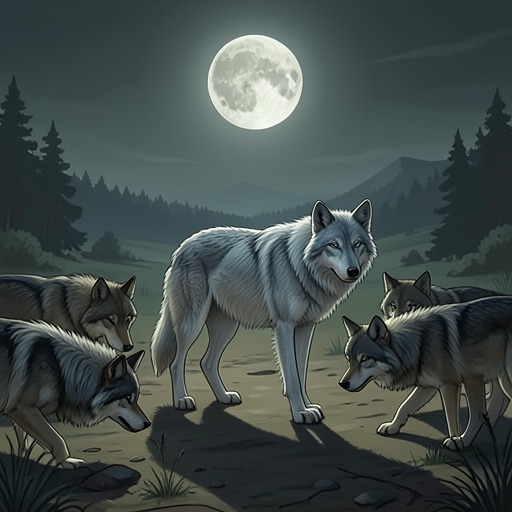
Pack Run Ritual
Broken Rejected MatePack Run Ritual is the recurring full-moon ceremony through which the pack transforms private wolf identity into shared belonging. It follows the first shift of members who are becoming full werewolves, gathers the community for a coordinated run, and gives the moonlit landscape a social and ritual meaning. For Alan Lowell, the ceremony marks his first experience of running as a wolf; later, it helps confirm Sierra’s acceptance into the pack after she learns to control her wolf form.
Definition and Ritual Setting
The ritual takes place during the full moon, when the pack members turn and run together as one. It is described as a practice most packs indulge in, making it both a recurring tradition and a recognizable feature of werewolf communal life. The pack grounds become a place of preparation and assembly as members arrive from across town. Because the pack is understood as an organized family as well as a community of predators, the run is not merely exercise: it is a public expression of collective identity.
The timing matters. During Alan Lowell’s first shift, the moon is rising at seven in the evening and has not yet reached its apex, yet he already feels it calling to him. The ritual therefore begins before the night has reached its fullest point. The moon acts as the signal that draws the participants beyond ordinary human time, while the gathering of familiar pack members establishes the social world into which the newly shifted wolves are being received.
First Shift and Collective Passage
For Alan Lowell, Andrew Lowell, and Anthony Lowell, the run follows a demanding initiation. Since it is their first time shifting, they must go into the middle of the woods, accompanied by Alana Lowell and Ronald Lowell and watched by members of the pack. The first transformation can take several hours because every bone in the body must break and reform; the process cannot be hurried. Three wolves from the Alpha family are therefore being born on the same day, making the occasion significant in the pack’s history.
The cousins face the transformation together. Energy travels down Alan Lowell’s spine and spreads across his skin as he and the others stand a few feet apart, exchanging an assuring look before their wolves take control. When the change is complete, Alan Lowell stands on four legs for the first time in his life. Anthony Lowell’s wolf still bears the scar on his neck, allowing Alan Lowell to distinguish the cousins even in their altered forms, while the two dark-brown wolves project a dominance that Alan Lowell feels he can match.
The run completes the passage from painful bodily change to communal recognition. Anthony Lowell begins the howling, and Andrew Lowell and Alan Lowell answer him. The howls summon Alana Lowell and Ronald Lowell, followed by the rest of the pack. Ronald Lowell leads, Alana Lowell follows closely, and the newly shifted cousins run behind them. The order places the older family members at the front while still giving the new wolves an immediate place within the pack’s movement.
Course and Shared Experience
The run heightens the sensations of the newly transformed wolves. Alan Lowell can smell everything and see more clearly, experiencing his strengthened senses as overwhelming but exhilarating. The pack runs for almost an hour before reaching a clearing formed by bare earth and dust. There, the wolves stop and bask in the moonlight, allowing it to rejuvenate them.
The clearing also becomes a space for varied forms of communal play and intimacy. Alan Lowell sees Andrew Lowell and Anthony Lowell engaged in a mock fight, while other wolves prance around or enjoy the moment with their mates. The ritual thus contains several kinds of connection at once: family rivalry without lethal intent, relaxed movement, romantic companionship, and the shared presence of the entire pack beneath the moon.
The ceremony is not limited to the first shift. After Sierra has been introduced to the pack, the twins and Alan Lowell decide to go on a run with her. Pack members initially seem surprised that she does not immediately change into wolf form and attack them, but they settle into their usual warmth once they understand that she is not a threat. She has never shifted in front of the twins, and the run becomes a test of whether her wolf will regard them as enemies. Her growing ability to control that wolf allows her to join the communal practice rather than remain defined by fear and suspicion.
Vision, Belonging, and Consequences
During Alan Lowell’s first ritual run, the moonlit pause is interrupted by a searing pain in his eyes and sudden darkness. He understands that the time has come for him to receive a vision of his mate. The vision shows a blonde woman with pale skin and eyes that glow like the sun; when she turns toward him, he recognizes her before the vision ends. The Pack Run Ritual therefore carries more than physical or social meaning: it becomes the threshold at which a wolf’s private destiny is revealed.
The ritual also frames later experiences of acceptance and mourning. Sierra’s participation follows her introduction to the pack and her increasingly manageable transformation, showing the run as a mechanism for incorporation into a community that once represented danger. By contrast, the ceremonial funeral held for Doherty Langford uses a different communal form: a shroud is burned as the pack sends a dead family member away. Together, the run and the funeral show how werewolf society marks major bodily and familial transitions through collective ceremony, whether the person is entering a new identity, joining the community, or being mourned by it.
After Sierra and Alan Lowell complete their union as wolves and become joined body and soul, they later join the traditional run with the rest of the pack. Sierra experiences the occasion as euphoric; the pack accepts her as one of its own, and she feels a sense of belonging that she has never known before. The ritual’s decisive function is therefore integration. It makes transformation visible, places the individual inside a shared rhythm, and repeatedly converts the dangerous separation between human and wolf into a moment of family, recognition, and collective life.