Sierra Langford
Broken Rejected MateSierra Langford is introduced as a seventeen-year-old girl whose identity has been formed by fear, secrecy, and repeated displacement. She has moved to Peoria with her father and enters high school hoping for a fragile form of normalcy, even though she expects to remain isolated and friendless. Her decisive significance is revealed in the contradiction at the center of her life: she wants an ordinary existence, but she is a Dysomnia, a persecuted supernatural being whose very nature makes concealment a condition of survival.
Identity and Background
Sierra’s first instinct is concealment. She describes hiding as the thing she does best and connects that habit directly to the fear of being hunted and rejected. Her caution is not presented as simple shyness; it is a learned survival strategy produced by a life in which exposure may bring danger. She has attempted to hide “the most vital part” of herself, while emotional injury has left her desensitized and detached from much of the world around her.
Her own statement that she never asked to be a Dysomnia establishes the distance between Sierra and the identity imposed on her by blood and circumstance. She does not initially treat her supernatural nature as a gift or heroic inheritance. It is an unwanted condition that has forced her to lie, withdraw, and live inside what she calls a shell. At the same time, her exhaustion with hiding signals that concealment is becoming unsustainable. Sierra’s identity therefore begins as a conflict between self-protection and the desire to live without apologizing for what she is.
Life and Plot Trajectory
The move to Peoria places Sierra in a new social environment but does not erase her past. In the classroom, she introduces herself as Sierra Langford, gives her age as seventeen, and explains that she has just moved there with her father. The polite applause that follows emphasizes how ordinary the scene appears from the outside, while her private history makes the introduction feel like another carefully managed performance. School offers her a limited sense of normalcy precisely because it temporarily allows her to be treated as a student rather than as a hunted Dysomnia.
That ordinary surface is repeatedly threatened by the supernatural reality she has tried to suppress. Sierra’s trajectory is not a straightforward movement from ignorance to confidence. Instead, each advance toward connection and self-knowledge exposes her to greater danger. Her fear of rejection remains intertwined with the fear of persecution: being known may mean being abandoned, but remaining hidden also prevents her from forming a stable life.
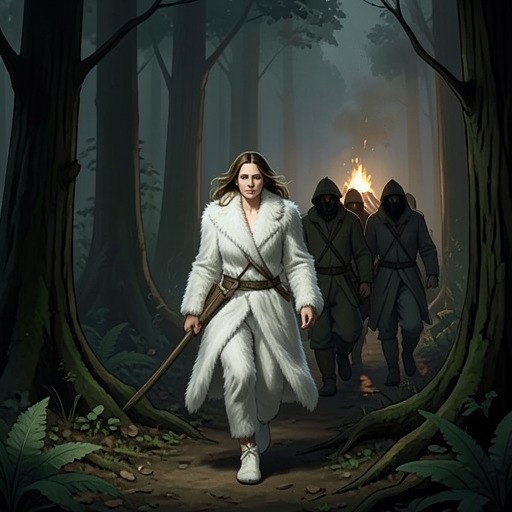
The decisive revelation comes through her bond with Alan Lowell. When Sierra undergoes her transformation, Alan witnesses the process and recognizes that his mate is a Dysomnia. Her wolf is unusually striking: it is six feet long, approximately twenty-five inches high, and has amber eyes that glow like the sun. Yet the feature that changes the meaning of the transformation is its white fur. The shift makes visible what Sierra has spent her life concealing, and it also confirms that her identity cannot be reduced to the ordinary Werewolf category.
Power, Violence, and Key Actions
Sierra’s most consequential action occurs when a huntress attacks her father. After hearing her father call her name, Sierra turns and sees him standing in front of her with a long sword protruding from his chest. The huntress pulls the weapon free and raises it toward Sierra, turning the attack from an act of murder into an immediate threat against the daughter as well.
Sierra responds without hesitation. She allows her wolf to take control while remaining in human form, an ability that ordinary Werewolves cannot perform. The moment is important because it joins her two identities rather than requiring her to choose between them: human Sierra remains physically present while the wolf directs her actions. She catches the huntress’s sword, tears it from the attacker’s hand, and advances with the immediate desire to make the huntress bleed and suffer for what she has done to her father.
The confrontation ends when the huntress’s own sword passes through her heart. As the huntress dies, Sierra’s wolf recedes into her subconscious, and Sierra returns to her father’s side. The action has a double consequence. It demonstrates an exceptional degree of control and power, but it also marks the point at which her protective instinct becomes lethal violence. Her response is neither distant nor abstract: it is driven by the sight of her father’s wounded body and by the direct attempt to harm her next.
Relationships and Conflict
Sierra’s relationship with her father is central to the meaning of her violence. He is the person with whom she has moved to Peoria and the immediate figure associated with her protected, hidden life. When the huntress attacks him, Sierra does not pause to calculate the danger to herself. Her protection of him overrides the fear that has governed her life, revealing that concealment has never meant indifference. Beneath her guarded exterior is a fierce capacity for attachment and defense.
Her relationship with Alan Lowell is defined by the revelation of her true nature. Alan is not merely a witness to her transformation; he identifies the significance of what he sees and understands that his mate is a Dysomnia. The discovery places Sierra’s identity inside the framework of a fated relationship while also creating a new test for acceptance. The mate bond does not make her nature less dangerous or less historically persecuted. Instead, it makes the question of whether she can be known and accepted impossible to avoid.
Sierra’s primary external conflict is with the hunters who pursue beings like her. The huntress who kills her father embodies the threat that has justified Sierra’s years of hiding, but the encounter also reverses the expected power dynamic. Sierra is not only prey. In human form, using the control of her wolf, she disarms and kills the attacker. Her survival is therefore inseparable from resistance, even when that resistance carries the moral and emotional weight of revenge.
Change and Narrative Role
Sierra changes from someone who understands hiding and running as her safest options into someone capable of allowing the most feared part of herself to act. Her statement that she is tired of lying and hiding does not yet constitute complete freedom, but it prepares the ground for the later transformation. Once her wolf emerges, the hidden identity becomes a source of action rather than only a source of danger.
The revelation that Sierra’s wolf is white and unmistakably Dysomnian gives her body a narrative visibility that ordinary social introduction cannot provide. At school, she can offer her name, age, and new residence; through transformation, the story reveals the truth that those facts conceal. The contrast makes her a figure of divided belonging: she seeks the normal world of school while carrying an identity that places her outside the safety of ordinary human categories.
Sierra’s role in the narrative is consequently both personal and representative. Her fear of being hunted reflects the broader persecution of the Dysomnias, while her choices give that persecuted identity agency. She is not defined solely by victimhood, nor is her power presented as uncomplicated liberation. The same wolf that helps her survive can also channel anger toward lethal punishment. Sierra’s central significance lies in that unresolved combination: she is a young woman trying to protect a vulnerable family bond, reclaim a forbidden nature, and survive a world that treats her existence as grounds for violence.