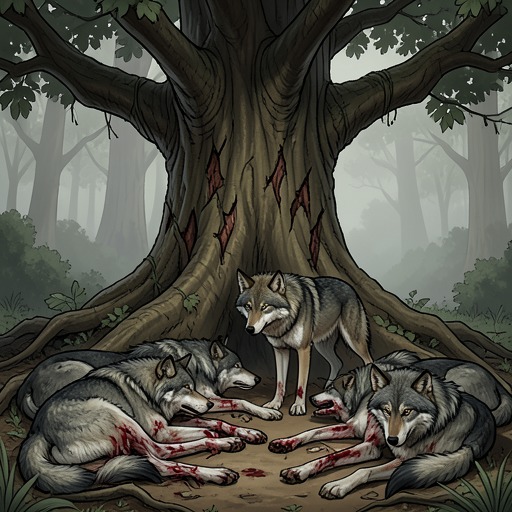
Sierra's Awakened Connection with Her Wolf Soul
Broken Rejected MateSierra's Awakened Connection with Her Wolf Soul marks the decisive change in Sierra's relationship with her supernatural nature. What had previously appeared as an unstable division between human consciousness and a violent wolf becomes a communicative partnership: her wolf can send a bodily warning, speak within her mind, appear in a vision, and acknowledge that both of them are finally in control. The connection does not erase danger or suffering. Instead, it gives Sierra a way to interpret her power, confront the history imposed on Dysomnias, and recognize that her personal breakthrough may carry consequences for an endangered people.
The Divided Wolf Before Awakening
Sierra's connection develops against a history of incomplete control. During the attack in which her father, Doherty Langford, is killed, she allows her wolf to take control while she remains in human form, catching the huntress's sword and killing the attacker with it. The response is immediate and retaliatory: Sierra's cold desire to make the huntress suffer follows the wound inflicted on her father. Later, when Sierra shifts beside the other she-wolves, the process seems easy, like putting on a new outfit, but the apparent ease conceals a serious reversal. Her wolf had not been grieving quietly; it had been prowling and waiting to be released. Doherty's death has injured the wolf as well as Sierra, and the control achieved through earlier practice collapses as soon as the wolf growls.
That divided condition makes the later awakening more than a new supernatural ability. Sierra had assumed that the wolf was attuned to her feelings and that this emotional link would give her some control, but the wolf's independent readiness for violence disproves that assumption. The human and wolf selves are connected without yet being reconciled. The awakening therefore answers a specific crisis in identity: Sierra must learn not merely to suppress the wolf or surrender to it, but to understand what the wolf feels and what it knows.
The Spark and the Word Lichen
The first unmistakable sign of the connection arrives while Sierra is holding Tony Lowell's hand. Tony is unconscious, with irregular breathing and a heartbeat that keep him from appearing dead, while his condition leaves his family in fear. Just as Sierra is about to let go, she feels a spark. The sensation returns, followed by a vision, and something surges through her veins. For the first time, she hears a voice in her head that sounds like her wolf. The wolf speaks one clear word: lichen. It immediately withdraws into the depths of Sierra's mind, leaving Sierra to repeat the word aloud.
The moment joins bodily sensation, knowledge, and action. The wolf does not offer an explanation or a complete instruction; it provides a precise clue at the point when Tony's life seems nearly lost. Sierra's body registers the connection before her conscious mind can interpret it, and the single word becomes the beginning of a practical discovery. The awakening is thus not presented as abstract spiritual illumination. It has a material consequence: Sierra can receive information from the wolf that may help recover the lichen antidote and revive Tony Lowell.
Deliberate Contact and Mutual Healing
After receiving the clue, Sierra attempts to summon the wolf deliberately. She instructs Alan Lowell to remain absolutely quiet and not wake her if she enters a trance, then sits on the bed, crosses her legs, breathes deeply, and clears her mind. Several minutes of concentration bring back the same spark of energy. This time, Sierra goes deeper until the wolf appears before her in a vision. She sees the wolf as others see her: its white fur glows in an ethereal light, transforming what had been frighteningly internal into a visible presence that can be addressed.
Their exchange establishes communication rather than domination. Sierra approaches tentatively, and the wolf tells her there is no need to bow. It expresses pride in her and identifies the achievement's rarity: Sierra is the first Dysomnia in a hundred years to establish a connection with a wolf. The wolf also says that Sierra has helped heal its mind. The relationship is therefore reciprocal. Sierra has not simply gained access to an obedient animal self; both sides have undergone a process of repair, and the wolf's statement that they are finally in control describes shared agency rather than the victory of one self over the other.
The vision also gives the connection a distinctly transcendent quality. The wolf's glowing appearance and almost godlike voice place the encounter beyond ordinary conversation, yet its content remains closely tied to Sierra's immediate bodily and moral crisis. The sacred-seeming image does not remove the wolf from Sierra's life; it makes the buried part of that life legible. The inner figure becomes a guide whose authority comes from both ancient knowledge and intimate participation in Sierra's pain.
Dysomnia Rarity and the Burden of History
The wolf's revelation changes the scale of Sierra's story. Her achievement is not normal among Dysomnias but unprecedented for a century, and the wolf asks whether she knows the history of their people. That question links personal integration to collective memory. Sierra's body and mind have become a site where the suppressed history of Dysomnias can return, and the connection makes ignorance no longer sufficient protection from that history.
The conversation refuses to turn healing into an automatic collective salvation. When Sierra asks whether all Dysomnias are healed now, the wolf explains that only three Dysomnias exist: Sierra and two others. Those two have journeys as harsh and painful as hers, but they may or may not reach the level Sierra has attained. Their struggle remains their own. Sierra immediately answers that she can help them, revealing the ethical consequence of her awakening. The connection gives her power, but it also redirects that power outward, toward lives that remain vulnerable and uncertain.
The wolf ends the vision by telling Sierra that this is only the beginning. Its disappearance and fading voice leave the promise unresolved rather than complete. Alan Lowell has been trying to wake Sierra for twenty minutes when she returns with a gasp, so the vision occupies a suspended interval between ordinary time and an inner encounter whose implications continue after consciousness resumes. Sierra has gained an answer, but not closure.
Power, Threat, and the Need for Control
The awakened connection does not make Sierra invulnerable. A later warning concerning yellow wolfsbane establishes a strict physical limit: because exertion causes the poison to flow more quickly, the wolfsbane must not reach her heart, and shifting would kill her. Even with a wolf that can communicate, Sierra cannot simply call on wolf form whenever greater strength is needed. The connection must operate within the conditions of an endangered body.
That limitation sharpens the contrast between Sierra's new control and the violence directed at her. Doherty Langford's death shows the lethal force of the huntress's persecution, while the offer to spare Dysomnias from extermination is conditional on Alan Lowell remaining with Sierra because he has proved capable of calming her in a wolf state. The proposed tolerance treats Sierra's safety as dependent on another person's supervision, and the threat posed by Ronald Lowell adds a further political dimension: Sierra believes Ronald has nefarious plans involving her and may be pursuing her power. Against these forces, the awakened connection becomes an internal source of knowledge and coordination, but not an escape from external control.
Sierra's awakening consequently stands between two failed extremes. Unchecked release can turn grief into predation, as after Doherty Langford's death; total restraint can leave Sierra unable to use the strength needed to protect others, especially when poison makes shifting fatal. The connection offers a third condition in which human and wolf consciousness can recognize one another, exchange knowledge, and share control. Its decisive significance lies not in removing the wolf's danger, but in making responsibility possible within that danger.