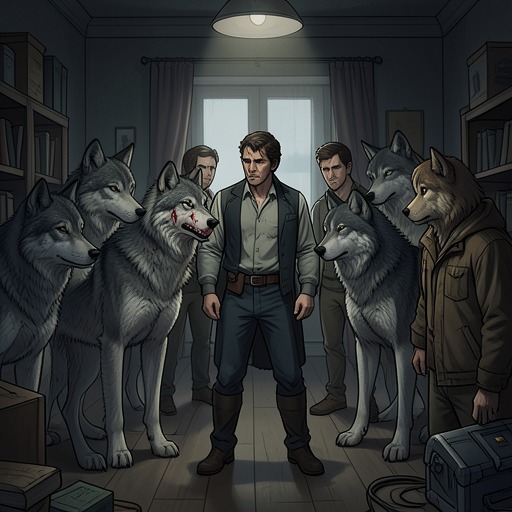
Sierra–Ronald Lowell conflict
Broken Rejected MateSierra–Ronald Lowell conflict is the central power struggle between Sierra Langford and Alpha Ronald Lowell over the possession, meaning, and political control of Sierra’s Dysomnian magic. Ronald Lowell does not regard Sierra merely as a dangerous outsider: he sees her abilities as a resource to be extracted, redistributed, and converted into personal supremacy. Sierra’s resistance therefore becomes inseparable from Alan Lowell’s opposition to his uncle’s rule and from the pack’s choice between fear-driven obedience and moral judgment.
The Conflict’s Hidden Foundation
Sierra’s conflict with Ronald Lowell begins as a concealed scheme rather than an open confrontation. When Alan Lowell overhears Ronald Lowell asking for a progress report, Lukas explains that Sierra has unleashed most of her powers and is now stronger, faster, and more capable than anyone he has ever seen. Lukas also identifies Sierra as the person who discovered how to cure Anthony Lowell. Ronald Lowell responds with satisfaction, declaring that he will soon have all the power he could possibly need at his fingertips. The exchange reveals that Sierra’s growth has been monitored from above and that her ability to heal is considered alongside her supernatural strength as part of the value Ronald Lowell wants to possess.
Ronald Lowell’s objective is consequently more extensive than defeating Sierra or removing her from the pack. He intends to extract her magic and use it to make himself and selected pack members stronger. The twins later confirm that the plan includes kidnapping Sierra, treating resistance with lethal force, and carrying out an extraction that will probably kill her. Sierra’s body and power are thus made into the intended foundation of a new hierarchy: Ronald Lowell presents exploitation as collective benefit while reserving control of the resource for himself.
Power, Possession, and the Threat to Sierra
The danger becomes sharper because Sierra and Alan Lowell have completed their mating bond. Ronald Lowell recognizes that separating Alan Lowell from Sierra will be difficult, but he treats the bond as an obstacle to be overcome rather than a relationship deserving protection. His plan attacks both dimensions of Sierra’s existence: her Dysomnian identity and her place beside Alan Lowell. If the extraction succeeds, Sierra will not simply lose her abilities; she will probably die, while Ronald Lowell’s authority will be strengthened by the power taken from her.
The immediacy of the threat is reinforced when the twins overhear Ronald Lowell’s plans again within twenty-four hours. Their repeated discovery shows that the kidnapping is active and advancing, not a discarded idea or an old fear. Alan Lowell understands that Sierra has already warned him about the danger, yet the twins’ independent confirmation makes Ronald Lowell’s intention impossible to dismiss. The conflict therefore shifts from suspicion to intervention: waiting would leave Sierra exposed to a planned assault from within her own pack.
When Sierra is later endangered by yellow wolfsbane, Ronald Lowell uses the crisis to tighten the trap. Alan Lowell asks where Noah Collins is because the healer is supposed to cure his mate. Ronald Lowell answers that Noah Collins is working on a cure and claims that Sierra’s survival depends solely on Alan Lowell. He also reminds Alan Lowell that the pack healer is skilled with potions and remedies, but the offer is inseparable from the demand that Sierra be brought back. Alan Lowell refuses to return her merely to place her within reach of the extraction and death Ronald Lowell has already arranged.
Ronald Lowell’s Rule and the Contest for Consent
Ronald Lowell attempts to disguise domination as communal protection. He demands that Sierra be handed over because, in his account, everyone agrees it is best for her to become powerless. He justifies the demand by declaring Dysomnian magic dangerous, turning fear of Sierra’s difference into a political argument for disarming her. Yet he immediately reveals the contradiction in that position: although he denies wanting the magic solely for himself, he intends to share it with the pack while retaining the power to decide who receives it and under what conditions.
His offer to Alan Lowell makes the authoritarian structure explicit. Alan Lowell may remain involved only by bending the knee, swearing loyalty for the rest of Ronald Lowell’s reign, refusing to resist the extraction, and abandoning any attempt to stop him. Ronald Lowell therefore seeks not only Sierra’s magic but Alan Lowell’s submission. The proposed bargain converts kinship and pack membership into instruments of political obedience: Alan Lowell’s love for Sierra is to be used as leverage, while the promise of shared power is meant to purchase the pack’s consent.
The confrontation also exposes Ronald Lowell’s hostility toward the former Alpha line. He tells Alan Lowell that Alan resembles his father and calls that resemblance sickening, inadvertently admitting that his conflict with Alan’s father was personal and politically charged. When Alan Lowell asks whether Ronald Lowell killed his parents, Ronald Lowell does not deny the accusation. His silence makes the charge legible to the surrounding werewolves, many of whom begin to look uncomfortable and uncertain. Their greed for Sierra’s power is forced into conflict with the recognition that murdering an Alpha is an unforgivable offense.
Resistance and the Pack’s Moral Division
Sierra’s defense depends on more than her own supernatural abilities. Alan Lowell and the twins devise a plan to gather werewolves who will stand with Sierra and Alan Lowell: friends and pack members who have come to know Sierra personally, understand that she is not dangerous, and believe that she does not deserve Ronald Lowell’s intended treatment. This organization changes the conflict from a private dispute into a test of the pack’s collective judgment.
The first practical test comes when Ronald Lowell sends Lukas toward Sierra. Before Alan Lowell can intervene, his friends block Lukas and prevent him from taking another step. Their action gives physical form to an alternative allegiance. Ronald Lowell’s command is no longer uncontested, and Sierra is no longer isolated before the authority that wants to possess her. The scene also shows why personal knowledge matters: the supporters resist the claim that Dysomnian magic makes Sierra inherently dangerous because their experience of her contradicts Ronald Lowell’s public narrative.
Ronald Lowell responds with direct coercion. He releases a low growl filled with Alpha power, forcing those around him to submit and clear a path as he advances toward Alan Lowell. The gesture demonstrates the mechanism of his rule: obedience can be produced bodily, before reasoned agreement is possible. Alan Lowell nevertheless stands his ground and refuses to allow Ronald Lowell’s power to dominate him. The conflict’s decisive opposition is therefore between compelled submission and chosen loyalty, with Sierra’s fate at the point where those forms of authority collide.
Alan Lowell’s Personal Reckoning
For Alan Lowell, opposing Ronald Lowell is emotionally more difficult than merely resisting a political enemy. Ronald Lowell is his uncle, the man Alan Lowell believes loved him, took him in, and treated him like a son. The possibility that Ronald Lowell was also the architect of his parents’ deaths turns an apparently protective family relationship into a devastating deception. The threatened revelation would crush Alan Lowell because it attacks both his memories of Ronald Lowell and the family structure through which he understood his own survival.
Sierra’s conflict with Ronald Lowell consequently forces Alan Lowell to reconcile two incompatible images of the same man. The affectionate uncle exists alongside the calculating Alpha who seeks to kidnap Sierra, extract her magic, and kill her if the process succeeds. Alan Lowell’s refusal to bring Sierra back, his accusation concerning his parents, and his resistance to Alpha power mark the point at which inherited loyalty gives way to moral recognition.
Sierra also interprets Ronald Lowell through the vision of Karl shown to her by her wolf. She sees both men as figures who killed their own families for power. The comparison gives the conflict a historical and psychological pattern: Ronald Lowell’s ambition is not an isolated act of political opportunism but a repetition of familial destruction in the pursuit of strength. Sierra’s determination that Ronald Lowell will not escape what he has done transforms her resistance into a promise of accountability as well as self-preservation.
Significance of the Conflict
The Sierra–Ronald Lowell conflict makes the pack’s debate over Dysomnian magic inseparable from its debate over who has the right to define danger. Ronald Lowell calls the magic dangerous in order to justify stripping Sierra of power, yet his proposed cure for danger is an act of lethal appropriation. Sierra’s existence exposes the hypocrisy of a ruler who claims to protect the pack while planning to turn a living person into a source of strength.
The conflict also reveals that Ronald Lowell’s authority depends on both consent and force. He invokes what the pack supposedly agrees is best, offers to share the extracted power, and demands lifelong loyalty; when persuasion falters, he uses Alpha power to make bodies submit. Against this combination, Sierra and Alan Lowell build a counterclaim grounded in relationship, evidence, and chosen solidarity. The werewolves who know Sierra refuse to reduce her to a dangerous category, while Alan Lowell refuses to let family devotion or supernatural dominance determine his actions.
By the confrontation’s close, Sierra is not merely the object of a succession dispute or a magical controversy. She is the person whose threatened destruction exposes the corruption of Ronald Lowell’s reign. Her protection becomes the measure of the pack’s conscience, Alan Lowell’s defiance becomes a repudiation of his uncle’s power, and the struggle over her magic becomes a struggle over whether strength will be used to possess others or to defend their right to remain whole.