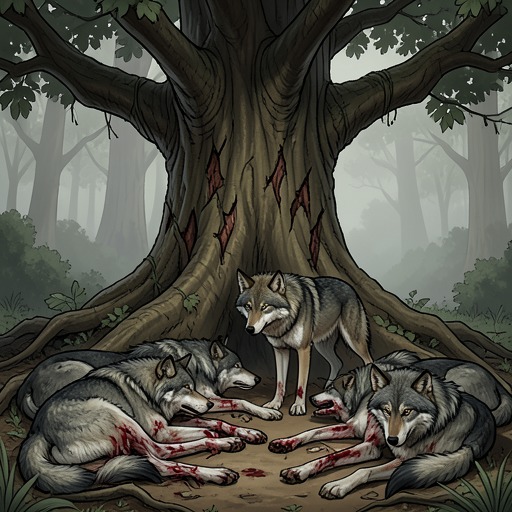
The Dysomnia origin war and massacre
Broken Rejected MateThe Dysomnia origin war and massacre is the decisive historical trauma behind the persecution of the Dysomnias. The conflict begins in a world where Dysomnias were treated as nearly royal figures among werewolves, but it ends with their destruction and the survival of a story shaped by grief, retaliation, and the fear of inherited power.
A Revered Lineage Before the Conflict
A long time before packs were organized under alphas or any formal hierarchy, Dysomnias were regarded as the most revered members of werewolf society. Only about a dozen lived on each continent, and their rarity reinforced their exceptional status. They were described as beautiful, powerful, graceful, intelligent, and special, possessing healing abilities, speed greater than that of an ordinary wolf, and extraordinary physical strength. Their authority was not merely political; it was bound to a near-mythic reputation that made their later persecution a reversal of their former position.
That concentration of ability also generated resentment. Other werewolves came to believe that the Dysomnias did not deserve the power they possessed. The narrative therefore presents the catastrophe as more than a single personal feud: private prejudice grows into collective discontent, and collective discontent creates the conditions for organized violence. The very qualities that once elevated the Dysomnias become evidence used against them.
Alistair and Lyra
The immediate tragedy centers on Alistair, a Dysomnia who loved Lyra, a female werewolf and the daughter of Karl, an influential man. Karl opposed the relationship because he distrusted Dysomnias, forcing the lovers to meet secretly. Their hidden romance places intimacy across a social boundary already hardened by suspicion: Alistair represents a persecuted but powerful lineage, while Lyra belongs to the werewolf society that increasingly questions that lineage.
The relationship ends when Lyra is killed and Alistair is framed for her death. The false accusation converts private hostility into public outrage. A riot is organized, mobs attack Alistair, and he fights bravely before being defeated and beheaded. His death is both execution and spectacle, demonstrating how quickly the community’s earlier reverence for Dysomnias can be replaced by dehumanizing violence.
Retaliation and Extermination
The Dysomnias were portrayed as a close family, bound together as blood brothers and sisters. When they learned that Alistair had been killed, they responded with rage. Their anger intensified when one of their number, possessing the ability to read minds, discovered that Karl—not Alistair—had arranged Lyra’s death. The revelation confirms the injustice behind the execution, but it does not restore Lyra or Alistair; instead, it turns grief into collective vengeance.
The Dysomnias attacked the werewolves and slaughtered hundreds. Their retaliation is described as a loss of control driven by hurt and fear, not as an unprovoked act of evil. Karl then found a charm capable of weakening them, raised an army, and ensured that every last Dysomnia was killed. This counterattack transforms a revenge massacre into an extermination campaign. The survivors’ descendants are subsequently treated as evil, and Dysomnias have been persecuted ever since.
The history remains morally unstable rather than cleanly divided between innocent and monstrous sides. The Dysomnias protected their own and were destroyed after responding violently to the killing of one of their family, yet their retaliation also killed hundreds. That contradiction becomes the central inheritance of the massacre: later generations are judged through the worst act committed by their ancestors, while the persecution that produced and followed the act is forgotten or suppressed.
The Trauma’s Inheritance
The massacre’s consequences extend beyond the destruction of the original Dysomnia population. The history becomes an explanation for why later Dysomnias are treated as inherently dangerous, even when they have not committed violence themselves. Sierra Langford learns that her mother was identified as a Dysomnia from birth and that her mother’s pack feared the first shift so intensely that it delayed judgment only because her grandfather was the alpha. Although her mother was eventually loved by the pack, that acceptance collapsed after her first transformation killed two members. Her pregnancy temporarily protected her from execution under the taboo against killing a pregnant werewolf, but she was taken away and killed immediately after giving birth to Sierra. The family’s flight afterward shows how the ancient extermination campaign continues to shape ordinary existence: Dysomnia identity is not merely a forgotten ancestry but a condition that forces descendants to hide, move constantly, and expect violence.
The same history also complicates the werewolf community’s political structures. In the present, some students at Domina High are supposedly werewolves who might have been Sierra Langford’s kind, yet she believes they would never accept her. The old fear therefore survives as social exclusion as well as physical persecution. At the same time, the Blue Blood Pack’s succession crisis reveals how bloodline and power remain politically charged. With no alpha, the pack considers candidates with Alpha blood, including Alan Lowell, while the possibility of multiple contenders traditionally leads to a fight to the death. The old war’s deepest pattern is thus repeated in altered form: inherited power attracts both reverence and suspicion, and communities attempt to control dangerous bloodlines through exclusion, violence, or tightly guarded succession.
Yet the later narrative does not leave Dysomnia inheritance defined solely by extermination. Sierra Langford and Alan Lowell confront the possibility of raising a child who would combine Dysomnian nature with alpha blood. They have been afraid of how such a child might be treated and whether they could manage the consequences, but their decision to try for a baby expresses a deliberate refusal to let historical violence determine the future. Their intended family stands in contrast to the earlier story of a Dysomnia mother killed directly after childbirth: where the past turned pregnancy into a temporary postponement of execution, the present imagines parenthood as protection, responsibility, and continuity. The origin war therefore remains a living wound, but its legacy can also become the basis for a different social order—one in which power is guided rather than exterminated and inherited difference is met with loyalty rather than fear.