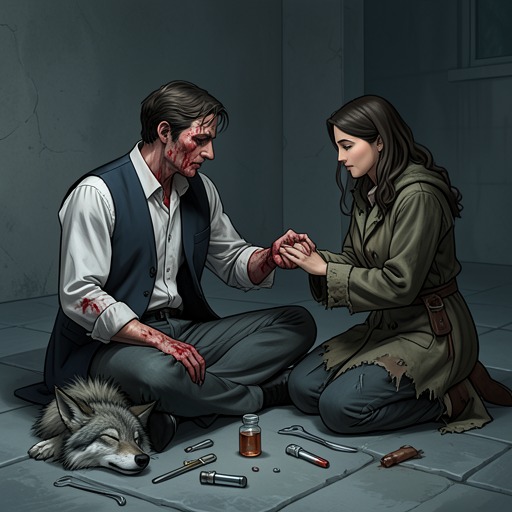
The twins discover Sierra is a Dysomnia
Broken Rejected MateThe twins discover Sierra is a Dysomnia during a private shifting practice with Alan, a scene that converts hidden identity into open danger. What begins as a moment of trust between Sierra and her mate ends with Anthony Lowell and Andrew Lowell confronting her in wolf form, Alan placing himself between them, and the twins learning that the girl they have been taught to fear is also Alan’s fated mate.
Hidden Identity and Inherited Fear
Sierra has spent her life concealing what she is. At Domina High, she tries to remain invisible in a school small enough that students are bound to notice a new arrival, while knowing that some of them are Werewolves who would never accept her. Her father has built extensive precautions around her identity, and Sierra understands secrecy as a condition of survival rather than a temporary inconvenience. Even her curiosity about Alan is divided against itself: if he is a Werewolf, the sensible response would be to stay away, yet she hopes he is not because she already regards him as one of the best people she has met in a long time.
The danger attached to Sierra’s identity is not merely personal suspicion. Doherty Langford explains that Dysomnias were once revered for their strength and intelligence, perhaps even treated as wolf royalty, before all Dysomnia wolves supposedly became feral and began hunting other Werewolves without reason. That history has made the remaining Dysomnias objects of collective fear. Doherty estimates that no more than twenty may remain in the entire world and tells Sierra that this persecution is driven by terror of a repetition of the past. The twins’ reaction therefore comes from a doctrine taught since childhood: Dysomnias must be killed before they can kill others.
The Run and the Recognition
Before the discovery, Sierra’s wolf has made meaningful progress. She stands on four legs in front of Alan while he smiles down at her, and the completed practice has taught her wolf not to attack him. The wolf trusts Alan, and Sierra is no longer entirely out of control. She nuzzles his leg to encourage him to shift, and he answers by revealing his large brown wolf. The two wolves playfully nip at one another and run together inside the tree-covered training space, turning shifting from a source of danger into an experience of intimacy and joy.
That happiness ends when two unfamiliar scents enter the space. Alan and Sierra turn toward the growls as two wolves emerge through the opening in the tree dome. Sierra recognizes them almost immediately as the twins, although her wolf does not share that human recognition. To the wolf, they are simply threats. The threat becomes active when the twins attack first. Their dark brown fur makes them look alike even in wolf form, with the scar on Anthony Lowell’s wolf marking the principal visible difference.
Alan shifts back first and rushes between Sierra and the twins. His intervention is both physical protection and an attempt to impose order on a scene that the pack’s hierarchy cannot easily settle. Sierra’s Dysomnian nature places her outside the ordinary influence of pack rank, while the twins also possess Alpha blood, leaving Alan’s command less absolute than it might have been against ordinary wolves. His warning is nevertheless forceful enough to hold the confrontation momentarily in suspension.
The Attack That Does Not Happen
The fragile restraint collapses when the twins return to human form. Their transformation does not remove the danger, because Sierra’s wolf still sees them as an immediate threat. Sierra lunges toward Anthony, nearly reaching his legs with her fangs, but Alan appears in front of her before the attack can land. Her wolf stops at once and retreats. The response establishes the strongest limit yet placed on her feral state: she may be prepared to kill anyone else, but she will not hurt her mate.
Alan crouches before her and asks her to shift back. His role in the moment is not passive sympathy. He physically blocks the twins, uses his authority to stop their aggression, and then addresses Sierra’s transformation as something that must be brought under control. The scene exposes the difference between Sierra’s instinctive violence and the bond that restrains it. Her wolf cannot recognize the twins as friends, but it recognizes Alan as the one person whose presence overrides the impulse to attack.
Alan’s Declaration and the Twins’ Choice
The twins are outraged that Alan is protecting Sierra. Anthony responds with bitter disbelief, accusing Alan of helping a Dysomnia and treating that choice as the worst of his many reckless decisions. Their anger is sharpened by the discovery that Alan has concealed the truth from them. The revelation is not simply that Sierra is a Dysomnia; it is that Alan has knowingly placed himself on her side.
Alan answers with the central fact governing his conduct: Sierra is his mate, the girl he saw in his vision. Because of that bond, he says he has to protect her. The declaration reframes every earlier encounter. Sierra is no longer only a hidden member of a persecuted lineage, and Alan is no longer merely a sympathetic Werewolf whose identity she is trying to determine. Their relationship has become the reason Alan is willing to defy the expectations of his family and pack.
Andrew Lowell reacts in shock, while Anthony’s response is more openly furious. Anthony insists that they are supposed to kill Sierra immediately, repeating the lesson they have received since childhood: Dysomnias must die before they have the opportunity to kill Werewolves. Sierra then speaks for herself, saying that she would never intentionally hurt them. Her appeal does not erase the history behind their fear, but it introduces a direct contradiction between inherited instruction and the person standing before them.
Consequences and Narrative Significance
The discovery changes the value of the encounter from private trust to public exposure. Sierra had been trying to keep her nature hidden, and Alan had been trying to preserve both her safety and his relationship with her. Once the twins witness her wolf and see Alan defend her, concealment is no longer sufficient. The conflict has moved from Sierra’s anxiety about being discovered to an explicit test of whether personal knowledge can challenge a community’s inherited rule.
The scene also makes the twins agents of the persecution that has defined Dysomnia existence. Their attack is not presented as a misunderstanding alone; it is supported by a rule they believe protects the entire Werewolf population. Yet the twins’ certainty is destabilized by the fact that Sierra does not attack first and that Alan’s bond with her is genuine. Their recognition therefore creates a moral fracture rather than a simple revelation. They see the supposedly uncontrollable enemy, but they also see the person Alan loves and the wolf who stops herself when he intervenes.
For Sierra, the encounter is a threshold in her movement from isolated concealment toward an acknowledged identity. The same wolf form that marks her as dangerous also reveals her capacity for trust, restraint, and attachment. For Alan, protecting Sierra becomes an active rejection of the pack’s inherited logic. For Anthony Lowell and Andrew Lowell, the discovery forces a choice between the command they were raised to obey and the evidence of Sierra’s conduct before them. The event’s lasting significance lies in that collision: the Dysomnia is revealed not through an abstract explanation, but through a body, an attack interrupted, and a mate bond strong enough to stand between her and those who were taught to destroy her.