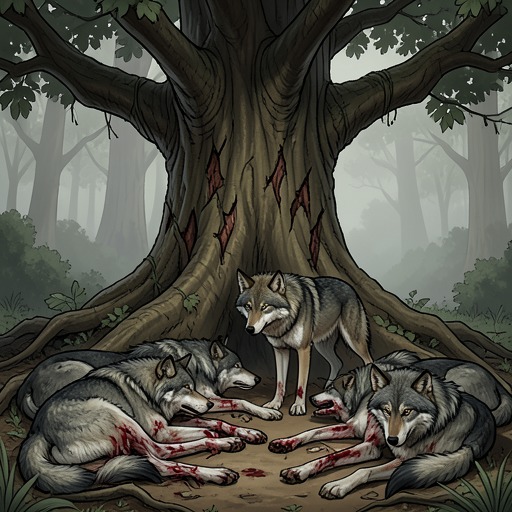
With great power comes great responsibility
Broken Rejected MateWith great power comes great responsibility is both a maxim and a governing idea in the novel. It first explains why the rare Dysomnias, endowed with abilities beyond those of ordinary werewolves, become objects of envy and persecution; later, it becomes a measure of how Sierra must use her own exceptional power when friends are poisoned, hunters attack, and the survival of others depends on her developing control.
Origin in Dysomnian History
The principle appears in Sierra’s account of the Dysomnias’ distant past. Before werewolf packs had alphas or any formal hierarchy, Dysomnias were regarded as the royalty of their kind. Only about a dozen lived on each continent, and their rarity was matched by their beauty, intelligence, grace, and power. Their abilities included healing, extraordinary speed, and superhuman strength, placing them far above the average wolf.
That elevation carried a cost. Their power generated enemies among werewolves who believed the Dysomnias did not deserve it. The maxim therefore functions ironically: the Dysomnias possess gifts that could serve their people, yet those gifts make them targets of resentment. Their social position turns ability into responsibility without guaranteeing acceptance, protection, or justice.
The story of Alistair makes the danger personal. Alistair, a Dysomnia, secretly loved Lyra, a female werewolf and the daughter of Karl, an influential man who distrusted Dysomnias and opposed the relationship. After Lyra was killed and Alistair was framed, mobs attacked him. Although he fought bravely, he was defeated and beheaded. The other Dysomnias, bound together as blood brothers and sisters, learned through one member’s mind-reading ability that Karl had arranged Lyra’s death. The maxim thus stands against the abuse of power: extraordinary gifts demand responsibility, but ordinary political and familial authority can also be used destructively.
Power Tested by Violence
The principle gains immediate practical force in the novel’s recurring poisoning and healing crises. Sierra confronts the hunter siblings after one of them has poisoned her friend and demands to know what substance was used. Their response is not remorse but satisfaction: they are glad the poison has taken effect and expect both victims to die. Their deliberate use of poison transforms power into an ethical test, contrasting the hunters’ revenge with the protective responsibility expected of those who possess healing or supernatural abilities.
Noah’s account clarifies the medical stakes surrounding Anthony Lowell. He explains that healing Anthony should be easy for someone with his ability, but the hunters’ sword was silver and had been infused with wolfsbane and another unidentified poison. The unknown substance prevents him from determining how to treat the injury effectively. The scene links power to knowledge: ability alone is insufficient when the nature of the harm remains concealed, and healing depends on diagnosis as well as strength.
Sierra’s own power responds at the edge of that medical impasse. While holding Anthony Lowell’s hand, she feels a spark, then feels it again as something surges through her veins. For the first time, the voice of her wolf speaks clearly inside her mind and gives a single word: “Lichen.” The wolf immediately withdraws, leaving Sierra with a clue rather than a complete solution. Her extraordinary nature does not remove uncertainty; it makes her responsible for recognizing and acting on a fragile piece of knowledge that may help save another person.
The Burden of Emerging Ability
The maxim also anticipates Sierra’s transformation from an endangered member of the pack into someone whose power must be disciplined. The Dysomnias’ history establishes that exceptional speed, strength, and healing are never merely private advantages. They affect the balance of the entire werewolf community, provoke fear, and can determine whether others live or die. Sierra’s connection with her wolf therefore carries a burden larger than self-discovery: her abilities must become useful without becoming another source of uncontrolled danger.
This responsibility is dramatized again when a surviving hunter returns in a white car to avenge his sister. Alan Lowell expects a direct fight, but the hunter turns toward Sierra, pulls her head back, and injects liquid from a syringe-like object into her neck. She collapses instantly. Alan responds with violent fury, advancing on the hunter and gripping his throat while demanding an explanation. The incident shows how power creates reciprocal obligations: the hunter weaponizes specialized knowledge against Sierra, while Alan’s strength becomes an immediate protective response.
Consequences and Meaning
The aftermath makes the maxim inseparable from care work. Sierra spends the following weeks in the pack hospital with Noah while he removes the wolfsbane from her system. Treatment is prolonged rather than miraculous, and recovery requires sustained attention. Her own exceptional identity does not exempt her from bodily vulnerability; instead, it places her within a network in which healing must be shared and responsibility moves between people.
The principle also reaches beyond individual rescue. After Andrew Lowell’s death, the pack gives him a traditional werewolf burial, while Tony remains silent and his mother collapses from shock and stops allowing her wolf to heal her. Alan Lowell fears that Tony blames him, and Sierra repeatedly reassures him that this cannot be the case. These consequences show that power is measured not only by the ability to defeat an enemy or cure a wound, but by the willingness to remain present amid grief, uncertainty, and responsibility for survivors.
Finally, the maxim carries a broader political implication. Sierra’s growth and increasing control help convince other packs that she is no longer a danger to werewolves, and knowledge of that change spreads across the packs. The same extraordinary power that once made Dysomnias feared can, when guided responsibly, challenge inherited assumptions about them. The expression therefore summarizes the novel’s central movement from fear of power to accountable use of power: ability becomes morally meaningful only when it is placed in service of protection, healing, and the community.