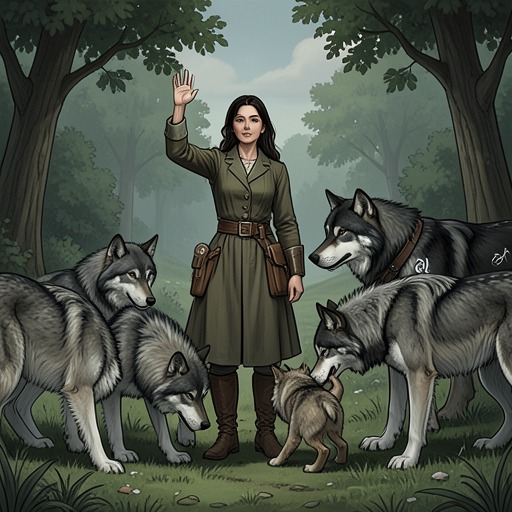
Wolf Form
Broken Rejected MateWolf Form is the supernatural body assumed by the werewolves in the novel, a state of pain, sharpened perception, physical power, and instinctive connection. It first appears as a frightening threshold for Sierra Langford, but develops into a shared language of trust and movement between Sierra Langford and Alan Lowell. Through repeated shifts, Wolf Form changes from something hidden and dangerous into an identity that can be controlled, practiced, and integrated with pack life—though its power continues to carry moral and political risks.
The Physical Threshold
The first shift is presented as an ordeal that remakes the body from the inside out. Sierra Langford experiences her arms and legs breaking “like twigs,” her fingers shortening into paws, her spine twisting, and fur sprouting across her limbs. The transformation has no reliable measure of time for her; it may last two hours or five. Its culmination is unmistakable: a guttural howl leaves her throat, and she finds herself standing on four legs rather than two, with energy pulsing through her veins and a sense of power greater than any she has previously known.
Wolf Form also alters perception. During the pack run, Sierra Langford discovers that her senses are heightened, allowing her to smell everything and see with unusual clarity. The abundance of sensation is overwhelming rather than effortlessly pleasurable, yet it quickly becomes exhilarating. She runs with the pack for almost an hour before reaching a circular clearing of bare earth and dust, where the wolves stop beneath the moon to recover and be renewed. The form therefore combines violence and vitality: it begins in pain, but opens into speed, sensory expansion, and a bodily freedom she has never possessed in human form.
Pack Ritual and Recognition
The first transformation is not an isolated private experience. Sierra Langford’s howl receives two answering howls from her cousins, Anthony Lowell and Andrew Lowell, who have shifted beside her. Even in Wolf Form, she can distinguish them: Anthony Lowell’s wolf retains the scar on his neck, while both brothers appear as tall, powerful dark-brown wolves. Their dominance is perceptible, but Sierra Langford recognizes that she is equally powerful. The scene establishes Wolf Form as a medium through which family identity survives physical alteration and through which Sierra Langford discovers her own strength in relation to the pack.
Anthony Lowell leads the cousins into a collective howl, and the sound draws in the wolves of the wider family and then the entire pack. Doherty Langford leads the run, followed by the other members, making the transformation part of an established communal ritual rather than a private anomaly. In the clearing, wolves mock-fight, move playfully, and enjoy the moonlight with their mates. Wolf Form thus carries social customs of its own: it is used for the traditional full-moon run, for courtship and play, and for reaffirming membership in a living collective.
The same form is also linked to the First-Shift Mate Vision Rule. When the moonlit ritual ends, searing pain strikes Sierra Langford’s eyes and darkness takes over her vision. She understands that the time has come for her mate vision. Wolf Form therefore functions as a threshold between bodily awakening and relational revelation, making the discovery of a mate part of the supernatural experience rather than a separate human romance.
Alan Lowell and the Mate Connection
Alan Lowell’s Wolf Form becomes the first transformed wolf Sierra Langford sees apart from her father. When he approaches her carefully, his blue eyes still glowing, Sierra Langford realizes that the painful nature of his transformation likely means he has only recently shifted for the first time. She had always known, at some deep level, that he was a werewolf. His wolf is huge, brown, and heavily built, with a broad snout, a muscular neck, and soft sandy-brown fur. Yet its size does not make the encounter threatening. Sierra Langford feels an inexplicable pull toward him and becomes calmer than she can remember while touching his fur.
That calm is important because Wolf Form initially exposes the conflict between mate recognition and inherited fear. Alan Lowell recognizes that Sierra Langford’s wolf is a Dysomnia: a six-foot-long wolf approximately twenty-five inches high, with amber eyes that glow like the sun and white fur. Her form is beautiful, but its whiteness identifies the danger that his culture associates with Dysomnias. Alan Lowell believes Dysomnias are feral wolves unable to control their powers, particularly while transformed, and Sierra Langford answers his fear with a growl. Wolf Form makes the hidden truth of her identity visible before either of them can safely resolve what that truth means.
Their relationship gradually changes the meaning of the form. During Sierra Langford’s later shift, Alan Lowell remains beside her and promises to stay with her through the ordeal. She refuses to let the pain dominate her, and her transformation takes about twenty minutes. When it ends, she stands on four legs before her mate, and the training they have undertaken proves effective: her wolf does not attack him, trusts him, and remains only partly out of control. She nuzzles Alan Lowell’s leg to encourage him to shift, and his large brown wolf emerges a few minutes later. They playfully nip at one another, run in circles, and share the happiness of moving together as wolves.
Control, Threat, and Pack Belonging
The joy of shared Wolf Form is repeatedly interrupted by the danger of instinct. When the twins enter the wooded enclosure, Sierra Langford’s wolf does not recognize them as family and sees only a threat. This reaction demonstrates that Wolf Form does not automatically preserve human judgment; its perceptions can be immediate, physical, and hostile before conscious recognition intervenes. Alan Lowell’s protection becomes necessary because the transformed body can convert uncertainty into violence in an instant.
Later, after the twins have helped save Sierra Langford, she shifts in their presence again. Her wolf initially gives them a low growl, but the sound softens into a whine once recognition returns. The change shows that repeated human contact and demonstrated loyalty can reshape instinctive response. Sierra Langford is becoming more capable of controlling her wolf, and the experience raises a larger question for her: if Dysomnias can control their wolves, the long persecution of their kind may have been based on a false assumption. Her Wolf Form is therefore evidence not only of personal growth but also of a suppressed collective possibility.
The contrast is visible in the ensuing run. Sierra Langford follows Alan Lowell, then leaves the other wolves behind because she is faster. The forest seems to pass at an impossible speed, while the howls of the others fade behind her and the act of running becomes almost euphoric. Wolf Form grants her an ability that exceeds ordinary werewolf limits, but the same superiority makes her exceptional and potentially frightening. It offers belonging through the pack run while simultaneously marking her as someone who cannot be measured by the pack’s ordinary standards.
Protection, Power, and Responsibility
Wolf Form is closely tied to the obligations of matehood. When danger approaches, Alan Lowell tells Sierra Langford that anyone who wants her will have to go through him and that he will fight to the death. His promise makes Wolf Form an instrument of protection, but it also reveals the burden placed on the mate who is expected to stand between Sierra Langford and the world. Sierra Langford later challenges the passive version of that arrangement. When Alan Lowell worries that she will be hurt, she urges him to transform and fight rather than remain restrained by fear. Her excitement at his strength is immediately tempered by Caroline’s uncertainty, showing that “wolfing out” can appear both heroic and alarming.
Sierra Langford’s own wish to join guard duty exposes the tension more directly. Alan Lowell understands that guarding the pack would also help protect her, yet Sierra Langford wants to participate herself. His immediate refusal reflects the protective expectation that she should be kept behind the lines, while her insistence asserts that her exceptional body should not automatically make her an object of protection. Wolf Form gives that argument material force: she is not simply a mate who must be sheltered, but a powerful being capable of entering the same dangerous space as the werewolves.
The novel ultimately places a limit on that impulse. Sierra Langford is told that Dysomnias were not made to be killers and that her role is to assist quietly from behind the scenes while werewolves fight their own wars. Her powers are described as almost divine, which makes responsible restraint more important rather than less. During the confrontation after Andrew Lowell’s death, Alan Lowell’s rage drives him toward Ronald Lowell, and he faces five attacking werewolves. Sierra Langford watches rather than joining the battle, because the conflict did not begin with her and Alan Lowell does not need her to end it at the cost of her safety. Wolf Form therefore carries a double lesson: power can make intervention possible, but moral maturity may require refusing to use it.
Integration and Future Identity
By the end of the supplied arc, Wolf Form has become inseparable from Sierra Langford’s emerging place beside Alan Lowell. The form reveals her as a Dysomnia, exposes the fear surrounding her white fur and amber eyes, and gives the pack visible evidence of a power it has been taught to condemn. Yet it also enables her to run with the werewolves, play with her mate, outrun the other wolves, recognize former threats as companions, and imagine a future in which Dysomnian control is possible.
The final movement of this identity is social rather than merely physical. Alan Lowell and Sierra Langford had planned to leave for Rome, Italy, but the possibility of remaining with the pack arises when Alan Lowell considers becoming its Alpha. He asks whether Sierra Langford would want to become his alpha female. Her answer treats the role as a major adjustment, yet she agrees to learn because his happiness matters to her and because she recognizes that he wants the position. Wolf Form thus culminates not in escape from wolf society but in a negotiated place within it. What begins as a body that breaks and howls ends as a foundation for partnership, leadership, and the disciplined use of extraordinary power.