“A man cannot give what he hasn’t got”
Bullet Train“A man cannot give what he hasn’t got” is both a literal answer to a ransom demand and the principle that shapes Nanao’s understanding of his childhood escape. The phrase marks a limit on what another person can provide, but its consequence for Nanao is not resignation: recognizing that his father cannot supply the money he does not have, the boy concludes that he must save himself.
The phrase in the kidnapping
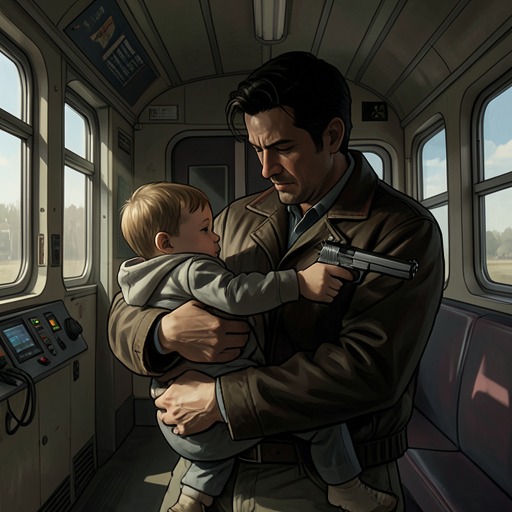
Nanao recalls being mistaken for another boy and held by kidnappers who wanted ransom from the parents of his fortunate friend. Those parents did not take the demand seriously because their son was safe at home. As the kidnappers grew angry and treated Nanao more cruelly, he continued to insist they had the wrong child. Eventually they listened, called his parents, and decided that some money from the wrong family would still be worth taking.
When asked what his father told the kidnappers, Nanao gives the phrase as his answer: “A man cannot give what he hasn’t got.” The kidnappers were angered by it and called his father a terrible parent. Nanao, however, understood the distinction the saying made: his father might want to rescue his son, but he did not have the money to meet the demand. The statement describes a material inability, not a lack of concern.
From recognition to self-rescue
The phrase’s decisive effect is the conclusion Nanao draws from his father’s limitation. If his father cannot provide the ransom, Nanao reasons, there is nothing his father can do for him; he will have to save himself. The saying therefore turns an explanation of helplessness into a prompt for action. It does not promise that escape will be easy or that help will arrive. It identifies the available choice as Nanao’s own.
The remembered escape makes that choice concrete. Nanao was eight years old. He took advantage of the kidnappers’ carelessness and his own youthful determination, escaping as a railway crossing arm lowered and a bus arrived. Once the bus had pulled away, relief was accompanied by fear that he had no money to pay the fare. The memory preserves both the success and its immediate uncertainty: he got away on his own, without the financial rescue his father could not provide.
A limit distinct from learned helplessness
The novel places this recollection near Kimura’s reflection on learned helplessness, but the two ideas describe different kinds of constraint. Kimura remembers guarding a kidnapped man who was neither tied up nor behind a locked door, yet did not leave. A fellow guard explains the idea through an experiment in which a dog subjected to unavoidable shocks later stops trying to escape even when jumping could prevent pain. Repeated punishment can teach a person that action is futile, so that an open possibility no longer feels available.
Nanao’s father’s saying instead names an actual lack of means: he cannot give ransom money he does not possess. Nanao does not mistake this limit for proof that every action is useless. He recognizes what his father cannot do and shifts to what he himself can attempt. Set beside Kimura’s account, the phrase helps distinguish material powerlessness from the learned expectation of powerlessness.
Echo in the schoolkids’ fear
Kimura applies the idea of learned helplessness to students living under the Prince’s control. They have repeatedly seen classmates and adults suffer, and Kimura suspects that electric shocks have reinforced their belief that resistance is impossible. When he watches them prepare an experiment involving Tomoyasu and his dog, the students’ fear and suspicion of one another reveal how thoroughly the Prince’s rule has eroded trust. They turn against potential allies to avoid punishment.
Against that pattern, Nanao’s childhood response gives the phrase a particular force. His father could not provide the requested money, but Nanao did not conclude that no action remained. The saying is not a general promise that people can overcome every constraint; in this recollection, its meaning lies in accurately recognizing one person’s limit and finding the responsibility that remains with another. The contrast links a child’s solitary escape to the novel’s wider concern with how coercion can make people surrender the possibility of acting.