Department-store rooftop
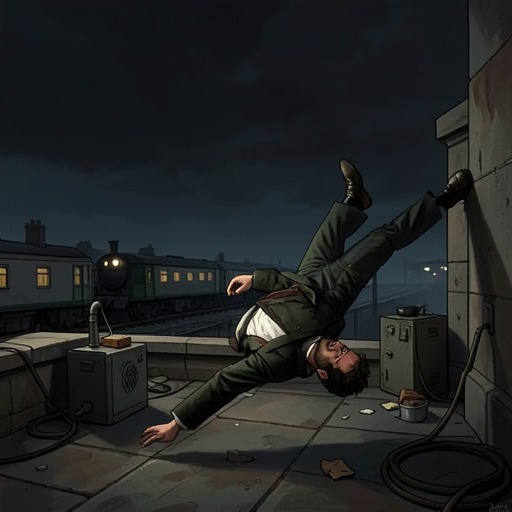
Bullet TrainDepartment-store rooftop is the setting of the violence that leaves six-year-old Wataru unconscious and unresponsive, and of the Prince’s calculated betrayal of the child’s trust. Its significance lies less in any elaborate physical description than in the few features the scene makes decisive: a railing, a downward view, and the Prince’s assurance that there is nothing to fear. The place returns in the story through the consequences of that moment, as Wataru’s father remembers his son in a hospital bed and the Prince taunts him with the possibility of another fall.
Setting and Narrative Function
The rooftop enters the narrative as a recalled site of violence rather than as a fully mapped location. The account identifies the department store and the railing but gives no wider description of the building. That narrow focus directs attention away from the store’s layout and toward the immediate arrangement of the encounter: a small child near an edge, looking down because an older boy has told him it is safe.
The episode is recalled during a confrontation between the Prince and Yuichi Kimura aboard the Hayate Shinkansen. In that present-tense exchange, the Prince invokes rooftops to wound Kimura, referring to his son’s near-fatal fall and warning that children sometimes fall from department-store roofs. The rooftop therefore operates on two linked levels: it is the place where the original violence occurs and the image the Prince deliberately reopens to exert control over Wataru’s father.
The Encounter at the Railing
The Prince’s classmates help take Wataru onto the rooftop. Although described as the Prince’s friends, they are identified more precisely as classmates who follow his orders. Their presence situates the incident within the Prince’s authority over other students: the child is brought there with help from the group that obeys him, while the Prince directs the encounter itself.
Wataru is frightened, but his fear comes from unfamiliarity with cruelty; he has not yet encountered it. The Prince tells him to look down from beside the railing and reassures him that he is safe. He delivers that reassurance with a warm smile, and Wataru believes him. The child’s question about whether he will fall makes his trust explicit. The Prince then pushes him. What the setting makes possible is not an accidental misstep but a deliberate reversal: the reassurance that should protect the child becomes the means by which the Prince gets him to approach danger.
The Prince experiences intense pleasure in the push. This detail makes the rooftop episode more than a tragic fall caused by carelessness. The violence is purposeful, and the apparent kindness immediately before it is part of its cruelty. The contrast between Wataru’s trust and the Prince’s pleasure defines the moral character of the encounter without requiring a detailed account of the rooftop itself.
Aftermath and Recurrence
The fall’s consequences follow Wataru beyond the rooftop. In Tokyo Station, a child with a backpack brushes past Kimura and brings his son to mind: Wataru lies unconscious and unresponsive in a hospital bed. Kimura’s mother has wailed at the sight of him, saying that he looks as if he is only sleeping and might still hear what the family says. The memory leaves Kimura feeling emptied out, while his grief turns to rage at the person who pushed his son.
The Prince later makes the rooftop recur as a threat. He asks Kimura how his child is doing, refers to the boy’s fondness for rooftops, and speaks of unsafe railings and dangerous places children might find. These remarks do not describe a new event at Department-store rooftop; they weaponize the memory of the first one. The original push has already placed Wataru in danger, and the Prince’s words make clear that he is willing to use that injury to frighten his father again.
Significance
The rooftop’s few stated details carry the scene’s central reversal. A railing marks the danger, but Wataru’s immediate vulnerability is not simply his proximity to an edge: he depends on the Prince’s assurance to understand it. The Prince exploits that dependence, first presenting himself as reassuring and then using the child’s trust to make the push possible. The place thus binds physical danger to deception.
For Kimura, the rooftop becomes inseparable from the sight of Wataru in the hospital and from the rage that drives him toward the Prince. For the Prince, it is both the setting of his act and a recurring instrument of intimidation. Its narrative force comes from this return: the story first reveals what happened to Wataru, then shows the Prince invoking rooftops to make the remembered danger present again.