Fujisawa Kongocho intersection
Bullet TrainFujisawa Kongocho intersection is where Morning Glory twice turns ordinary traffic into a weapon, pushing people into the path of vehicles and then leaving the scene. Its changing signals, crossing crowds, and passing cars give his attacks their timing; the familiar public setting makes the violence appear, for a moment, like an accident.
Setting and Traffic
At the main intersection in Fujisawa Kongocho, cars pass one after another while people gather at the kerb for the pedestrian signal. A chain bookstore stands nearby. The setting is governed by a repeating sequence: pedestrians cross in several directions, the walk signal flashes before turning red, and traffic begins moving again. Morning Glory watches the people and the lights, treating these routine patterns not as background but as conditions to study and exploit.
His attention falls especially on the interval around the signal change. He observes that drivers may accelerate when the light turns yellow, abandoning some of their caution. The intersection thus offers him a way to make a deliberate shove coincide with an approaching vehicle, while the movement and noise of ordinary traffic obscure the act that set the collision in motion.
The Earlier Attack
A woman approached Morning Glory with questions about the Pusher, pressing him for information and suggesting that reports of such a figure might be invented. Their exchange turns on the explanation for sudden injuries: she compared belief in the Pusher to people attributing cuts to the Kamaitachi, while Morning Glory rejected the idea that the cuts came from wind. When she continued questioning him, he decided he disliked her, refused the job, and walked away. She followed.
At night, as the light was about to turn red, Morning Glory pushed her into the road. A pickup truck struck her. He felt no regret over the collision itself; his only regret was that he had carried out the killing without receiving a fee. The episode establishes that his violence at the intersection is purposeful, even when an onlooker might mistake its visible result for a traffic accident.
The Later Attack
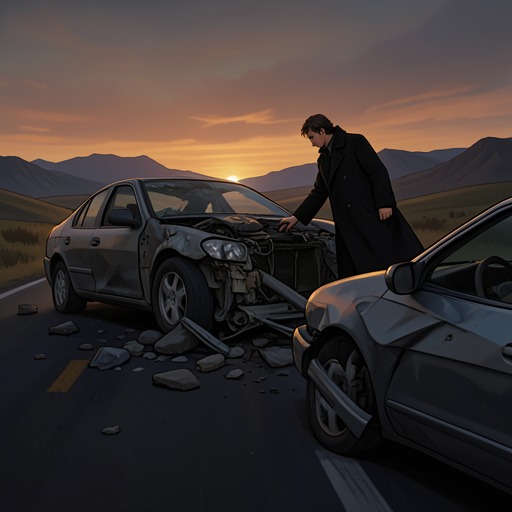
Morning Glory later returns to the same intersection and notices a short-haired, broad-shouldered man in a pinstriped grey suit among the people waiting to cross. He follows him into the crowd. As the light changes from green to yellow, the man stops at the edge of the crossing. A black minivan passes, but its timing does not suit Morning Glory's plan. The next car is coincidentally the same type of minivan; when the light changes, it surges forward, and Morning Glory casually touches the man's back.
The impact and screeching tyres announce the collision. The crowd's shock briefly silences the scene, before people begin calling for an ambulance. Morning Glory is already walking away. His composure contrasts with the suddenness of the collision and with the alarm left behind among the witnesses.
Recurrence and Narrative Significance
As Morning Glory leaves, he recalls having carried out a job at this same intersection long before. The memory makes the second attack a recurrence rather than an isolated use of the setting: the same traffic rhythms have served him before, and he again disappears into the everyday flow after a person is struck. The intersection's ordinary public function—moving pedestrians and vehicles through a shared space—becomes inseparable from the concealed violence Morning Glory introduces into it.