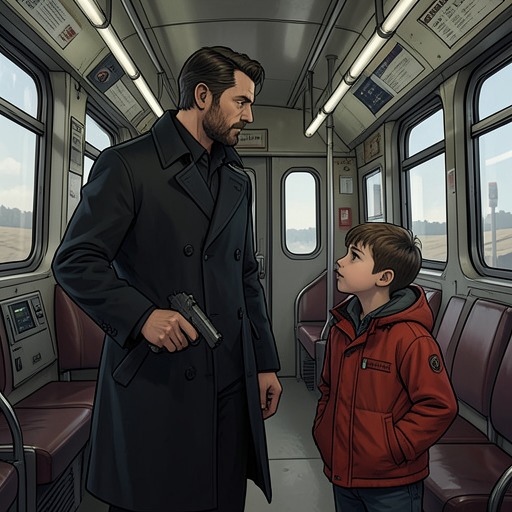
Kimura Is Shot by Lemon Aboard the Train
Bullet TrainLemon’s shooting of Kimura aboard the Shinkansen is the moment a tense, unstable partnership becomes a direct threat to Kimura’s life. The scene turns on a reversal: a gun that Kimura did not know was in the Prince’s backpack becomes Lemon’s means of deciding which of them will survive, while Kimura’s resolve to live for Wataru is answered not by escape but by a nearly inaudible shot.
The search and the hidden weapon
Before Lemon acts, Kimura is already unsure what the Prince intends. He wonders whether the Prince expects him to take the gun and confront Lemon, or whether the Prince is simply manipulating him. His thoughts divide between caution and an impulse to act, leaving him unable to trust either his own judgment or the Prince’s apparent position. The uncertainty matters because the next turn arrives before Kimura can settle on a plan.
Lemon adopts the manner of someone inspecting baggage and takes the Prince’s backpack. The Prince, like Kimura, appears surprised by the sudden move. When Lemon opens the bag, he finds a handgun with a silencer attached. Kimura can only stare as Lemon recognizes that the silencer solves a practical problem: firing an ordinary gun inside a train would draw attention, but this weapon can be used far more quietly. The backpack has changed from an object in the Prince’s possession into the source of Lemon’s advantage.
Lemon’s test
Lemon aims the gun at Kimura and asks whether he and the Prince work for Minegishi. He explains that he intends to shoot one of them, not both: Tangerine would object if Lemon killed someone who might provide information. At the same time, Lemon says that leaving both alive would be too dangerous. His explanation places the threat within the pair’s working relationship. Tangerine’s expected disapproval limits Lemon’s choices, but does not make either captive safe.
Instead of choosing immediately, Lemon makes the two identify which of them is the leader. On his count, the leader must raise a hand while the other points to the leader. If their answers do not match the required pattern, Lemon says he will shoot them both. The test gives the appearance of a rule-bound decision, but Lemon controls both its terms and its consequences. Kimura tries to invoke Lemon’s earlier concern about getting into trouble if he kills them both; the threat remains in force.
A boy and his mother pass through the carriage doorway as Kimura repeats to himself that he must live and get out for Wataru’s sake. Their departure briefly marks the boundary between ordinary passengers and the danger unfolding nearby. When Lemon counts, Kimura raises his hand. The Prince points at Kimura, identifying him as the leader. Their gestures converge on Kimura, and Lemon has the answer he demanded.
The shot
A hand dryer is blowing in the curtained sink area beside them. Its steady noise draws Kimura’s attention to the possibility that someone has been there throughout the confrontation. Then the silenced gun fires. Kimura initially fails to recognize the quiet mechanical sound as a gunshot; only when he notices warmth spreading across his chest does he understand that he has been hit. The dryer’s noise and the weapon’s silencer have made the violence difficult to hear even for the person it strikes.
Lemon remains smiling and tells Kimura there are no hard feelings, then treats the matter as settled. Kimura loses sight of the scene, feels the train’s rumble, and passes into darkness as his mind gives way. The contrast is stark: Lemon’s casual manner makes the shooting sound like the completion of a task, while Kimura’s awareness narrows to bodily sensation, the Shinkansen’s motion, and a loss of orientation. The scene does not present the shot as an open exchange or a fair contest; Kimura is disarmed of control before he can act.
Confinement and consequences
Kimura is not dead immediately. Lemon and the Prince put his barely breathing body inside the bathroom and secure the door from outside. Lemon uses a thin copper wire to manipulate the lock, tugging it as the door closes. The first attempt fails; the second makes the lock click. A short length of wire remains protruding from the frame, an improvised device that Lemon says he can use to reopen the door by pulling it upward. The escape mechanism is also the mark of Kimura’s confinement.
The Prince asks about the visible wire, and Lemon dismisses the likelihood that anyone will notice or care. Afterward, he takes a drink of mineral water and asks what the Prince whispered to Kimura when they were dragging him into the bathroom. The question leaves the content of the whispered words unresolved in this moment, but shows that the Prince had sought a final private exchange with the dying-seeming man. The shooting therefore does not end the conflict between them; it changes its conditions, with Kimura alive but locked away and the Prince’s intentions still under scrutiny.
The Prince later taunts Kimura by blaming him for Wataru’s possible death. That accusation sharpens the scene’s central reversal: Kimura’s effort to survive for his son is followed by a renewed attempt to make him feel responsible for the danger to Wataru. The episode’s sound pattern reinforces the same reversal. A loud train and a running hand dryer surround a shot so quiet Kimura does not recognize it at once; the machinery that belongs to routine travel helps conceal the moment when his life is put at risk.