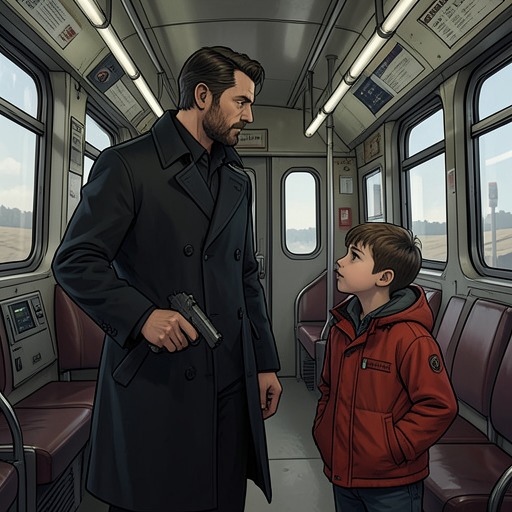
Kimura's .22 pistol
Bullet TrainKimura's .22 pistol is a once-neglected firearm that becomes the instrument of Kimura’s attempt to confront the person he holds responsible for Wataru’s fall. On the Hayate Shinkansen, he prepares it with a silencer and conceals it in a paper bag, but the weapon’s size and presence begin to betray him before he reaches his target. The Prince eventually takes the pistol and removes the silencer, reversing the balance of control: what Kimura brought to frighten another person becomes part of the Prince’s hold over him.
Retained and Reclaimed
Kimura has not fired the pistol since Wataru was born. He touched it again only while packing for a move, and is now glad he did not throw it away. The interval gives the weapon a place in the background of a life that had moved beyond its former use; Kimura retrieves it not as a routine possession but as a means of acting on his rage over Wataru’s condition. He sees the person who pushed his six-year-old son from a department-store roof as someone who should not be able to continue living without consequence. The gun offers a way to make that anger physical, though Kimura first describes its utility as putting fear into someone who has crossed a line.
His plan depends on information from former associates. Kimura boards the Hayate and intends to move from the next car toward a target seated on the three-seat side of the fifth row in car seven, approaching from behind. That route gives the pistol a practical role in an organized approach, but the target’s location and Kimura’s careful plan contrast with the instability of his own state. In the gangway, he studies his unkempt reflection and washes his hands until the water stops, trying to steady himself. He tells himself that his trembling comes from nerves, not alcohol. The pistol is thus bound to an effort at self-command as well as to threatened violence.
Silencer and Concealment
Before leaving the sink area, Kimura takes the pistol from his tracksuit pocket and fits a narrow cylinder to its muzzle. The silencer will not eliminate the sound of a shot, but, on this small-calibre weapon, it will reduce it to a muted noise. He checks his reflection again, places the modified pistol in the paper bag, and leaves. The silencer marks a shift from the gun as a general means of intimidation to a weapon prepared for a specific, concealed use. Its presence is also materially consequential: it makes the pistol longer than usual, a small alteration that complicates the disguise intended to hide it.
That complication becomes visible in car four. As Kimura passes a seated man, the pistol catches on the man’s leg through the bag. Kimura pulls the bag toward himself; the man notices that it is torn and points this out. The opening does not expose anything that can be plainly identified as a gun, but the concealment has ceased to be seamless. Kimura answers sharply and moves on. The scene makes the weapon’s physical dimensions part of the suspense: the silencer may reduce the sound of a future shot, yet its added length increases the risk of discovery before Kimura reaches the planned location.
A Check on Kimura’s Resolve
The pistol also comes into view at a point when Kimura is trying not to drink. A car attendant’s trolley carries beer, and seeing the cans makes him draw back rather than snap at her. The words of Kimura’s father return to his mind as a warning that one sip would undo his sobriety. This encounter does not remove the firearm or alter Kimura’s plan, but it places the weapon alongside a second test of restraint: Kimura is carrying a means of violence while attempting to maintain control over an alcohol dependence he knows can return.
The contrast sharpens when Kimura later loses control of the pistol. The Prince has taken it from him and holds it close between them while keeping it out of other passengers’ sight. The weapon that Kimura carried to frighten his target now helps the Prince restrain him and compel his attention. Its change of possessor changes its function without changing its basic threat: Kimura’s plan has become the Prince’s leverage.
The Prince’s Reframing of the Weapon
The Prince discusses the pistol as evidence of Kimura’s past and preparation. He asks whether Kimura has ever killed anyone and points to the silencer as a sign of professional intent. He has removed the attachment and holds it up while mocking Kimura’s fear. In his hands, the silencer is no longer merely a practical device meant to muffle a shot; it is an object the Prince can display to characterize Kimura and unsettle him. The episode exposes the gap between Kimura’s planned approach and the control he actually possesses.
The pistol’s narrative role rests on a series of reversals rather than on any confirmed shot. Kimura retrieves it after years without firing it, equips it for a covert confrontation, and hides it in a bag whose tear nearly gives it away. Then the Prince takes it, making Kimura the person under threat. The weapon remains dangerous, but its movement between them reveals that possession alone does not guarantee command. Its silencer promises discretion, while its length betrays the attempt at concealment; its intended use as intimidation is finally turned back upon the man who brought it aboard.