Kimura's alcohol dependence
Bullet TrainKimura’s alcohol dependence is more than a habit he privately regrets: it governs his workday, compromises his honesty with Wataru, and gives new weight to his father’s warning that one drink can reopen a condition that never truly goes away. The story traces the gap between Kimura’s explanations for drinking and his eventual recognition that alcohol has become something he cannot safely control. When he later stops, that change does not resolve his family’s crisis; instead, Wataru’s coma makes sobriety feel newly fragile and painfully incomplete.
Pattern of Use and Self-Justification
Kimura carries a flask of cheap brandy while working as a security guard and takes small drinks when he feels he needs them. He explains the practice to himself as a practical precaution: without alcohol, he expects his concentration to falter and his hands to shake, making him less effective at his job. In this private account, the flask is comparable to medicine kept ready for a chronic ailment. The reasoning turns dependence into a work requirement, allowing Kimura to treat continued drinking as responsible preparation rather than a danger.
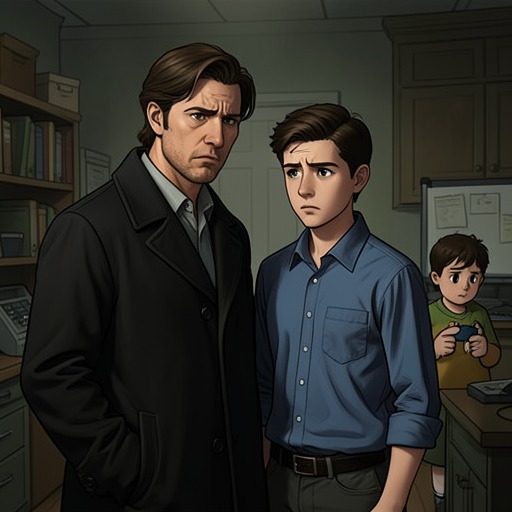
The pattern reaches into his family life. When Wataru’s mild symptoms improve at a clinic, Kimura, relieved, takes a nip from his flask while they wait. He has Wataru continue pretending that his stomach hurts so they can see the doctor and obtain medicine before leaving. Outside, Wataru asks whether his father has been drinking; he has noticed what Kimura hoped to keep private. The moment sets Kimura’s rationalization beside its consequence: the drink may be small, but his son sees the concealment and recognizes that his father is making excuses again.
Kimura also uses an anecdote about brandy’s supposed history to redirect Wataru’s attention. He talks about distillation reaching back to Mesopotamia, though Wataru does not know what Mesopotamia means. The elaborate explanation cannot answer the child’s underlying concern. Its light, playful sound contrasts with the familiar reality behind it: Kimura has reached for alcohol again, and Wataru has noticed.
His Father’s Warning
Kimura’s father confronts the drinking directly during a visit to a park. After watching his mother hurry after Wataru at the playground, Kimura reaches for his flask. His father, who has sat down beside him without Kimura noticing, grips his hand and takes it. The interruption turns an ordinary family outing into a blunt discussion of what Kimura’s drinking may become. His father says Kimura is approaching full alcoholism and defines the condition as addiction rather than simply liking alcohol or drinking heavily.
The distinction matters to the father’s account: dependence means being unable to stop once drinking begins, not merely lacking restraint on a particular occasion. He says that neither he nor Kimura’s mother drinks because they know there is no recovery that makes it safe to resume. He suggests Kimura may share the same vulnerability, while leaving open whether it is hereditary. His warning is categorical, but it also gives Kimura a framework for understanding the risk as something physiological rather than a test of character alone.
His father expands that explanation through the brain’s reward system. Alcohol stimulates the A10 cells, producing a sense of accomplishment without the work that would ordinarily earn it. Repeated drinking, he says, can alter the brain and leave behind a switch that reacts when alcohol returns to the system. Even after a long period without symptoms, a person with alcohol dependence may resume the old pattern after a single drink. The father’s conclusion is that the only way to avoid that return is to give up alcohol entirely and seek satisfaction through honest work instead of an easy reward.
Kimura does not accept the warning comfortably. He reaches for familiar explanations, including the idea that dependence might be treated and then left behind, and he invokes the story about brandy’s ancient origins. His father challenges that anecdote as uncertain and warns him against believing whatever he hears. Yet the discussion does not immediately stop Kimura from drinking. Later, with his father’s warning in mind, Kimura opens the flask and takes a small sip. He feels shame, and the drink seems to him to produce the very change his father described. The warning has entered his thoughts, but knowledge alone has not ended the behavior.
Recurring Risk and Recognition
The phrase his father used about a single sip returns well beyond the park. In a later scene aboard the Shinkansen, Kimura passes a snack trolley carrying beer. He is close to snapping at the attendant when he notices the cans, then backs away. His father’s words flash through his mind. The episode makes the warning an active constraint: the presence of alcohol brings the risk back into focus, and Kimura chooses not to approach it.
This recurrence is significant because Kimura’s dependence is shown through both use and anticipation. Earlier, he makes alcohol available to himself at work and describes it as necessary. Later, simply encountering beer prompts caution. The contrast records a change in his conduct without suggesting that the underlying vulnerability has disappeared. The father’s account of dependence insists on precisely that distinction: the absence of drinking is not proof that the risk has been erased.
Sobriety, Fatherhood, and Loss
By the time Kimura struggles with a combination lock on the moving train, he has stopped drinking. The memory of his earlier life is severe in its practical detail: when he went too long without a drink, he became anxious and irritable; when Wataru hid the alcohol on his grandparents’ instructions, Kimura searched the apartment and grew desperate. He remembers coming close to drinking hair tonic when he could not find alcohol. These recollections show how far the flask’s role had expanded beyond a convenient aid at work.
Kimura is grateful that he never became violent toward Wataru, and he imagines the remorse of harming his son as something he could not bear. That thought connects his dependence to his responsibilities as a father without making harm inevitable: the history includes desperation and concealment, but also his awareness of the boundary he feared crossing. Wataru had been affected in another way too, by being asked to hide or pretend while adults managed Kimura’s drinking.
His sobriety should be a beginning, but Wataru is lying in a hospital in a coma. As the train rocks around him, Kimura feels that the achievement has been robbed of its meaning because his son cannot see it. The juxtaposition does not make stopping irrelevant; it shows how Kimura’s hoped-for change remains bound to the relationship for which he wanted to change. Recovery has taken him out of the drinking pattern, but it cannot itself restore Wataru or undo what has happened to the family.
Powerlessness and Narrative Significance
Kimura’s reflections on alcohol sit alongside a separate idea he once encountered at work: learned helplessness. He recalls guarding a kidnapped man who was not tied up and whose door was not locked, yet who did not leave. Another guard explained that repeated, unavoidable shocks had taught a dog not to attempt escape even when escape later became possible. Kimura carries the concept into his assessment of the schoolchildren under the Prince’s control, whose repeated exposure to punishment and electric shocks has persuaded them that resistance is futile.
The story does not identify Kimura’s dependence as the same condition as the schoolchildren’s learned helplessness. Instead, the two strands give his attention to powerlessness a wider context. He knows what it is to explain a damaging pattern as necessary, and he has heard his father describe a mechanism that can persist even after a person stops drinking. His own history makes the difference between apparent choice and effective control a recurring concern, while the return of his father’s warning on the train links that concern to a concrete decision: Kimura sees the alcohol and turns away.