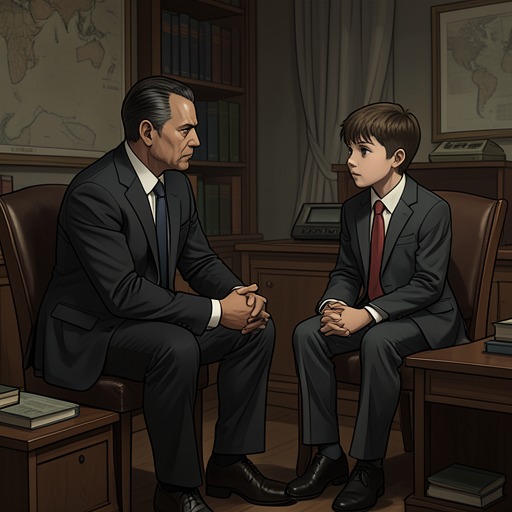
Kimura–Wataru father–son relationship
Bullet TrainThe father–son relationship between Yuichi Kimura and Wataru is shown through the practical, repetitive work of caring for a child who cannot respond—and through the danger Kimura faces when he is forced away from his hospital bedside. Wataru’s coma does not lessen his place in Kimura’s life; it makes his safety the reason Kimura must keep moving, even when doing so exposes him to further risk.
Care at the Hospital
For the month and a half after Wataru fell into a coma, Yuichi Kimura had barely left the hospital. Wataru was unresponsive, so his father could not talk with him or encourage him in the ordinary way. Kimura nevertheless attended to the things he could do: changing Wataru’s clothes, moving him on the bed, and remaining beside him. The care was constant but offered no assurance of a reply or recovery, and the difficulty of sleeping in the hospital steadily accumulated into fatigue. The ward held as many as six young patients at a time, with their parents staying alongside them. The other parents did not make small talk with Kimura, but neither did they visibly avoid him. They could recognize his situation as one they shared: like them, he sat beside an unconscious child and muttered to himself and to Wataru. Kimura, accustomed to treating other people as enemies or as people who kept their distance, initially did not know how to read their sympathy. In time, he came to think of the parents as fellow members of a team, together on the same bench in the same struggle.
Leaving Wataru
When work required Kimura to be away for a day, he asked the other parents to call if anything happened to Wataru. Their willingness to help gave him a measure of support, but leaving still became a source of regret. On the train, he remembered the hospital and thought he should never have left his son alone. His original plan had seemed simple: board the Shinkansen, confront the Prince, and then return to Wataru. He expected to be gone for one day and imagined the hospital as the place to which he could go back once the task was finished. That plan breaks against the possibility that Wataru is in danger. The Prince tells Kimura that a friend is waiting near the hospital and has already called after the train left Omiya Station. The friend, according to the Prince, is eager to kill Wataru; the Prince claims he has told him to wait, but warns that the friend may act if given the signal or if the Prince fails to answer. Kimura immediately understands the threat: Wataru’s life is being used to control what happens aboard the train. The Prince’s flippant treatment of the boy’s breathing sharpens the contrast between his own callousness and Kimura’s sustained attention to his son.
Devotion Under Threat
Kimura’s care for Wataru is expressed both in long-term bedside routines and in the choices forced on him by the threat. He is furious at the possibility that the Prince may be bluffing, but he cannot safely dismiss it: even a small chance that the threat is real means he must keep the Prince alive. The resulting restraint is not a sign of diminished resolve toward his son; it is the condition imposed on him by the danger to Wataru. Kimura must suppress his immediate anger because acting on it could leave the boy exposed. The relationship thus links physical separation to a continuing obligation. At the hospital, Kimura performs intimate acts of care for a child who cannot answer him; on the train, the thought of Wataru waiting there drives him to leave his seat and try to act, despite being bound and having no plan. His fatherhood is not presented as a single declaration but as a sequence of tasks, worries, and decisions shaped by Wataru’s vulnerability. The threat makes that devotion a point of pressure, turning the distance between the hospital and the train into the means by which the Prince attempts to control Kimura.