Lemon
Bullet TrainLemon is a hired operative whose combination of physical composure, sloppy work habits, and unshakable devotion to Thomas and Friends shapes both his partnership with Tangerine and his role in the Shinkansen’s unfolding crisis. He can remain calm when danger closes in, but that calm often looks like indifference: he avoids admitting mistakes, changes the subject when pressed, and treats grave problems as if they can be left for later. The result is a character whose apparently frivolous talk eventually carries both personal history and plot significance.
Identity and Background
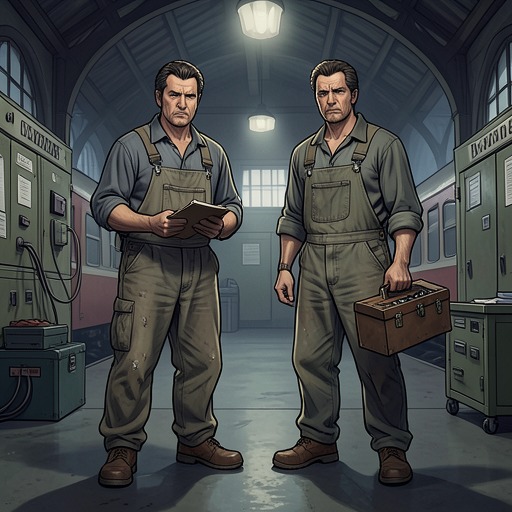
Lemon works alongside Tangerine as a killer for hire. They have been partners for five years, and their similar height and rangy builds lead other people to mistake them for brothers, sometimes even twins. Tangerine dislikes the comparison, which he feels wrongly groups his careful, controlled manner with Lemon’s carelessness. Lemon appears untroubled by the idea. An associate once summed up the difference by describing Tangerine as easy to deal with and Lemon as a pain; Tangerine agreed with the latter assessment.
Lemon’s appearance contributes to the impression of disorder. His long hair sticks out like a mane, though Tangerine cannot tell whether it is deliberately styled or simply unkempt. When Tangerine asks about a mark on Lemon’s cheek, Lemon rejects the suggestion that he was cut during a recent encounter and calls it an allergy rash. Tangerine insists that he heard the attack and Lemon’s reaction. Their disagreement gives a small, comic form to a larger pattern: Lemon would rather dismiss an uncomfortable fact than acknowledge that he has been hurt or caught unprepared.
A conversation with Kimura reveals a more serious part of Lemon’s past. He says that both his parents were alcoholics and describes keeping his distance as their addiction worsened. He explains that he never drinks because he believes he cannot safely moderate it, and says he drinks water instead. The story of Duck being pushed by a freight train until it crashes into a barbershop gives him a way to describe feeling unable to stop once drinking begins. His Thomas and Friends comparisons are not merely a hobby in this scene: they provide his chosen language for a childhood shaped by his parents’ drinking and by his effort to stay apart from it.
The Thomas and Friends Lens
Thomas and Friends is Lemon’s central frame of reference. The long-running children’s television series, made with model trains, supplies characters for his jokes, examples for his explanations, and allegories for events in his life. Tangerine knows that almost any conversation can be steered back to it. When the pair play at inventing names, Lemon substitutes the twin black locomotives Donald and Douglas for Tangerine’s suggestion of Dolce and Gabbana, then explains that the engines speak very properly. Even a discussion about making a good impression becomes an occasion to invoke the trains.
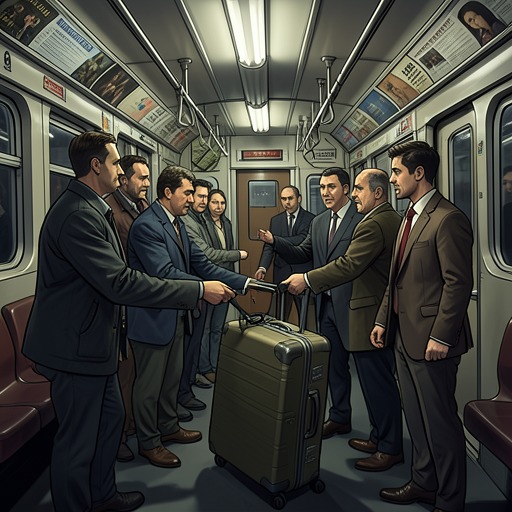
The habit can seem particularly misplaced when the stakes are high. After returning from a search for the missing suitcase empty-handed, Lemon sits down casually and asks Tangerine to name Thomas and Friends characters. Little Minegishi’s body remains in the carriage, the suitcase is still missing, and they have made no progress in explaining what has happened. Tangerine asks whether Lemon found the bag; Lemon’s answer turns the discussion back toward the television series rather than the urgent problem. His ease in such moments unsettles the expectation that danger must produce visible alarm.
The references also recur as a form of persistence. When the train is approaching Omiya, Lemon smiles and asks Tangerine if he is nervous about the contact waiting there. Tangerine admits some apprehension; Lemon says he is not nervous. Later, he treats the search for the missing suitcase and the person responsible for Little Minegishi’s death as a problem of method rather than cause for panic. He acknowledges that Minegishi is angry and that they have found neither the killer nor the bag, but insists that making a mistake is no reason to become upset. The same lightness that makes him a poor keeper of details also helps him remain composed.
Work and Partnership with Tangerine
Lemon and Tangerine are transporting Minegishi’s suitcase and are expected to account for it when the job goes wrong. The suitcase is missing, and Little Minegishi is dead. Lemon’s contribution to the search is uneven: he returns without the bag, offers no clear explanation, and initially behaves as though the crisis can be put out of mind. Tangerine expects to be the one who must repair the consequences. In his view, Lemon’s physical ability and refusal to panic make him useful, but his irresponsibility and tendency to evade blame repeatedly leave his partner to handle the details.
Their different temperaments surface in teasing as well as in conflict. Lemon takes pleasure in the possibility that Tangerine has made a mistake, suggesting that their target could hardly have been missed unless Tangerine had failed to pay attention. When Tangerine says the fugitive had help, Lemon proposes that he should have pressured those helpers. Tangerine explains that the fugitive apparently forced a couple of passengers to assist him, including a man in drag and an older man in ordinary clothing. Lemon’s quick criticism sits alongside his own established carelessness: he can spot a lapse in someone else’s work more readily than he accepts his own failures.
Lemon does, however, take part in the active pursuit. He and Tangerine move through the train as they search for the missing person and try to determine what has happened. When they reach the gangway, Lemon checks his watch and notes that Sendai is only thirty minutes away. Tangerine points out that their quarry had said there was more time. The exchange shows Lemon contributing practical information even as the two remain uncertain about the train’s circumstances. His competence is real, but it does not cancel the unreliability that Tangerine has learned to expect from him.
Confrontation with Nanao
Lemon eventually finds Nanao, who has been considering whether to approach him with the claim that they share Minegishi as a client and might cooperate to find the suitcase. The possibility of an alliance collapses before Nanao can explain. Lemon greets him in a familiar, almost genial manner, blocks the aisle, and attacks. Nanao evades the initial blow and the two fight at close quarters. When Lemon draws a gun and aims it at Nanao, Nanao warns that firing would reveal Lemon’s position. Their encounter shows that Lemon’s relaxed manner does not mean passivity: he moves quickly from casual greeting to direct violence when he sees Nanao as an opponent.
Nanao overcomes him, and Lemon later comes to with his head still fuzzy. He realizes that Nanao has taken his gun and recalls the claim that Nanao was also working for Minegishi. This leaves Lemon confronting the possibility that the person who stole the suitcase from him may have been hired by the same client. The reversal puts the work’s tangled loyalties into personal terms: Nanao may be an adversary, but he may also be pursuing the same assignment. Lemon’s own earlier failure to recognize the connection has left him behind in the search.
Death and Narrative Significance
Lemon’s death is discovered in a train toilet, where Tangerine finds his copper wire used to secure the door from the outside. The wire is the same kind Lemon had used when the pair hid Little Minegishi’s body. Its presence first makes the locked, apparently occupied toilet seem suspicious; when Tangerine follows the clue, he finds Lemon dead inside. For Tangerine, recognition is not just a procedural discovery. He pictures the companion who chattered beside him and wanted people to think he was a good train, and realizes that he has never before felt this kind of loss. Lemon’s death gives the partnership’s habitual irritation a new and irreversible weight.
Lemon’s attachment to the series remains active in his final encounter with the Prince. Tangerine finds a small sheet of Thomas and Friends stickers in Lemon’s jacket, including a sticker of Diesel, a character Lemon described as malicious and untrustworthy. Tangerine shows the sticker to the Prince, who recognizes the characters. Tangerine then finds a paperback in the same jacket, marked with a bookmark; Lemon had disliked that book. As Tangerine speaks about Diesel’s qualities and the sticker’s appearance on the Prince’s clothing, the series that had seemed like Lemon’s private conversational detour becomes part of the evidence against the Prince. Tangerine concludes that Lemon must have placed the sticker there when he grabbed him, making it Lemon’s last act.
That clue changes the meaning of Lemon’s fixation without reducing it to a plot device. His constant talk about model trains had been a source of amusement, irritation, and explanation, a language through which he could discuss everything from polite speech to the dangers of alcohol. At the end, his knowledge of the characters supplies a precise way to mark the person he had encountered. Lemon cannot explain the clue himself, but the details he carried with him let Tangerine read his final action and continue the confrontation.