Maria
Bullet TrainMaria manages Nanao’s jobs from behind the scenes, connecting him to clients, tracking the suitcase assignment, and stepping in when the work goes off course. She calls herself an agent rather than a participant, but Nanao suspects there is more to her role; by the end of the train journey, she has come aboard to help him and is already reconsidering who may have commissioned their job.
Identity and Working Arrangement
Maria is Nanao’s regular source of work and the person who directs him through assignments. Nanao has heard her tell him that he is overthinking things, and he understands their working arrangement through a simple division: Maria gives the orders and he carries them out. He pictures her as the coach and himself as the amateur player, an image that captures both her authority and his reliance on her judgment.
The arrangement is not presented as a formal organization with a clear structure. Maria describes herself as basically an agent, a go-between who passes work along, while Nanao wonders why she never takes jobs herself. He cannot get an answer that changes the situation, and eventually gives up trying to alter their roles. The uncertainty remains important: the narrative establishes that she directs Nanao, but does not confirm that she personally carries out criminal assignments.
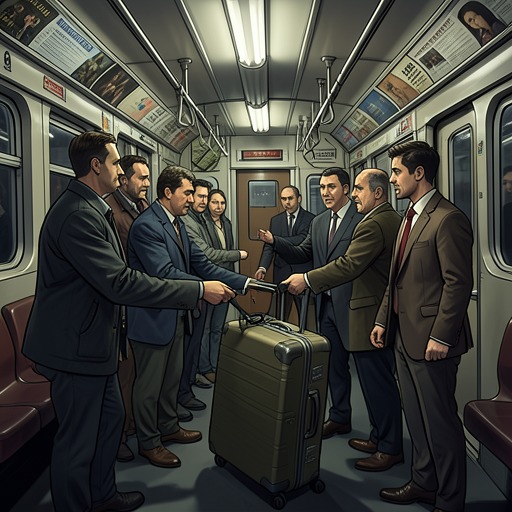
Her work puts her inside a layered chain of commission. In the suitcase operation, Maria explains that their immediate client is taking orders from a further client, making them subcontractors to a subcontractor. She treats this arrangement as ordinary business, but it also means that information and responsibility travel through several hands before reaching Nanao. Maria functions as the point where that distant chain becomes practical instructions for him.
Managing the Suitcase Assignment
Before the train leaves, Maria expects to contact Nanao once she has received information about the suitcase. She thinks the details will arrive just after departure, placing her in the role of coordinating the job while Nanao is already in transit. The timing creates a dependence on messages from outside the train, even as the assignment begins to unfold inside it.
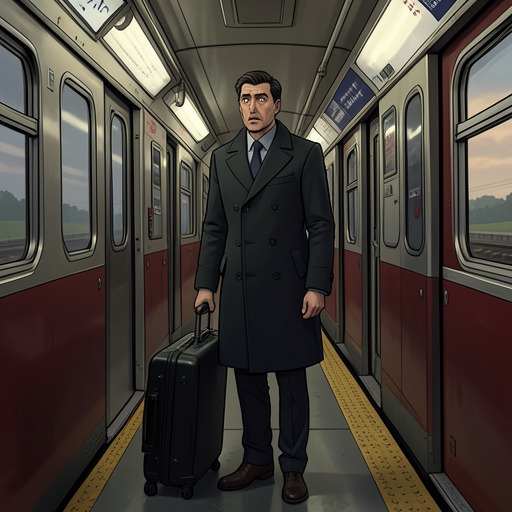
When Nanao does not get off at Ueno as expected, Maria calls to demand an update. Her questions are pointed and practical: she wants to know where he is and whether he has the bag. Later, she tells him she has updated their client, explaining that Nanao has the suitcase but could not leave at Ueno. She judges the change to Omiya as manageable, yet reports it so the client is not left uninformed. Her comparison to employees reporting problems to supervisors gives the exchange a matter-of-fact, workplace quality, even though the job itself is far from routine.
Maria’s information is useful but incomplete. The suitcase is reported to be in the storage area between cars three and four, and she and Nanao recognize that the person who supplied that detail may still be aboard. The source’s possible presence on the same train turns a piece of intelligence into a new uncertainty: the job is not merely about locating property but about accounting for who knows where it is. Maria helps Nanao interpret the information rather than treating it as a settled fact.
The assignment grows more complicated when Nanao discovers that Tangerine and Lemon are also working for Minegishi. Maria recognizes the danger of a direct confrontation and asks whether they would recognize Nanao. Her concern shows that she is not simply relaying the client’s requests; she is considering how Nanao’s identity and the other workers’ presence could affect his chances. When she proposes that he first try to steal the suitcase back from the pair, the advice is direct and tactical, while leaving the decision and risk with him.
Advice, Monitoring, and Trust
Maria’s manner combines blunt correction with active attention. Her calls can sound irritated when Nanao fails to report in, but she continues to follow his situation and supply instructions. When he is again out of contact, she eventually reaches him and urges him to get the suitcase off the train if he can, reserving a plan B for the case that his attempts fail. The distinction between the immediate objective and the fallback plan shows her trying to preserve options as circumstances shift.
She also tries to steady Nanao by turning his reputation for misfortune into a joke: perhaps Tangerine and Lemon were wary because Nanao seemed to attract bad luck. Her relief that the situation has not become worse, and her insistence that he should not lose the suitcase again and should get off at Sendai, make clear that the humor does not replace her concern. She is tracking both the property and the route, trying to keep the job pointed toward a workable outcome.
Nanao’s response to her calls is mixed. When her phone call interrupts an unusual conversation, he feels relief as well as irritation. The combination suggests that her attention is a familiar source of support, but also another demand arriving in an already crowded situation. Their partnership depends on this exchange: Maria monitors and advises from a distance, while Nanao acts in circumstances she cannot fully control.
Arrival at Omiya and the Changing Picture
Maria’s role changes from remote coordinator to physical presence when Nanao reaches Omiya. Something jabs him from behind; he turns suddenly and reaches toward the person who startled him, only to discover that Maria has come aboard. She explains that his failure to get off at Ueno led her to expect a prolonged and troublesome job. Rather than leave him to manage the consequences alone, she has traveled up to Omiya and boarded the train to help.
Her arrival does not make her fearless. Seeing Minegishi nearby, Maria immediately judges that they should leave rather than remain where he might question them about the suitcase. She pulls Nanao by the arm and urges him to move. The moment gives her concern a concrete form: she has come to his aid, but her first response to Minegishi is to avoid drawing attention and get them out of the situation.
As they leave, Nanao catches up beside her and expresses frustration that she had thought he was tired from watching Star Wars. The exchange offers a small glimpse of their familiarity: Maria has made an ordinary explanation for his behavior, while Nanao is still irritated by the assumption. Their relationship is not only a chain of instructions; it includes casual knowledge of one another, though it does not erase the unequal coach-and-player structure Nanao has described.
Reassessing the Client and the Job
After moving away from Minegishi, Nanao asks whether Hornet was responsible for the danger. Maria treats her answer as a preview of a larger theory: perhaps their assignment did not originate with Minegishi at all, but with the Hornets. This is presented as her hypothesis, not a confirmed revelation. It nonetheless reopens the question that had seemed settled by the chain of clients she described earlier. The person who passed on an assignment, the client who commissioned it, and the group whose interests it serves may not be the same.
Maria’s final speculation recasts her value to Nanao. She has been the agent who translates instructions into action, but she also evaluates the shifting network around the job and considers who may be behind it. The evidence does not establish what Maria knows beyond what she tells Nanao, nor whether she has an independent role in the broader operation. It does show her moving between practical coordination, protective intervention, and strategic suspicion—while Nanao, for all his dependence on her guidance, remains the one who must face the immediate consequences aboard the train.