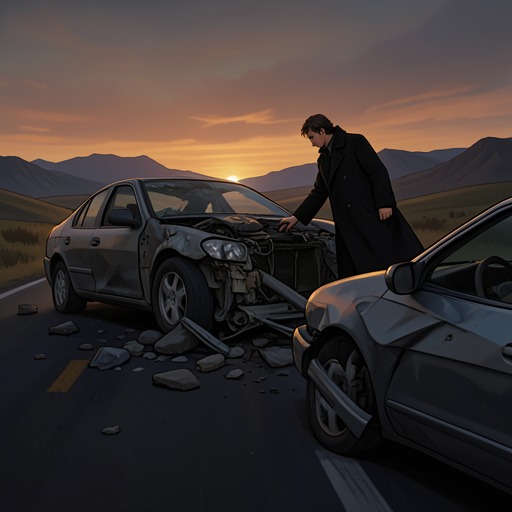
Morning Glory's hit on the woman at the intersection
Bullet TrainMorning Glory's hit on the woman at the intersection exposes the violence behind the Pusher's reputation: what others might dismiss as a made-up story is, in this case, a deliberate killing. When a woman approaches Morning Glory for a job and probes him about the Pusher, he turns her questions into a reason to push her into the path of traffic. The scene's grimest measure of his detachment comes afterward: he regrets only that he did it for no fee.
The Pusher and the kamaitachi
A woman seeking to hire him compares the Pusher to the kamaitachi, a weasel spirit from stories blamed for sudden cuts. She proposes that people may likewise invent the Pusher to explain why someone is hit by a car or jumps in front of a train. The comparison tests whether the Pusher is a real agent or merely a convenient tale for events people cannot explain.
Morning Glory rejects her distinction between an actual cause and a story. He tells her that the kamaitachi's cuts do not come from the wind, and that blaming the wind is itself the made-up explanation. His answer makes the analogy threatening: behind an apparently mysterious injury, there may be a human actor. The conversation gives the Pusher's name a more concrete and sinister meaning without establishing that every incident attributed to him has the same cause.
Questions become a target
The woman could have left after Morning Glory answered her, but instead she presses him with further questions, digging for scraps about the Pusher. Morning Glory decides that he dislikes her, refuses the job, and walks away. Her persistence does not lead to a fuller account of the Pusher; it brings her within reach of the very violence her questions circle around.
The killing at the crossing
Morning Glory pushes the woman into the road at night, just as the traffic light is about to turn red. A pickup truck barrels through the intersection and smashes into her. The timing places the attack at the threshold between the walk signal and traffic's right of way: rather than simply answering her questions or ending the encounter, Morning Glory uses the crossing and an approaching vehicle to make the killing happen.
The aftermath supplies the scene's starkest evidence of his priorities. Morning Glory's only regret is that he performed the act for no fee. The episode therefore connects the Pusher's aura of rumor to paid violence, while showing how easily a story about an unseen force can obscure a person who deliberately causes harm.