Nanao
Bullet TrainNanao is a hired bag-retriever aboard the Hayate–Komachi Shinkansen, but his defining predicament is not simply the danger of the job: he has come to regard misfortune as a force that repeats without end. That conviction turns each complication into proof of an accumulating pattern. On the train, his preparations and evasions give him ways to keep moving, while encounters with Tangerine, Lemon, the Prince, and a vulnerable child expose the limits of treating every crisis as one more inevitable disaster.
Identity and the Pattern of Bad Luck
Nanao understands his life through recurrence. Five years before the train journey, his first job became far more dangerous than he had expected. He remembers thinking that if a misfortune happened once, it might happen again; his second job, then his third, also became disasters. He now extends the thought into an almost inescapable rule: one occurrence may lead to another, as if a domino effect had begun. The pattern is not presented as a supernatural fact. It is Nanao’s way of interpreting experience, and it helps explain why he expects trouble even when a task initially appears manageable.
That expectation shapes his practical habits. Nanao believes a man without the favor of Lady Luck must be prepared, so he carries a bag of tricks. Preparation is his answer to uncertainty, though it does not make him feel secure. Before he has even recovered the assigned bag, the short interval before the next stop weighs on him; later, the train journey brings him into contact with dangers his preparations cannot fully control. His self-image thus joins competence to pessimism: he plans because he expects things to go wrong, and each new setback seems to confirm the expectation.
Maria’s Assignment on the Train
Maria is Nanao’s contact for the job. At the platform, he waits for her call as the Morioka-bound Hayate–Komachi Shinkansen approaches track 20. The station announcement makes it difficult for him to hear her, an early interruption that places the assignment amid the ordinary noise and movement of railway travel. As the train arrives, passengers stream off, the waiting lines break apart, and then reform without anyone giving a signal. Nanao notices that he, too, falls back into the pattern. The episode briefly sets his personal sense of recurring disorder against the automatic routines of the station.
Once aboard, Nanao sits at the end of car four and watches his phone. He expects to reach Ueno Station only minutes after leaving Tokyo Station, leaving little time to take the bag. Maria has told him that its owner is in car three, a proximity he dislikes; since the whole train feels too close, he decides to remain in his assigned seat rather than improvise a different place to wait. His concern is practical as well as personal: the schedule gives him a narrow window, and the person whose property he is meant to take is nearby.
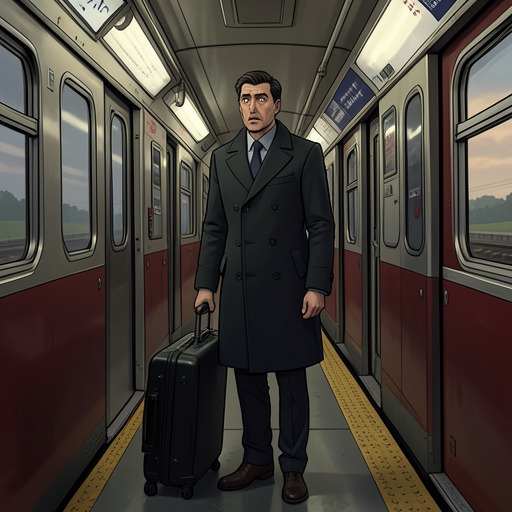
With five minutes until Ueno, Nanao finds the luggage storage and locates the black, mid-sized, hard-sided suitcase without difficulty. It has wheels and a sticker by the handle. He removes it quietly, checks the time, and returns to car four at an even pace, with four minutes remaining before arrival. No one appears to pay attention to him. The sequence gives the job a brief appearance of simplicity, but Nanao’s own unease and the tight timetable make that success provisional rather than reassuring.
Encounters, Evasion, and Mounting Danger
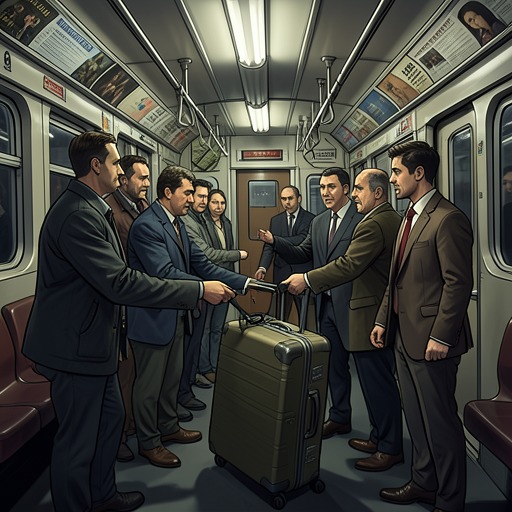
The train’s confined spaces bring Nanao close to people whose interests intersect with the missing bag and with one another. When the train stops, Tangerine and Lemon step onto the platform and watch along its length for anyone getting off. Their careful surveillance makes each doorway and brief stop consequential: someone leaving the train might be noticed, and Nanao’s movements take place within the field of attention they are trying to maintain.
Nanao responds to pursuit by trying to slow it. He considers whether Tangerine will investigate a distraction, but does not know whether it will work or what Tangerine might do. He sets out to create as many diversions as possible because even a delay could improve his chance of survival. This is an extension of his usual reliance on preparation, now adapted to a moving contest: he cannot guarantee an escape, but he can try to complicate the pursuer’s decisions.
His exchanges with the other passengers also reveal how little control he has over the identities and motives around him. When Nanao suggests that the Hornet may have killed Minegishi’s son, he points to a man and asks whether the man is the Hornet. The question records suspicion, not confirmation. Elsewhere, Nanao is unexpectedly described as Ladybug, a name used in exchanges that associate him with both Tangerine and the Prince. The Prince later speculates that Nanao may work in the same line as Tangerine and Lemon, helping other people commit crimes. That is the Prince’s inference, not an established account of Nanao’s occupation beyond the assignment Maria gives him.
Danger becomes immediate when Nanao tries to push himself up and finds a needle lodged in his hand. The needle had bent against a door, leaving its point curved; he realizes that it is poisoned. The incident turns an overlooked object into a threat and underscores how a small, unintended contact can defeat the control his planning is meant to provide. The evidence establishes his realization of the danger, but does not specify the eventual medical consequences.
The Past Returns
In a conversation with another man, Nanao says that he was kidnapped when he was eight. The statement introduces a childhood experience that later becomes more than a piece of personal history. When a child calls out for help, the child’s defenseless expression and voice prompt Nanao to act. He sees in that plea the kidnapped boy he had abandoned long ago. The remembered event therefore gives the present encounter its force: the child’s appeal recalls not an abstract fear but Nanao’s own unresolved memory of having left a vulnerable child behind.
The book does not, in these moments, turn that memory into a complete account of the kidnapping or spell out every circumstance of Nanao’s earlier decision. It does show the past returning through recognition and prompting immediate action in the present. Against his repeated expectation that events will only go wrong again, this response marks a different possibility: the memory still hurts, but it can also move him to intervene rather than repeat his earlier abandonment.
Relationships and the Unfinished Journey
Maria connects Nanao to the assignment and remains a continuing presence through their calls. When his phone rings with her number, he feels both relief and irritation: the call interrupts an unusual conversation, but it also reconnects him to the person who sent him into the job. His work relationship with her is practical, yet her instructions determine where he sits, what he seeks, and how he enters the chain of events aboard the train.
Other passengers frame Nanao in competing ways. Tangerine is someone he tries to delay and evade; with Tangerine, survival depends on anticipating attention and buying time. The Prince, by contrast, watches Nanao’s awkward movements in the gangway with amusement and treats him as a possible criminal facilitator. Nanao also follows Tangerine into the gangway while suggesting that the intended passenger may have got off at Sendai because something urgent arose. These exchanges show him trying to influence what others believe even when he cannot establish what has happened.
The train continues toward Morioka, and an announcement says it will arrive in five minutes. During this journey, Yuichi Kimura states that he bought all available seats once he knew which train Nanao would take with his son. The statement reveals deliberate preparation by another passenger and further complicates Nanao’s understanding of the people sharing the train. At another point, Nanao stands over a body as the Shinkansen carries it onward; the available account does not identify the body, so the moment cannot by itself establish who has died or what Nanao’s ultimate fate will be.
Narrative Role
Nanao’s story combines a narrowly timed retrieval job with an increasingly crowded pursuit. The train’s seats, luggage racks, gangways, doors, and short station stops impose practical limits on what he can do, while passengers’ movement and attention continually alter the situation. His attempt to take one suitcase thus becomes a test of improvisation among people watching, pursuing, or misreading one another.
His recurring bad-luck belief supplies the journey with a pattern of expectation: every complication appears to belong to a sequence that will continue indefinitely. Yet the childhood memory introduces a counter-movement. Faced with a child who needs help, Nanao is driven to act by the very past that had been associated with abandonment. The evidence leaves the broader outcome of his journey unresolved, but it makes this response a decisive change in the meaning of his repetition: the past returns, and this time it prompts action.