Nanao Kills Tangerine
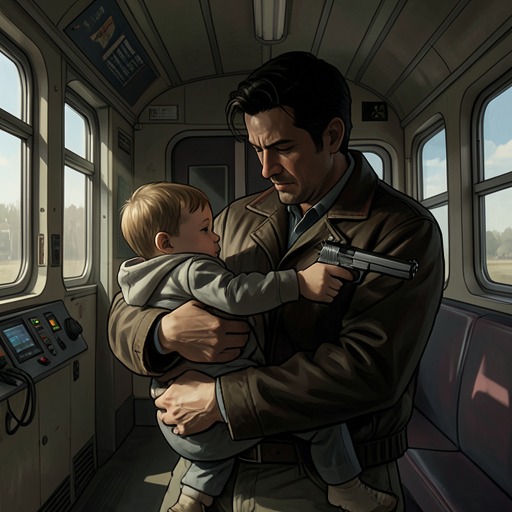
Bullet TrainNanao Kills Tangerine is the sudden reversal in which Nanao intervenes as Tangerine threatens Prince aboard the Shinkansen. The killing turns a moment of apparent danger into an immediate, decisive act of violence, driven not only by the present threat but by Nanao’s memory of a child he once failed to protect.
The Sudden Reversal
Prince has been told that pulling the gun’s trigger would make it explode and injure him, but he believes his luck protects him and no longer fears Tangerine. When a door slides open behind Tangerine, Prince cries out for help, pleading as though Tangerine is about to kill him. Tangerine turns sharply toward the sound and topples over, his gun falling with him. Nanao stands over him; the train carries Tangerine’s body along the floor with a shuddering that resembles a funeral procession, while Nanao stares blankly at his broken-necked corpse.
The Trigger for Intervention
Nanao had gone to retrieve the suitcase from the crew room. When he returned, he found Tangerine pointing a gun at Prince. The threat became personal through the child’s face and voice: Prince’s expression and the catch in his plea for help stirred Nanao into action before he could stop to reason through it.
In that moment, Nanao saw not only the boy before him but the kidnapped child he had abandoned long ago. The memory collapsed into the present; his mind emptied, and his body moved automatically. He seized Tangerine from behind and wrenched his head sideways. The narration describes the response as primal: Nanao sensed that merely attacking Tangerine without finishing him would leave him in danger. The intervention is therefore both an immediate response to Prince’s vulnerability and a violent return of Nanao’s unresolved past.
Afterward, Nanao asks why Tangerine had been trying to shoot Prince. Prince says he does not know, explaining that Tangerine found the bodies in the train toilet and then went out of control. His answer offers Nanao an account of the escalation, but not a complete explanation of Tangerine’s intentions; the scene leaves the killing rooted most firmly in Nanao’s own split-second recognition of a child in danger.
The Aftermath and Its Narrative Weight
The killing ends the immediate danger to Prince, but the scene does not present Nanao as emerging from it with relief or triumph. He has no sighs left; he looks down at Tangerine’s corpse blankly. That stillness sets the force of the act against its aftermath: Nanao has acted with lethal certainty in the instant of danger, yet the narration gives no corresponding release. The gesture has answered the threat, while leaving the memory that helped trigger it unresolved.
The train’s movement makes the death at once intimate and impersonal. Tangerine falls onto the Shinkansen floor, and the carriage bears his body onward with a judder likened to a funeral procession. Nanao stands above the corpse, a witness to the consequence of his own reflex. The image turns the train into more than a setting for the killing: its forward motion carries the dead away even as Nanao remains fixed over what he has done.
Delayed Identification
The scene withholds Nanao’s identity at the instant he enters: first, the door slides open and only “someone” steps through. The narration then stays with the rapid consequence—the sharp turn, the fall, the dropped gun—before naming Nanao above Tangerine’s body. That brief delay makes the intervention register first as a sudden interruption of Prince’s danger and only afterward as Nanao’s act. The sequence gives the killing its abruptness without obscuring its cause: the figure who arrives unseen is the person whose memory of an abandoned child has already prepared him to respond.