Nanao's Hidden Suitcase Disappears Aboard the Shinkansen
Bullet TrainNanao's Hidden Suitcase Disappears Aboard the Shinkansen is the turning point at which Nanao's carefully concealed Black Suitcase becomes a liability: he cannot retrieve it, cannot safely leave the train, and does not know who has taken it. The disappearance converts a hidden object into an urgent problem of timing and trust. Nanao's fear that the job will go wrong is no longer merely a private worry; when the train reaches Omiya Station, he must choose where the search can still succeed.
Causes and Background
Nanao returns to the first row of car four, having learned from Maria that the bag's owner is in car three. He dislikes being so close, but the whole train feels too close, and sitting in his assigned seat seems the simplest course. He thinks of Tangerine and Lemon and wonders whether they are searching for the bag. The thought of their coldness and violence makes the confined train seem more threatening, while the go-between's warning about them gives that fear a source beyond his own imagination.
Nanao considers moving the suitcase nearer to himself, to the trash-receptacle panel in the gangway between cars four and three. He rejects the idea because someone could notice him moving it. Leaving the bag where it is seems safer than drawing attention to it. Yet his effort to reassure himself that everything will work out is undercut by the counterthought that his plans are always disrupted by unforeseen turns, a pattern he connects to his childhood kidnapping on the way home from junior school. His anxiety is therefore tied both to the immediate risk of the suitcase and to a history that has taught him to expect events to escape his control.
The suitcase's concealment depends on the train's interior being more than it appears. The Prince tells Kimura that the trash bin is set into a wall panel that opens, a feature Kimura had not known about. When Kimura points out that carrying a suitcase near their seats would attract notice, the Prince agrees that there is no useful place to hide it there. The secret compartment offers concealment, but it also makes the bag vulnerable to anyone who knows how the panel works and where to look.
The Hidden Compartment and the Disappearance
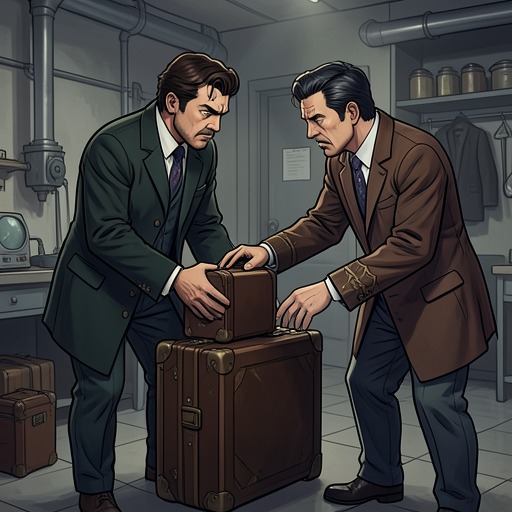
The Prince takes Kimura to a gangway farther back and shows him the round protrusion on the wall. At the Prince's direction, Kimura pushes it, pulls, and twists. The panel swings open, revealing the Black Suitcase on the top shelf. Kimura is surprised by the compartment and reaches inside to lift out the bag; the Prince closes the panel neatly afterward. This recovery makes clear that the suitcase has not simply been misplaced: the hidden storage Nanao relied on has been located, and the Prince and Kimura now have the bag in hand.
The Prince also turns the search into a psychological taunt. Near the toilet door, he knocks once and tells the unseen searcher that the bag had been there all along and that the searcher had walked past it. The remark frames the missing suitcase as a test Nanao has already failed, although the account does not establish whether the Prince's statement is a literal description of where the bag was or a deliberate provocation. Its placement beside the approach of Omiya sharpens the pressure: Nanao is running out of time to decide whether to leave the train.
When Nanao speaks with Maria, he reports that the bag is gone and that he could not get off. Maria asks whether he had hidden it; Nanao confirms that he had, but says it has now disappeared. The exchange establishes the immediate reversal plainly. His concealment had been meant to preserve the job and keep the suitcase from notice; instead, the missing bag prevents him from completing the planned exit at Omiya Station.
The Choice at Omiya Station
Maria reasons through the problem rather than treating the loss as an isolated mishap. If someone took the suitcase, that person may still be aboard or may have left at Omiya Station. Nanao had faced the same two possibilities as the train arrived and had to choose between getting off to search and staying aboard to look for the bag. Neither option offered certainty, and the decision had to be made before he knew which possibility was true.
Nanao stays on the Shinkansen because the train gives him a better, if still limited, chance of recovering the suitcase. If the thief has left, the person could board another train or disappear into the streets, leaving Nanao with little chance of finding them. If the thief remains aboard, however, the train temporarily restricts their ability to get away. Nanao can search through the carriages and may be able to catch them. This calculation does not make the choice safe; it only makes remaining aboard the option with slightly better odds.
Practical self-preservation is not his only consideration. Remaining on the train also lets Nanao claim that he is still working on the assignment if Minegishi checks in. Maria could say that Nanao is aboard and still trying to recover the suitcase. He hopes this will protect his position, but his reasoning exposes how narrow that protection is: he is trying to preserve the appearance of progress at the same time as he confronts the possibility that the job has already escaped his control.
Nanao does briefly step onto the platform to look for anyone running off with the bag. He is prepared to chase a likely suspect, but the length of the train and the curve of the platform prevent him from seeing all the way to the front. He swivels his head back and forth, watching as best he can, then remains aboard. The gesture shows that staying on the train is not passive resignation; he tests the alternative, finds his view inadequate, and returns to the search that still seems possible.
Consequences and Narrative Significance
The disappearance changes the suitcase from a concealed object into the center of competing searches. Nanao's original concern was that moving it might expose him. Now the hidden compartment has been opened by the Prince and Kimura, while Nanao is still trying to work out whether the person who took it is aboard or has escaped at Omiya Station. The train's narrow, connected spaces make concealment and pursuit part of the same problem: a wall can hide a suitcase, but the person who knows its mechanism can turn that hiding place into a point of access.
The episode also gives concrete form to Nanao's conviction that his life is governed by bad luck. He anticipates unforeseen complications even while trying to reassure himself, and the disappearance immediately turns his planned exit into a forced decision under uncertainty. Yet he does not simply surrender to that expectation. He weighs the routes, makes a choice based on the relative chance of recovering the bag, and scans the platform before committing to remain. The result is an unresolved pursuit: the suitcase is missing from Nanao's control, the identity and location of its taker remain uncertain to him, and the train carries him onward with the search still open.