Nanao's childhood kidnapping and escape
Bullet TrainNanao's childhood kidnapping and escape begin with a mistake: abductors took him for a wealthy schoolfriend because Nanao was carrying the friend's distinctive bag. The ransom plan collapsed when the friend's parents did not believe their son was missing, and Nanao's own father could not pay. Nanao eventually escaped at eight, but the freedom he won for himself was shadowed by the boy he left behind. Recalled years later, the episode joins resourcefulness to guilt and helps explain why Nanao describes his life as a run of mishaps.
Mistaken identity and captivity
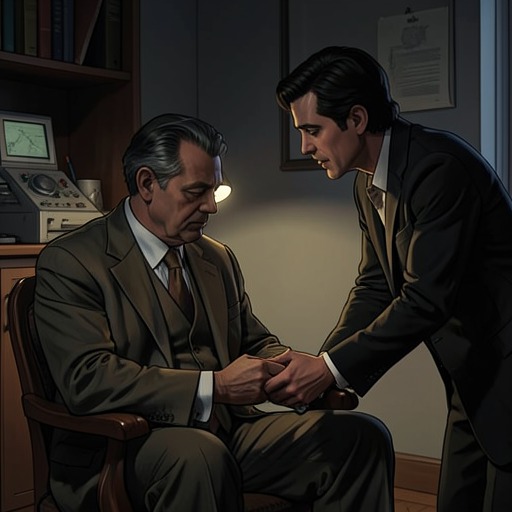
Nanao recounts the abduction while speaking with an unfamiliar man in a suit. He had been walking home with a rich friend and lost at rock-paper-scissors, so he had to carry the friend's bag. The bag was unlike those of the other children: it was custom-made for wealthy people. The kidnappers saw the distinctive luggage and took its carrier, not the friend they intended to seize. Nanao kept telling them they had the wrong boy, but they did not believe him.
The mistake became clear only after the kidnappers demanded ransom from the friend's parents. Their son was safe at home with them, so they did not take the demand seriously. The abductors became furious and treated Nanao with increasing cruelty. Eventually, they listened to his repeated insistence that they had the wrong child. They then contacted his parents, reasoning that some payment would be better than none. The change of target did not make Nanao safe: it only shifted the demand to a family without the means to meet it.
His father's refusal and the escape
Nanao remembers his father's response as a plain statement of what was possible: “A man cannot give what he hasn’t got.” The kidnappers told his father that he was a terrible parent, but Nanao understood the logic behind the refusal. His father may have wanted to rescue his son, yet he did not have the money. In Nanao's account, that realization marks the point at which he concluded that he would have to save himself.
He escaped alone. The memory comes back in concrete, linked impressions: the kidnappers' carelessness, his own youthful energy and determination, a railway crossing arm lowering at the right moment, and a bus arriving. He remembers relief as the bus pulled away, immediately accompanied by fear that he had no money for the fare. The danger and uncertainty did not erase the achievement. Nanao was eight, and he was proud that he had got out by himself. He later identifies the escape as the moment he learned he could do things on his own.
The boy left behind
Nanao's recollection does not end with his escape. Another boy, unfamiliar to him and identifiable by his buzz cut, was being held in the same place. Nanao describes the place as “some sort of storehouse for kidnapped children,” but he never knew the other child's name or any other details about him. As Nanao prepared to leave, the boy pleaded, “Help me.” Nanao did not help him escape.
The omission remains the memory's unresolved center. Asked why he left the boy, Nanao cannot supply a reason: he does not remember deciding that the other child would slow him down, and thinks he may simply have acted on instinct without considering the choice. He also does not know what happened to the boy. He calls him his personal trauma and says he does not want to think about him. In the memory, the successful escape therefore carries a cost that Nanao cannot settle with the fact of his survival: he got himself out, but cannot say what became of the child who asked him for help.
The memory's return
The recollection surfaces as Nanao speaks unusually freely to the stranger. He describes memories as doors in a mental storage cabinet, swinging open and shutting; childhood scenes appear dusty but still vivid and immediate. After the other boy comes to mind, Nanao recognizes that he has opened a memory he would rather have kept closed. He tries to shut it away, wishing he could lock it and throw away the key. The cabinet image gives the episode a double shape: the escape is a story Nanao can tell, while the abandoned boy remains a part of it he cannot explain or resolve.
Nanao also connects the kidnapping to his sense that his life has been one mishap after another. As an example, he recalls failing his high-school entrance exam despite studying hard because the child sitting beside him kept sneezing. He presents the exam failure as another instance of bad luck, not as a proven consequence of the abduction. The connection is in the way he narrates his life: escape taught him self-reliance, while the surrounding memories encourage him to see misfortune as a recurring pattern.
Later echoes
Years afterward, Nanao's work on a Shinkansen provides a contrast to the childhood escape without establishing that one directly caused the other. At Tokyo Station he watches the crowd reorganize itself into boarding lines without anyone speaking, and recognizes that he is doing the same. On the train, he worries about the narrow window for stealing a suitcase before Ueno Station. He finds the wheeled black case in the luggage storage with four minutes to arrival and carries it back through the cars, hoping to avoid any encounter that might complicate the task. The adult Nanao is still alert to mishap and friction; unlike the child in captivity, however, he is acting within a job whose risks he has chosen to take.
The episode thus gives Nanao's self-reliance a specific origin without turning his survival into a simple victory. His father could not buy his release, and Nanao found a way out alone; yet another child's unanswered plea persists beside that success. The story's lasting force lies in that imbalance: the escape establishes what Nanao could do for himself, but leaves him with a trauma whose central question he cannot answer.