Nanao’s bad luck
Bullet TrainNanao’s bad luck is the name he gives to a recurring run of danger and mishap that turns an ordinary train journey into something he expects to go wrong. It is more than a passing complaint: the belief governs his choices, from discarding potentially useful objects to resisting a frightened child’s appeal for help. As disasters accumulate aboard the Shinkansen, the story lets Nanao treat misfortune as both a personal burden and a force that may affect those around him, without establishing that his luck has a supernatural cause.
A Journey Recast as Misfortune
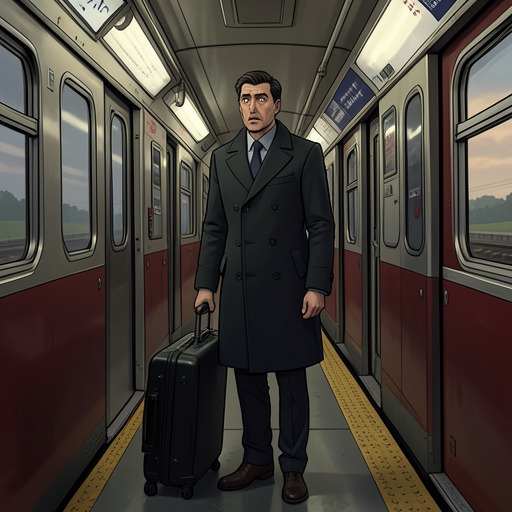
After finding bodies in a train toilet, Nanao stops trying to determine who killed whom. His attention shifts from solving the immediate mystery to escaping the train. He imagines the Shinkansen itself as misfortune hurtling north at 250 kilometres an hour, with himself trapped aboard. In that image, the train is no longer simply transport: its speed and direction become part of the oppressive momentum of the events surrounding him.
Nanao throws away the gun Tangerine has dropped, then discards Tangerine’s phone as well. A schoolkid suggests that keeping the weapon might make them safer, but Nanao believes possession of dangerous objects will only bring more trouble. The decision expresses his practical caution and his fatalism at once. He wants to reduce his exposure to danger, but he also treats avoiding contact with it as the wisest response to a run of events he does not believe he can control.
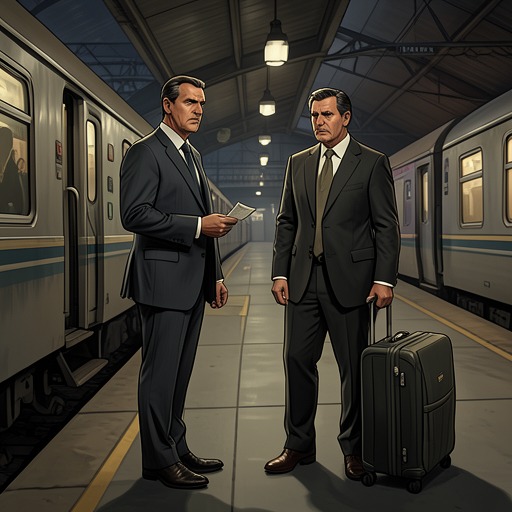
His immediate objective is to get off with the suitcase. With Tangerine and Lemon gone, Nanao cannot predict what Minegishi will do, but reasons that Minegishi’s anger would probably have fallen on the two men rather than on him. The original job was to steal the bag and leave the Shinkansen; disembarking at Ichinoseki Station with it seems likely to earn him a low A, even if not a perfect score. His qualification that this is what he wants to think reveals how uncertain that reassuring calculation is.
The Choice to Stay
As the train approaches Ichinoseki Station, the schoolkid asks Nanao to remain with him until Morioka because he is scared. Nanao wants no further entanglements and can imagine several things going wrong if he continues north. His hesitation turns the idea of bad luck into a pressure on his decisions: leaving seems safest for him, while staying means accepting an uncertain responsibility.
The child then says that a little boy will be in danger if he does not reach Morioka. Nanao’s attempt to shut out the appeal gives way to a question about what the child means. The exchange marks a limit to his wish to escape. His fear of becoming involved remains, but the possibility that someone else may be endangered makes departure harder to treat as a simple solution. Later, after leaving Sendai, Nanao sits with the Prince and Suzuki in a nearly empty train car. The Prince presents himself as too frightened to be alone, and the adults believe him; the scene places Nanao once more beside someone seeking company rather than safely apart from other people’s troubles.
Mishaps and Self-Assessment
When the Prince asks why he looks glum, Nanao says that, compared with his usual bad luck, what has happened is not so bad. The comparison is an attempt at consolation, not evidence that he feels secure. The narration presents a sadness in his tone and suggests that he is trying to convince himself. The Prince, unable to understand what it is like to be unlucky, cannot find an appropriate response. Their difference makes Nanao’s self-description feel isolating: his supposed familiarity with misfortune offers no easy language for sharing it.
A later incident gives the idea of recurrence a concrete, absurd form. Nanao discovers a snake on his arm and insists that it was not there before, while also fearing that it would appear again. When it tightens around him, he panics, strikes it against the sink, and removes it. He then carries the dazed snake to a rubbish bin and discards it, still afraid that something else might emerge. The snake’s unexpected appearance supports Nanao’s sense that trouble can return at exactly the wrong moment, though the episode does not prove that a curse is responsible.
As the train slows toward Morioka, Nanao feels relief that the journey is nearly over, then fears that he will somehow be unable to get off. He tries to return to car eight for the suitcase, but passengers block the doorway. He wonders what has happened to the couple and whether the child is all right, yet the snake has left him too shaken to engage with what is happening there. When the train’s final shaking throws him to his knees, his response is exhaustion and surrender. The chain of small obstacles matters as much as the dramatic danger: even the approach to an exit becomes another occasion on which his expectations of failure seem confirmed.
Burden, Luck, and Interpretation
Nanao’s responses do not settle whether he is objectively more unlucky than anyone else. At one point he decides that an incident was not such a big deal by his usual standards; at another, he interprets the snake as a feared recurrence. Together, these reactions show how the belief supplies a scale for measuring events. It can make an ordeal seem comparatively manageable, but it also leads him to anticipate new trouble before it arrives.
Maria offers a different explanation. She suggests that Nanao may be carrying everyone else’s bad luck for them, and when he asks whether that would account for his own misfortunes, she says that otherwise he would not be so unlucky and that he is probably helping others. Nanao cannot tell whether she means this as praise or mockery, so he says nothing. Immediately afterward, a crash sounds behind them. Nanao turns and sees men in black suits trying to support Minegishi, who has fallen where he had been standing. The sequence gives Maria’s speculation a striking narrative echo, but it does not establish that Nanao caused, absorbed, or predicted Minegishi’s collapse. His bad luck remains at once a personal explanation, a recurring motif, and an unresolved possibility that his misfortunes may be entangled with other people’s.