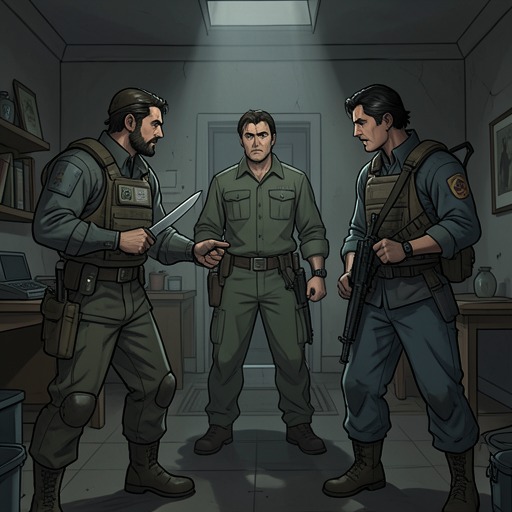
Nanao's fight with Lemon
Bullet TrainNanao’s fight with Lemon is a struggle over more than the missing suitcase: Nanao needs time to explain that he and Lemon work for the same client, while Lemon sees the theft as grounds to capture him. Their confrontation unfolds in a crowded Shinkansen carriage, where the need to avoid notice limits both men’s movements. Nanao finally turns Lemon’s momentary distraction into an opening, knocks him unconscious, and takes his gun and phone before choosing a route away from Tangerine.
Causes and Competing Aims
Before the fight, Nanao has pieced together that Minegishi hired both him and Tangerine and Lemon in connection with the same suitcase. He hopes this shared employment might make cooperation possible, despite having stolen the case from the pair. His proposal is not an attempt to deny what he has done: he intends to tell Lemon the situation and suggest that their common goal could take precedence over the theft between them. He also believes that avoiding a public commotion matters, since police or reporters could expose his failure to Minegishi and cost him time to recover the bag.
That plan depends on reaching Lemon before Lemon can act against him. Nanao closes a train catalogue, puts it back in the seat pocket, steadies himself, and stands, intending to take Lemon by surprise and then explain. Instead, Lemon is already there, in the aisle beside Nanao’s seat, blocking the way. His friendly manner briefly jars with his position, but he immediately throws a punch. Nanao’s attempt to begin with a conversation is overtaken by the need to defend himself.
The Fight in the Carriage
Nanao ducks the first attack, then catches Lemon’s wrist and turns his arm behind his back. He keeps the struggle controlled because he does not want to attract the attention of the other passengers. Lemon likewise appears reluctant to cause a scene: he makes his hand tremble as if in a spasm, disrupting Nanao’s hold without openly escalating the confrontation. Nanao glances around and notices a toddler standing on a seat and watching them. The presence of an observant passenger sharpens the practical constraint already governing the encounter: a visible struggle may bring attention neither man wants.
Nanao uses an elbow to disturb Lemon’s balance and moves back into the window seat. Lemon sits in the aisle seat, and they trade punches across the empty middle seat. Its reclined position obstructs a clean line of attack, forcing both men to work around the carriage’s furniture rather than fight freely. The awkward seated exchange is an improvised contest, shaped by the cramped space and the need to keep the disturbance contained.
When Lemon attacks with an uppercut, Nanao brings down the raised armrest, making it an obstacle between them. Lemon’s fist strikes the armrest instead of reaching Nanao. The brief advantage does not settle the fight: Nanao sees that Lemon has a small knife in his other hand. He takes a magazine from the seat-back pocket and opens it in the knife’s path, using the pages as a makeshift barrier. The blade cuts through photographs of rice paddies, but Lemon pulls it free before Nanao can wrap the magazine around it.
Lemon attacks with the knife again. Nanao tries the same defense, mistimes it, and is cut on the left arm. He immediately grabs the knife hand, draws it toward himself, and strikes it with his free elbow; Lemon drops the knife. Nanao then attempts to disable him by reaching toward his eyes, but Lemon turns away at the last moment. As Nanao prepares to try again, Lemon reaches inside his jacket. Nanao’s brief blink gives Lemon time to produce a gun and aim it at him. Lemon says that he had not wanted to use it but had run out of alternatives, accepting that gunfire would draw attention as the price of continuing the fight.
Reversal and Aftermath
The gun shifts the immediate balance of power, but Nanao notices another Shinkansen passing in the opposite direction. He mentions it without intending to distract Lemon. Lemon nevertheless turns to look, responding with interest rather than suspicion. Nanao acts at once: he forces the gun hand down and strikes Lemon’s chin. The blow knocks Lemon unconscious, ending the immediate threat and reversing the advantage the gun had given him.
Nanao moves Lemon into the window seat and considers whether to kill him, but decides against it. He fears that killing again after the Wolf would carry too great a risk, and expects that Tangerine would respond with anger. More broadly, Nanao still does not want to turn the two men into enemies if he can avoid it. His restraint is therefore both a practical calculation and a limit on how far he is willing to escalate the encounter.
Nanao takes Lemon’s gun and secures it under his jacket, then takes Lemon’s phone. He considers taking the knife from the floor but leaves it behind. With Lemon unconscious, the immediate contest is over, but Nanao’s larger problem remains: Tangerine is likely to arrive soon, and the suitcase is still missing. Nanao reasons that he cannot go toward the front of the train, where Tangerine is coming from, and chooses the rear instead. The fight thus ends not with a resolution of their shared assignment, but with Nanao gaining equipment and a short-lived chance to escape or regroup.
Significance
The encounter turns on the gap between Nanao’s intended negotiation and the situation Lemon imposes. Nanao initially approaches him as a possible partner in finding the suitcase; the theft makes that possibility fragile, and Lemon’s decision to attack replaces discussion with an immediate test of survival. Yet the fight does not erase the common interest Nanao identified. Even after incapacitating Lemon, Nanao avoids killing him and avoids taking the knife, choices consistent with his hope of limiting further hostility rather than making reconciliation impossible.
The carriage’s ordinary details repeatedly shape the action: the seat pocket supplies the magazine, the armrest interrupts a strike, the empty middle seat constrains their punches, and the passing train creates an accidental opening. These objects and circumstances do not simply frame the conflict; they determine what each man can do. Nanao wins not through an uninterrupted plan but by adapting to the confined setting and noticing Lemon’s unguarded reaction. His victory remains temporary, because Tangerine is still nearby and the missing suitcase continues to govern what happens next.