Nanao's recurring misfortune
Bullet TrainNanao’s recurring misfortune is not one catastrophe but a steadily accumulating pattern of ordinary setbacks, from sold-out shoes and slow queues to a ruined exam and a suitcase job that will not stay simple. He reads these incidents as evidence that bad luck has followed him throughout his life; Maria, who has watched trouble recur during their work together, recognizes the pattern even as she tries to keep him calm. The tension between his determination to do things properly and his expectation that circumstances will undo him gives the pattern its force.
A pattern of ordinary reversals
Nanao describes his bad luck as low-grade and familiar. Shoes are sold out whenever he looks for his size in the color he likes, and the line he chooses at a cash register moves more slowly than the one beside it. Even a courteous gesture can become a mishap: after letting an elderly person onto a lift first, he steps in and sets off the overweight alarm. These examples make his complaint cumulative. None is a disaster by itself; their repetition turns minor inconvenience into a forecast he carries into each new situation.
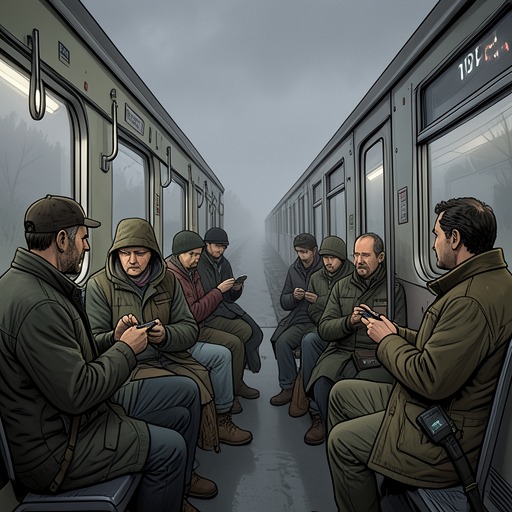
Aboard the train, the pattern continues in miniature. The snack trolley has run out of orange juice, so Nanao buys sparkling water instead. When he gulps it, its sharp fizz catches in his throat and sends him swallowing the wrong way. The moment is small, but it belongs to the same logic as the queue and the lift: even a routine choice seems to acquire an awkward consequence. The book presents these incidents as Nanao’s experience of chance, not as proof that an outside force literally controls events.
Childhood and the origin of his account
Nanao connects his belief in bad luck to a childhood kidnapping. The kidnappers were never caught, and his father did not report the incident to the police, judging that a report would cause more trouble than it was worth. Nanao says he did not particularly care about the lack of a report; what mattered to him was that he escaped. He remembers taking pride in that escape because it taught him he could do things for himself. The memory therefore contains more than helplessness: alongside the trauma he would rather not revisit is an early sense of his own capacity.
His next example is the high-school entrance examination, for which he studied hard because his family could not afford school fees and he needed a high enough score to win a scholarship. A student beside him sneezed, sending a large glob of mucus onto Nanao’s answer sheet. When he tried to wipe it away, he smeared the answers he had worked to complete; even his name became illegible. His parents were not especially angry or distraught, but the practical consequence was severe: an accident unrelated to his preparation jeopardized the result he needed. Maria responds that he really does have bad luck. Nanao frames the exam as a particularly vivid instance of the same pattern, invoking Murphy’s Law as a description of his life.
The pattern at work with Maria
Maria’s view of Nanao’s misfortune is bound up with her experience of working alongside him. She has advised him to relax when he becomes jumpy, suggesting tea, deep breaths, or tracing Chinese characters on his palm. Nanao rejects the idea that his unease comes simply from a nervous nature or from getting stuck in his own thoughts: he insists that it comes from experience, because he has had rotten luck his whole life. Their disagreement is not over whether things go wrong, but over whether his vigilance can be eased. For Nanao, expecting trouble is an answer to what has repeatedly happened; for Maria, his readiness to anticipate it can itself make him seem jumpy and paranoid.
During the suitcase job, Nanao initially takes heart from the possibility that the person who passed Maria information about the bag is still aboard the train and might be on his side. Maria cautions that the informant’s task may have been limited to confirming the bag’s location and calling her, and that the person probably got off at Ueno. Nanao nevertheless says he intends to do the job right. He sees himself as someone who keeps moving forward, does not complain about his parents’ poverty, and persists despite setbacks. That self-assessment sits beside his insistence that he is unlucky: he does not treat misfortune as an excuse to stop trying.
The suitcase, expectation, and escalation
Nanao hides the bag and expects to get off at Omiya Station, meet Maria, and finish a job he had thought would be simple. He believes that once he has left the train, Minegishi will have no reason to be angry. But the bag is missing, and Nanao does not get off at Omiya Station. Rather than abandon the chance of recovering it, he decides that staying aboard gives him a better opportunity. His intended ending to the job—one stop, one handoff, and then relief—has already been displaced by a new problem.
Nanao’s explanation for the missing bag is that Tangerine and Lemon took it back after he stole it from them. He calls this the likeliest account and hopes no third party is involved, because that would make matters more complicated. The hope immediately exposes the trap in his outlook: he expects what he fears to happen, and Maria knows how readily complications gather around him. She tells him that even a job which seems impossible to mess up can go wrong, or that some other terrible thing can happen even if the job itself succeeds. Nanao points out that she still calls the jobs simple. Her answer is that the job may indeed be simple; trouble, in her view, follows him around.
Meaning and limits of the bad-luck story
The pattern gives Nanao a way to organize experiences that otherwise seem unrelated: a sneeze, a queue, a lift alarm, a missing suitcase. He moves from particular accidents to a general rule about his life, and Maria’s accumulated observations give that rule a second voice. Yet the story also shows Nanao responding actively to circumstances. He studies for the exam, escapes his kidnappers, persists at his work, hides the bag, and chooses to remain aboard when recovering it seems more likely there. His misfortune describes the resistance he meets, not an absence of effort.
That distinction makes the recurring pattern both comic and unsettling. The cash-register example and the lift alarm are almost harmless; the smeared examination threatens a scholarship, while the missing suitcase turns a supposedly straightforward job into an uncertain pursuit. Each new scale gives Maria grounds for her rueful prediction that something else may go wrong. Nanao’s bad luck is therefore less a single explanation than a repeated collision between his practical intentions and outcomes he cannot control. He keeps trying to do the job right, even as the history he has built from past mishaps teaches him to expect that doing so may not be enough.