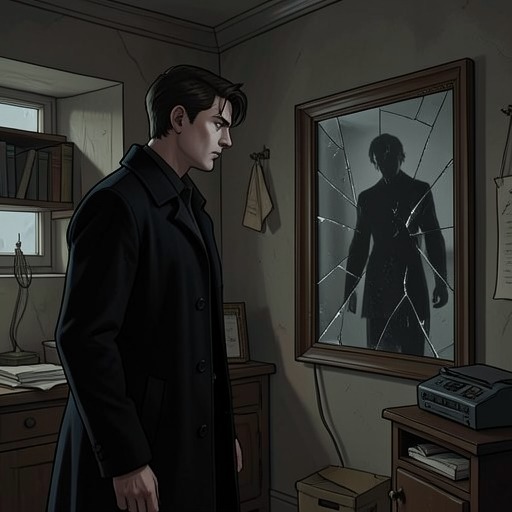
Nanao's self-attributed bad luck
Bullet TrainNanao’s self-attributed bad luck is the explanation he repeatedly reaches for when events go wrong or take an unlikely turn. It shapes how he interprets danger aboard the Shinkansen, where he is already trying to evade Tangerine, but the incidents do not all have the same cause: some are coincidences, while others follow from Nanao’s own actions. That gap between a sense of being cursed and the concrete chain of events gives the belief its comic edge without making its consequences feel harmless to him.
A mishap in the luggage area
Searching for something useful as he moves between cars, Nanao finds a transparent case packed inside a box. What first appears to be coiled black rope is a snake. Startled, he falls backward; in the jostling, the lid comes loose, and the snake slips out. Nanao interprets its unexpected presence as another sign of his rotten luck, even imagining the goddess of bad luck as a reptile enthusiast.
The episode also complicates that interpretation. The snake’s escape follows the loose lid, which Nanao notices only after the animal is already moving away. He watches it glide toward the front of the train and feels that he has set something irreversible in motion. Yet Tangerine is pursuing him, so he cannot stop to chase it. He replaces the lid, unwinds the packing string, and abandons the effort to put the incident right in order to continue seeking an escape. His misfortune, in this instance, is not only something that happens to him: it becomes a new worry created by an accident in the course of his own hurried search.
The fall and the dropped phone
Later, while speaking with the man whose attention has turned toward him, Nanao asks why he killed someone. The train then lurches sideways. Nanao braces himself by pressing his forehead against the window, but something wet strikes the glass outside his face. Unable to tell whether it is bird droppings or mud, he is startled, jerks back, and lands hard on his backside. He treats the fall as another appearance of his bad luck, and the immediate consequence is practical as well as emotional: he has dropped his phone.
The coincidence gives the man an opening to connect Nanao’s reputation for terrible luck to the phone and to talk of Murphy’s Law. His interpretation is pointedly more informed than Nanao’s: he observes that Nanao seems to get caught up in trouble whenever he travels on the Shinkansen, except when he is deliberately seeking it. Nanao, frightened by the man’s threatening gaze, asks whether he does dangerous jobs; the man denies it gently. The exchange shows how the language of bad luck can expose Nanao to another person’s scrutiny. What Nanao experiences as a private pattern becomes something another character can notice and use to unsettle him.
A curse turned into an image
In a later conversation, Maria offers another explanation for the suitcase’s return. Perhaps its takers were frightened of Minegishi; perhaps they were frightened of Nanao. She compares him to a magic lamp that absorbs and stores the world’s bad luck, then says she feels everything will be fine. Her image converts Nanao’s self-description into an extravagant joke: he is not merely unlucky, but a container into which misfortune seems to collect.
Maria’s reassurance does not erase the dangers still facing him. Nanao points out that Tangerine and Lemon remain a concern, and she asks whether he has encountered them. The contrast matters: for Maria, the returned bag makes the situation seem to be improving; for Nanao, the continuing pursuit prevents that hopeful reading from settling into certainty. His bad-luck identity can be teased and shared between them, but it does not make the threat disappear.
Murphy’s Law and the open suitcase
The belief reaches its sharpest reversal when Nanao handles the combination lock on a suitcase. He does not think he can guess the code; given his luck, he assumes that trying combinations will not work. Instead, while fumbling with the dials to make his ignorance seem convincing, he hits the correct combination. The lid springs open, spilling women’s underwear from the case.
Nanao turns the outcome into a joke about being lucky, but immediately recognizes that the opening may make him look suspicious, or suggest that the bag is a fake. The exchange around the suitcase thus gives his claim a double meaning: the improbable result is good fortune in the narrow sense that the lock opens, but bad fortune because it may damage the explanation he needs others to believe. The train will not stop before Morioka, and Nanao offers that delay as a temporary reassurance, while admitting to himself that the silver lining is an illusion.
Narrative function
Across these episodes, bad luck is less a proven force than Nanao’s recurring way of making sense of events whose timing seems cruel or absurd. The snake is released during his search for an escape; the fall interrupts an already uneasy encounter and costs him his phone; the lock opens precisely when an open suitcase is inconvenient. Each event invites him to see a pattern, while the circumstances leave room for accident, personal action, and other people’s interpretations.
The motif also shifts with its audience. Nanao privately treats misfortune as something that follows him, Maria recasts it as a comic power to absorb trouble, and the man who examines his story invokes Murphy’s Law to suggest a pattern Nanao cannot easily dismiss. The result is not a settled explanation of why things happen to him. It is a portrait of how he anticipates the next reversal: even a lucky break can arrive in a form that creates another problem.