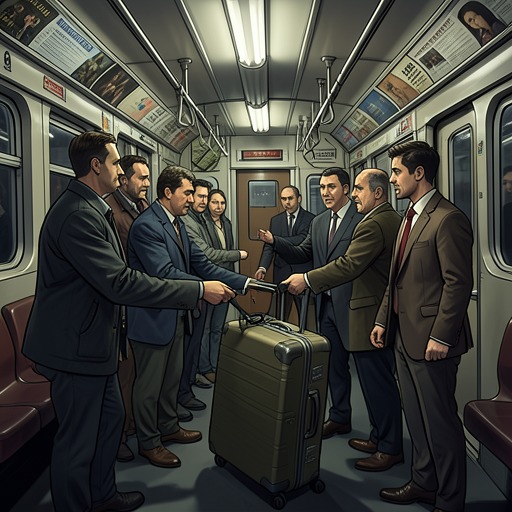
Prince Opens the Suitcase and Takes the Bank Card
Bullet TrainThe Prince’s opening of the suitcase turns a stolen bag into an instrument of leverage: once he learns what it contains, he takes the five debit cards but plans to put the cash-filled case back into circulation. The episode also exposes Kimura’s impulsive response to money and the Prince’s preference for studying how people behave over simply possessing what they want.
The plan and the constrained setting
The suitcase has already become more than cargo. Nanao has retrieved a mid-sized, hard-sided black case with wheels and a sticker by its handle from the Shinkansen’s luggage storage, moving it quietly through the train as Ueno Station approaches. Earlier, at Tokyo Station, passengers had poured off the arriving train and then automatically re-formed orderly boarding lines. Inside the moving train, however, a short interval and a narrow sequence of cars give the people seeking the case little room to act without being seen. The suitcase’s movement among passengers and compartments makes its whereabouts uncertain even as the train carries everyone toward the next stop.
The Prince sees that uncertainty as useful. He first considers the bag something he can conceal and use to influence the people who want it. He also wants to know what is inside, and reasons that a four-digit combination lock can be defeated by trying different combinations. Rather than attempt that himself, he tells Kimura that Kimura will take the suitcase into the bathroom and do the work. Kimura objects to being made to try combinations in a train toilet, but the Prince treats his resistance as another display of how readily the older man loses his composure. The planned opening is thus also an exercise of control: the Prince makes Kimura perform the risky task while he waits to learn what the bag holds.
The lock opens
The lock clicks at 0600, bringing Kimura’s recollection to an end. The Prince’s luck seems to have delivered the combination quickly despite the many possible four-digit codes. Kimura lifts the suitcase onto the toilet and opens it. Inside are neatly stacked sheaves of used, wrinkled 10,000-yen notes. The money is substantial in appearance but does not impress Kimura, who has transported much larger sums in the past.
The cash is not the only contents. Kimura notices several cards held in the suitcase’s webbing and pulls them out: five debit cards, each issued by a different bank, with a PIN written on the back in permanent marker. He reads them as an additional means of payment, a practical supplement to the cash. The discovery changes the value of the bag for the Prince as well. It is not merely a hidden purse of banknotes; the cards offer access to separate accounts, while their written PINs make them immediately usable to whoever possesses them.
Before closing the suitcase, Kimura gives in to a sudden impulse. He peels off one 10,000-yen note, remarks that nobody is likely to miss it, and tears the note into pieces. He has wanted to try destroying money in this way. After closing the bag and moving it off the toilet, he throws the shreds into the bowl and activates the water by waving his hand in front of the sensor. The gesture is private, unnecessary to opening the case, and revealing: faced with a stack of cash, Kimura does not take it for ordinary use but destroys a single note to satisfy a long-held curiosity.
The Prince reads Kimura
When Kimura leaves the bathroom, the Prince is waiting. He asks for the combination, and Kimura wonders how he knew the case had been opened. The Prince reads his agitated expression and points out that he has neither the look of surprise nor the happiness expected of someone newly confronted with a fortune. Kimura confirms that the combination was 0600 and says he has locked the suitcase again. The combination’s successful discovery is therefore followed not by an escape from the situation but by a return to the Prince’s control.
The Prince then takes Kimura back to their seats. There, he makes him sit by the window and re-secures his hands and feet with bands and tape. With Kimura bound, he places the suitcase at his feet and opens it again. The cash does not interest Kimura much; he says the debit cards are the unusual part. The Prince examines the five cards and their four-digit PINs, inferring that the numbers are meant to authorize withdrawals. Kimura considers the inconvenience of having two forms of payment and doubts that a withdrawal would let the bag’s owner track them through the police, since the people involved are not making an ordinary living and likely have arrangements among themselves.
As he thumbs through the banknotes, the Prince guesses that Kimura tore up one of them and flushed it down the toilet. Kimura’s face stiffens; when the Prince presses the point, the blood drains from his face. The Prince’s inference confirms that he has been watching not just the suitcase but Kimura’s character. Kimura begins moving his bound hands and feet, but the opportunity to resist has passed. The ripped note, which Kimura treated as a private experiment, has become evidence the Prince can use to unsettle him.
Taking the cards, returning the case
The Prince dials the lock back to 0600 and opens the suitcase once more. He removes the five debit cards, puts them in his pocket, then closes and locks the case. Kimura taunts him about wanting the money, suggesting that the Prince’s parents must give him little allowance. The Prince ignores the provocation. He says he intends to put the bag back where it was, in the compartment over the garbage bin, or perhaps somewhere easier to find, such as the luggage rack. The evidence establishes this as his stated plan; it does not establish that the return has yet taken place.
His reason is not to restore what was stolen. Having learned what the case contains, he no longer cares about keeping it. He expects that the people who want it will fight over it, and the missing debit cards will create further problems for someone later. He leaves with the locked suitcase, wheeling it behind him, while Kimura remains bound. The apparent prize is divided: the cash stays in the case, but the cards that could unlock access to the bank accounts are now in the Prince’s possession.
The episode’s reversal lies in that selective theft. The Prince first treats the suitcase as leverage because its contents are unknown; once the contents are revealed, he takes what may produce consequences beyond the train and relinquishes his claim to the bag itself. The 0600 combination, Kimura’s destroyed banknote, and the five marked cards each expose a different kind of access: the lock gives entry to the case, Kimura’s impulse gives the Prince insight into his captive, and the PINs turn possession of the cards into potential withdrawals. By choosing to return the suitcase rather than simply keep it, the Prince keeps the conflict alive for the other people pursuing it.