Prince Subdues Kimura Aboard the Train
Bullet TrainPrince Subdues Kimura Aboard the Train turns Kimura’s attempt to confront the Prince into a sudden reversal of power. Kimura enters car seven armed and looking for the teenager who pushed his son, Wataru, from a department-store roof. Before he can act, the Prince incapacitates and restrains him, then reveals that Kimura’s predictable pursuit has left Wataru exposed to a threat at the hospital.
Approach and Ambush
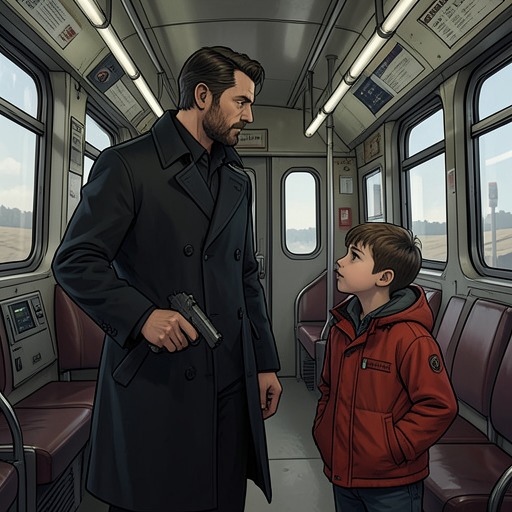
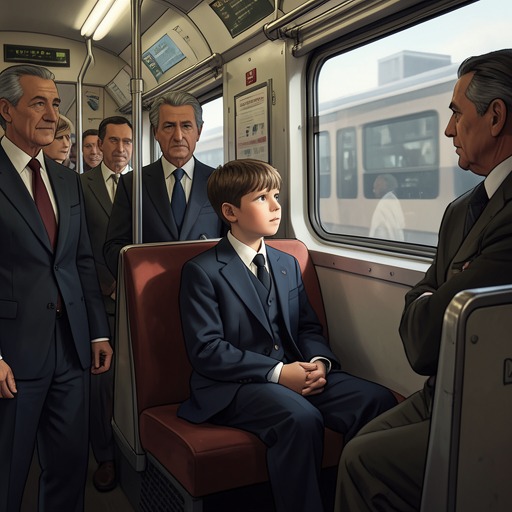
Kimura enters car seven with one hand closed around the gun inside his bag. He counts the rows as he moves down the aisle. The carriage is quieter and emptier than he expected: only a scattering of passengers occupies the seats. In the fifth row, a teenager in a white-collared shirt and blazer watches other Shinkansen trains arrive. The boy’s neat appearance and slight build give Kimura pause. A row away, Kimura hesitates over whether he can bring himself to hurt someone who looks so young and vulnerable.
The hesitation ends when the teenager turns and presses a homemade stun device against Kimura’s thigh. Kimura first mistakes the sudden disruption for a problem with the train; then he realizes that his own body has been disabled. The Prince has used the kind of homemade device Kimura has encountered before. The armed pursuer is now unable to move freely, and the Prince has seized the initiative before Kimura can draw his gun.
When Kimura comes to, he is seated beside the window with his hands bound in front of him and his ankles secured with sturdy fabric and duct tape. He can bend his arms and legs, but the restraints prevent him from going anywhere. The change is practical as well as symbolic: Kimura arrived expecting to choose how the confrontation would proceed, but the Prince has made him captive and controls the weapon.
A Pursuit Turned into a Trap
The Prince treats Kimura’s arrival not as a surprise but as the predictable result of information deliberately placed in his path. He mocks Kimura for coming after him in person and for being easy to anticipate. Kimura’s question about whether the Prince planted the information confirms the reversal: what seemed to be a straightforward chance to find the boy was part of the Prince’s plan. The Prince had also anticipated that Kimura would want more than a quick, unannounced attack. He believes Kimura would want to frighten him and force an apology, and says he expected to get Kimura first.
The Prince has taken Kimura’s gun and holds it close between them, out of sight of other passengers, while Kimura initially struggles against the restraints. He tells Kimura that he must hear his account through to the end. The threat of the gun helps quiet Kimura, but the Prince’s control does not rest on the weapon alone: he can speak at length, set the terms of the encounter, and make Kimura listen while immobilized. His later use of the homemade stun device makes explicit how carefully he has prepared to overcome Kimura at close range.
The Prince’s composure sharpens the contrast between them. Kimura’s anger is immediate and physical; when he accuses the Prince of pushing Wataru from the roof, he lunges despite being tied up. The Prince responds calmly, holding him back with the reminder that what he is about to say concerns Wataru’s life. At the mention of his son, Kimura falls back into his seat. The Prince has found a point of leverage that restraint and threats alone could not provide.
The Threat at the Hospital
The Prince tells Kimura that he has someone waiting near the Tokyo hospital where Wataru is receiving life support. He describes the person as a former medical-equipment-company employee who could interfere with the machine keeping Wataru alive. Kimura disputes that this could be done, but the Prince does not need to prove that the threat has been carried out; he makes Kimura confront the possibility while his son is unable to protect himself.
The Prince explains the signal system that would authorize the attack. He can call his accomplice directly, or a call from the accomplice that goes unanswered for more than ten rings—including a call outside the scheduled contacts at each station—will count as permission. He says the accomplice is waiting for that signal near the hospital. In this arrangement, even a missed call becomes part of the threat: Kimura cannot treat silence from the Prince as reassurance.
Kimura points out that a phone might lose service in a train tunnel. The Prince counters that antennas have been installed in tunnels, then makes the danger more concrete by describing how he could get off at Omiya, go to a movie, and switch off his phone. By the time he emerged, he says, something terrible might have happened to Wataru’s life-support equipment. The conditional threat gives the Prince leverage beyond the carriage, turning the distance between the train and the hospital into part of his control over Kimura.
Consequences and Significance
The immediate outcome is that Kimura cannot act against the Prince on his own terms. He has been disarmed, bound, and made dependent on listening; when he tries to resist, the Prince redirects his attention to the danger facing Wataru. The confrontation therefore becomes a coercive contest over the son’s safety as well as a physical reversal between the two men. The Prince’s advantage lies not only in the stun device and restraints, but in his ability to make Kimura’s every possible response seem capable of endangering Wataru.
The scene also links Kimura’s presence on the train to the earlier violence against his son. Kimura has come after the Prince because of Wataru’s fall, but the Prince turns that history into a means of controlling him. What begins as Kimura’s search for a chance to confront the boy becomes an ambush whose stakes reach from car seven to a hospital in Tokyo. The event establishes the Prince as a planner who anticipates an opponent’s actions and extends his threats through an accomplice, while leaving the outcome for Wataru’s life-support equipment unresolved in this confrontation.