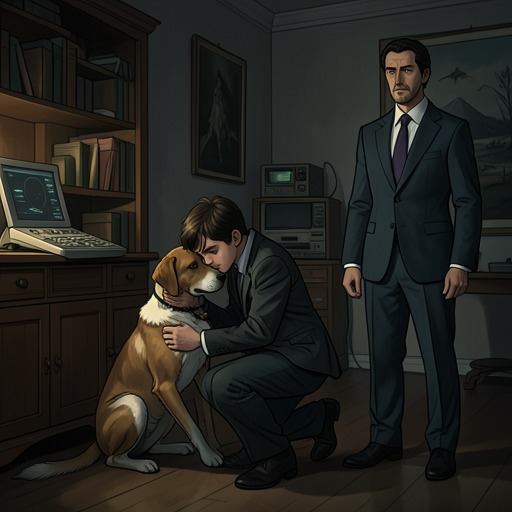
Prototype defibrillator
Bullet TrainThe Prototype defibrillator is a heart-restarting device whose intended medical purpose is twisted into a threat by the Prince. When the Prince prepares to test it on Tomoyasu and then redirects the plan toward Takeshi, the device becomes more than a dangerous piece of equipment: it is the center of an attempt to make classmates betray someone they love. Kimura arrives before the test can proceed, leaving the defibrillator’s threatened use, rather than a completed experiment, to reveal its role in the Prince’s system of control.
Origin and operation
A classmate’s father, who was a doctor and ran a private clinic, had a prototype defibrillator. The students understood it by comparison with an AED: it was meant to deliver an electric shock to restart a stopped heart, but was stronger than a typical defibrillator. The distinction between its medical purpose and the use imagined for it is central. The machine was not introduced as a weapon; its capacity to harm emerged when the Prince decided to test its strength on a person.
The device had two electrode pads, placed on opposite sides of the chest, and supplied information to an electrocardiogram. If it determined that the heart needed a shock, the operator could press a button to deliver one. In the children’s account, ordinary AEDs were automatic and would not work in the proposed way, whereas this prototype was stronger. The classmate’s father reportedly warned that using it on a healthy person could kill them. The Prince knew that the device could conceivably be fatal, but did not share that crucial information with the others.
The Prince’s proposed test
After hearing about the prototype, the Prince wanted to find out how powerful it was. He ordered the doctor’s child to steal it, bringing the machine into a plan that the classmates were to carry out in a park. The setting was a wooded section of a large neighborhood park, down in a gentle dip in the ground. In that secluded space, medical equipment meant to respond to a failing heart was prepared for use on someone whose heart was functioning.
The Prince initially chose Tomoyasu as the proposed test subject. His interest was not limited to what the device would do. He recognized that a death could leave the other students panicked and more likely to look to him for direction. When Tomoyasu’s distress led the Prince to switch the proposed test to Takeshi, the purpose shifted further: the Prince wanted to see how Tomoyasu would respond to the prospect of his faithful dog suffering. Tomoyasu loved Takeshi, yet the situation was designed to pressure him into accepting harm to the dog. The device thus became part of a test of loyalty and self-worth as well as a threat of physical danger.
The interrupted attempt
About ten students tied Tomoyasu and Takeshi together with duct tape. Takeshi was muzzled, and the students began attaching the defibrillator’s pads. Their conversation showed that they were not acting with shared conviction: one student challenged another’s commitment and threatened to report apparent reluctance to the Prince. Fear of punishment set them against one another even as they prepared the device.
Kimura, who had been told what was planned, watched from behind a tree before stepping in. He saw Tomoyasu trying to reassure Takeshi and recognized that the boy was attempting to comfort his dog while both were being restrained. Kimura confronted the students and disrupted the plan before the shock was administered. The evidence therefore establishes a threatened experiment and an interrupted setup, not a completed test or a confirmed injury caused by the prototype.
Fear, helplessness, and significance
The device’s importance extends beyond the park. Kimura connects the students’ failure to imagine resisting the Prince with learned helplessness. He recalls guarding a kidnapped man who was not physically tied up and whose door was unlocked, yet who did not leave. A fellow guard explained the idea through an experiment in which a dog, after learning that it could not avoid shocks, stopped trying to escape even when escape later became possible. Kimura sees a similar pattern among the schoolchildren: repeated suffering at the Prince’s hands, reinforced by the threat of shocks, has taught them to believe that resistance is futile. He does not know precisely how those shocks were delivered or what orders the Prince gave, so the prototype should not be treated as the established source of every punishment.
The classmates’ behavior also reflects the Prince’s deliberate use of distrust. Kimura recognizes a pattern familiar from the criminal organization of Terahara: fear makes people guard themselves, watch one another, and turn against potential allies in the hope that someone else will bear the consequences. In the park, the dispute between students over whether one of them had shown sympathy illustrates that pattern as the defibrillator is prepared. The threatened use of the machine helps make the Prince’s authority feel inescapable, even before it is activated.
The prototype’s narrative force lies in the contrast between its restorative purpose and the Prince’s intended use. It is designed to help when the heart has stopped; here, its presence is used to make children anticipate a potentially fatal shock and to test whether Tomoyasu can be made to accept harm to Takeshi. Kimura’s intervention interrupts that conversion of medical equipment into an instrument of domination. The device remains unused in the attempted experiment, but the plan around it exposes the fear and fractured trust that the Prince has cultivated.