Shinkansen Carriage Display Screen
Bullet TrainThe Shinkansen Carriage Display Screen, normally used for news headlines and train announcements, becomes an improvised lifeline aboard the train. Its brief, public message confirms that Wataru is safe, answers a danger that Kimura cannot resolve by ordinary means, and gives the Prince a sudden piece of information he did not control. The screen’s significance lies not in a change to its machinery but in a change of purpose: a routine display becomes a discreet channel linking people across a crowded train.
An ordinary display repurposed
The screen is a digital ticker mounted above a door in car eight. Its usual function is to carry headlines and train announcements, text moving from right to left across the wall. Passengers can encounter its messages as part of the carriage’s ordinary background; nothing in its placement announces that it might carry a personal communication. That familiarity gives the message its force. The screen does not arrive as a conspicuous new device but as an existing public surface made useful for a private emergency.
The display’s role depends on a practical constraint. Before leaving home for Mizusawa-Esashi to catch the Shinkansen, Kimura asks Shigeru to check on his grandson and protect him if anyone suspicious appears. Kimura has no mobile phone and suggests that Shigeru contact him through a Shinkansen payphone if anything happens. Shigeru points out that the phones no longer accept incoming calls and proposes the carriages’ digital tickers instead. The screen’s value therefore begins with a failed communication plan: an unavailable route prompts the pair to find another one.
Shigeru can arrange the message because, as a go-between, he knows people and is on good terms with someone at the Shinkansen information broadcasting office. The book presents this access as a practical connection, not as a special feature available to every passenger. The screen can carry information between Kimura and Shigeru only because someone outside the immediate scene has the means to place a message there.
A message that changes the scene
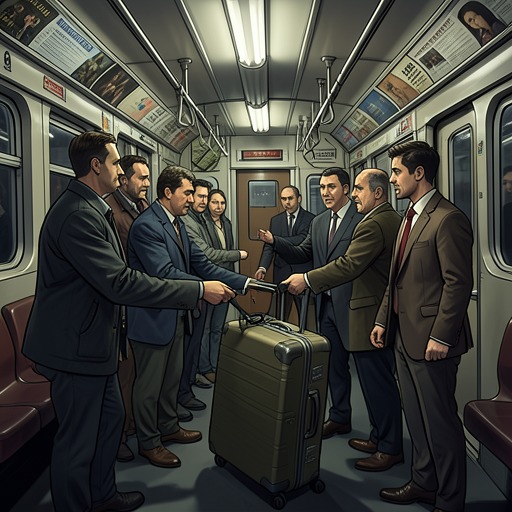
The ticker becomes decisive when the Prince follows two passengers’ gaze and finds that they are looking not at a person entering the carriage, but at the display. He turns to search for the expected figure, looks around, and turns back again before noticing the text above the door. Its appearance redirects his attention from the space around him to a message whose significance he has not yet grasped.
The line reads: “Shigeru to Shigeru. Wataru is safe. Intruder is dead.” The message carries more than one status update. It confirms Wataru’s safety and reports that the intruder is dead, while its opening identifies the communication as one arranged through Shigeru. The screen lets news of events elsewhere reach the train without requiring the sender and recipient to meet or speak directly.
Kimura later sees the message flow across the display in car eight. When “Wataru is safe” appears, that same sentence passes five times. The repetition makes the reassurance unmistakable. Kimura laughs and asks whether the Prince is surprised; as his own relief spreads, the Prince’s composure gives way to visible emotion. The ticker does not merely inform the passengers. In the same carriage, its announcement produces sharply contrasting responses: relief for Kimura and an unsettling discovery for the schoolboy.
Information as leverage
The episode gives material form to an idea the Prince has stated while discussing the suitcase: the person who possesses information and can use it to advance their goals is strongest. He describes how bureaucrats can remain out of public view while politicians absorb public anger, and how sensitive information can be leaked to influence events. He also treats knowledge of the suitcase’s location as a means of controlling those who want it. For him, information is not simply a record of what happened; it is a resource that can direct other people’s choices.
The display briefly puts that principle to work against him. The Prince has been using what he knows to pressure others, but the message supplies him with knowledge from a channel he did not command. It confirms a fact that matters to Kimura and reveals that the attempt to reach him has succeeded. The ticker does not itself explain how the danger was resolved or give the Prince control over the outcome. Its power is narrower and more immediate: it changes what the people in the carriage know, and therefore changes the balance of the moment.
Elsewhere, the Prince’s reflections on the book about Rwanda connect failures of response to the management of information and public judgment. He recognizes that American authorities resisted acknowledging genocide despite reports of growing numbers of slain Tutsi, partly because recognition could oblige the United Nations to act. He maps this avoidance onto his school: teachers, like the institutions in his analogy, may refuse to recognize a bullying problem because acknowledgment would require action. His book report hints at this criticism, but his teacher praises his reading without recognizing that he is writing about her. These episodes do not involve the train display directly; they establish the novel’s broader concern with what institutions notice, admit, or leave unaddressed. Against that pattern, the ticker’s concise message makes a fact visible and hard to evade.
Public communication and its limits
The screen’s intervention is personal and immediate, but the later public account of the Shinkansen deaths demonstrates how different communication can work at a national scale. Two months after the events, reports of multiple bodies in bathrooms and passenger seats draw public attention. As the investigation proceeds, the dead are described as people involved in criminal circumstances, and much of the media follows the police’s vague characterization of the events as a feud within the criminal underworld. Reporting also treats Minegishi’s death at a station on the same platform as the death train as coincidence, leaving his criminal career and network of influence out of the news.
The account says that this framing helped present the incident as exceptional, reassuring the public that ordinary passengers need not fear a similar event and avoiding concern that could damage the national economy. Kimura, found alive in the toilet and taken to hospital, receives no further reporting. Set beside that omission, the ticker’s short, repeated assurance performs a modest but precise task: it communicates a specific fact to the people who urgently need it. The contrast does not make the display an instrument of comprehensive truth. It shows instead how much can depend on who can send information, who receives it, and what a channel is willing—or able—to make visible.