Suzuki’s marriage to his deceased wife
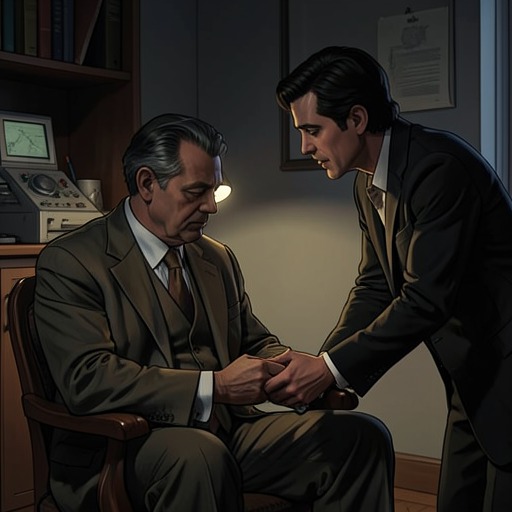
Bullet TrainSuzuki’s marriage to his deceased wife is presented through its aftermath: she was murdered long ago, and her absence remains a source of grief that he struggles to describe or comprehend. The relationship gives personal weight to his insistence that killing is wrong, while his fragmented account of the past shows that moral conviction has not made the loss intelligible. His journey to visit her parents for the first time since her death suggests a cautious willingness to re-enter the family ties left behind by the marriage.
The marriage and its absence
The account supplies few details about the marriage itself: it does not describe how Suzuki and his wife met, how long they were together, or what their life was like. Instead, the bond is made legible through what remains after her death. Suzuki identifies her as his wife and says that she was murdered, a loss he still carries even though it happened a long time ago. The relationship is therefore defined less by remembered domestic scenes than by the continuing presence of someone who is no longer there.
The distinction between the length of time since her death and the force of its emotional return is important. Suzuki speaks calmly about the fact that she was killed and that those responsible are dead, yet that finality does not settle his understanding of what happened. He still cannot make sense of why she is gone. The passage does not offer a solution to that uncertainty or suggest that time has resolved it; it shows how bereavement can persist without yielding a coherent explanation.
Murder, law, and personal conviction
Before disclosing his wife’s death, Suzuki considers why murder is prohibited. He separates legal explanations from an ethical one: laws and the state’s interests, he argues, do not account for his own belief that killing is wrong. What matters to him is the terrifying and tragic disappearance of a person from the world. The later revelation that his wife was murdered makes this argument personal, without turning his loss into a simple proof that every question about killing has been settled for him.
His conviction is firm, but his account of the loss is not. He does not claim to understand the murder or to have extracted a complete moral lesson from it. Nor does the death of those responsible restore what was taken or resolve his questions. The contrast between his clear position on killing and his inability to understand why his wife died gives the relationship its particular weight: ethical certainty and personal comprehension are not the same thing.
A memory that will not settle
When Suzuki tries to think about the circumstances surrounding his wife’s death, his account breaks into disorienting images. He recalls a light that would not change and finding himself on a platform; he also describes having expected Tokyo Station to be the end of the line, only to find that a train continued through without stopping. These details are presented as fragments of a dreamlike experience, not as a complete explanation of the murder. The passage does not establish a precise chronology or show exactly how the images connect to her death.
His manner changes as he speaks. His voice grows softer, the statements become harder for the others to follow, and a desperate expression appears before he shakes his head and seems to return to the conversation. The shift makes the difficulty of recollection visible without supplying facts that Suzuki himself cannot provide. His grief is not just a subject he can calmly recount; at moments, the effort to approach it seems to draw him away from the present. He then describes imagining his wife lost in darkness, beyond his ability to find or help her. The image expresses separation and helplessness, not a claim about her actual fate after death.
Returning to her family
Suzuki is on the train carrying sweets he has bought, but he has left them at his seat. When he remembers them, his manner briefly becomes carefree; he stands because he wants to retrieve them before the train reaches Morioka. In the same exchange, he explains that he is visiting his wife’s parents for the first time since she died and that it has taken him a long time to feel ready. The visit is a concrete step toward her family after a prolonged absence, although the passage does not say what reception awaits him or what the meeting will change.
The small practical detail of the forgotten sweets sits beside the much larger difficulty of returning to his in-laws. Suzuki can attend to the immediate task of recovering what he left behind, while the family visit signals an emotional readiness achieved only after considerable time. His wife’s parents remain part of the life connected to the marriage, and going to see them brings that connection back into view without undoing the loss. The relationship thus ends in neither resolution nor simple withdrawal: Suzuki continues to grieve, but he is at last making the journey to those who were also bound to her.