Takeshi
Bullet TrainTakeshi is Tomoyasu’s dog and lifelong companion, drawn into the Prince’s campaign of control when the Prince makes him the proposed subject of a prototype defibrillator test. Bound to Tomoyasu and fitted with the device’s pads by a group of frightened students, Takeshi becomes both a threatened victim in his own right and the focus of the loyalty that prompts Kimura to act.
Identity and Bond with Tomoyasu
Takeshi is identified plainly as a dog, not a person, when a student urgently explains the situation to Kimura. That distinction initially confuses Kimura, but it also changes his response: the prospect of a dog being used as a test subject interests him where the students’ earlier troubles had not. The scene establishes Takeshi as more than an incidental animal in the schoolchildren’s conflict, because the plan depends on the bond between him and Tomoyasu.
Tomoyasu has had Takeshi for his whole life, and the dog is described as deeply loved by him. When the Prince first selects Tomoyasu for the test, Tomoyasu refuses and pleads for his own safety. The Prince offers to spare him if he brings Takeshi instead. The exchange makes the dog’s place in Tomoyasu’s life central to the threat: Takeshi is chosen not only as a possible test subject but as the means by which the Prince can force Tomoyasu to confront a sacrifice.
The Prince’s Plan
Kimura initially supposes that the Prince has chosen Takeshi because he lacks the nerve to test the device on a person. The students correct that assumption: the Prince had first intended to use Tomoyasu, who begged to be spared. Only after that plea did the Prince make Tomoyasu’s dog the substitute. Kimura therefore recognizes that the device’s use is not the plan’s only purpose. The Prince’s demand exploits Tomoyasu’s attachment to Takeshi, turning the dog into leverage against the boy.
The planned test involves a prototype defibrillator, described as stronger than an automatic AED. At the woodland gathering, about ten students prepare the device while binding Tomoyasu and Takeshi together with duct tape. The dog is muzzled with a length of fabric, and the students attach the defibrillator pads to him. These details show how the group’s threat becomes a coordinated procedure: the device, the restraints, and the students’ participation all serve the Prince’s order. The evidence establishes the preparation and intended use, but does not establish what would ultimately have happened to Takeshi if Kimura had not intervened.
The Woodland Intervention
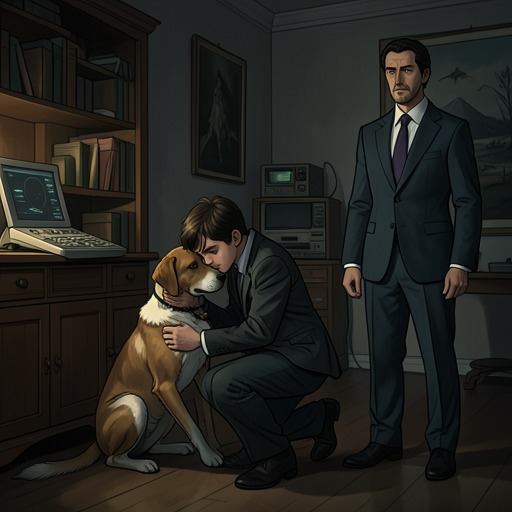
Kimura watches from behind a tree as the students gather in a hollow among fallen leaves. Tomoyasu tries to calm Takeshi, assuring him that everything is all right. The dog does not bark; Kimura then notices the makeshift muzzle. Tomoyasu’s effort to comfort his companion gives the scene its clearest expression of their bond, even as the students continue preparing the test.
The students themselves are not depicted as a united group acting with confidence. One accuses another of having apologized during an earlier beating and threatens to report him to the Prince. Kimura sees their mutual suspicion as part of the Prince’s control: fear turns potential allies against one another and makes each student focus on avoiding punishment. The students’ preparation of the device is therefore also a sign of their subjection to the school’s hierarchy, not simply a spontaneous act of cruelty.
When Tomoyasu begs them to stop and says he does not want Takeshi to die, Kimura leaves his hiding place and approaches the group. He addresses the dog as the one he intends to rescue, then takes advantage of the students’ hesitation. He removes the pads from Takeshi and tears away the tape binding the dog to Tomoyasu. The adhesive catches in the dog’s fur, and Takeshi thrashes as Kimura frees him. The intervention interrupts the preparations and shifts Kimura from observer to protector; the account ends with a student insisting that they must stop him, so the immediate confrontation remains unresolved.
Narrative Significance
Takeshi’s role connects the story’s discussion of learned helplessness with a concrete act of domination. Kimura recalls a captive man who did not leave an unlocked room because he had come to believe escape was impossible. A guard explained the idea through an experiment in which a dog, after being shocked regardless of its actions, stopped trying to avoid the shocks. Kimura applies this framework to the students, whose repeated exposure to the Prince’s punishments has taught them that resistance is futile. The analogy helps explain the students’ paralysis; it does not establish that Takeshi himself has learned helplessness.
That distinction matters to the scene’s emphasis. Takeshi is not presented as a device or an abstract example alone: he is Tomoyasu’s lifelong companion, the dog Tomoyasu tries to comfort, and the animal Kimura physically frees from the preparations. At the same time, the Prince treats him instrumentally, making his proposed use part of a design to break Tomoyasu’s resolve. By intervening for Takeshi, Kimura acts against both the threatened experiment and the coercive arrangement that has made the students participate in it. The dog’s significance rests in that overlap between an individual bond and a system that turns attachment into leverage.