Takuya
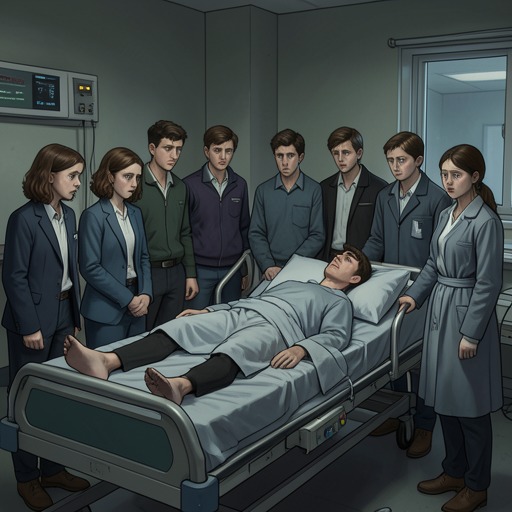
Bullet TrainTakuya is a student whose death reveals the lethal consequences of the Prince’s control over a group of schoolboys. He is not present in the scenes that recount his story; instead, his classmates identify him as a boy who had been punished for disobeying the Prince, then disclose that he died after being pushed toward suicide. Their account makes his fate more than a private tragedy: it exposes the harm concealed beneath the group’s fearful obedience.
Identity and Introduction
Kimura first hears Takuya’s name while entering a men’s room where schoolboys have gathered to discuss what to do about the Prince. One boy says someone must explain the situation to him; another blames Takuya for backing out of an action, claiming that Takuya had said his stomach hurt. The conversation presents Takuya as an absent participant whose choices have become a source of danger for the others: they fear not only what happened, but the Prince’s response to it.
Kimura later recognizes the boys from an earlier encounter in department-store toilets, where they had been distressed because the Prince was angry with them. He recalls that Takuya was then the one due to be punished for failing to follow the Prince’s orders. These accounts place Takuya within a hierarchy in which refusal or failure can bring retaliation. They do not establish exactly what order he disobeyed, or how the punishment was carried out; what becomes clear is that the other students understood the Prince’s anger as an immediate threat.
The Boys’ Account of His Death
The boys eventually tell Kimura that Takuya is dead. Their disclosure is followed by a fuller explanation: they had all been involved in trying to drive him to suicide, and one boy had put a video online. The same boy adds that Takuya had spoken of wanting to die even before the video appeared. The details complicate, but do not erase, the group’s responsibility. Takuya’s despair predated that particular act, while his classmates acknowledge participating in a campaign intended to intensify it.
A student distinguishes the plan from its outcome: they had meant to bring Takuya to the point of suicide, not to have him actually die. The Prince is said to be furious. This distinction reveals the gang’s warped measure of what counts as acceptable. The boys had treated severe harm as something that could be deliberately approached and then safely stopped at a chosen limit; Takuya’s death makes plain how little control they had over that boundary. Their fear now concerns both the loss itself and the consequences of having failed to contain it.
Kimura responds by asking whether Takuya’s death is literal and then confirms that the person who jumped was Takuya. His attempt to treat the revelation lightly gives way to recognition that the boy is gone. The scene does not supply further particulars about Takuya’s life or death. Instead, it makes his absence the fact around which the surviving students’ fear and remorse gather.
The Prince’s Rule and the Students’ Powerlessness
Takuya’s story is set against a school culture in which the Prince’s authority reaches beyond direct punishment. Kimura thinks of learned helplessness: people repeatedly exposed to circumstances in which their actions seem unable to prevent harm may stop trying to escape or resist, even when an opportunity appears. He applies the idea to the students, who have seen classmates and adults suffer under the Prince and have come to believe that they cannot defeat him. The text suggests that electric shocks are among the means of control, but does not specify whether Takuya personally experienced them.
A later episode shows the same system continuing after Takuya’s death. Students prepare an experiment involving Tomoyasu and a defibrillator, while one threatens to report another to the Prince for showing sympathy. Kimura observes that fear has weakened trust among the boys: instead of joining together against the person who commands them, they monitor one another and try to avoid becoming the next target. This episode is not presented as part of Takuya’s own experience; it shows the coercive environment that persists around his classmates and clarifies why asking for help has been so difficult.
Consequences and Narrative Significance
After naming Takuya’s death, the boys turn to Kimura for help. Their appeal comes only after they have shown him how fear of the Prince governs their actions. Kimura had initially approached them hoping to provoke or unsettle them, but the disclosure changes the encounter: he now faces students who recognize that the situation is beyond what they can manage alone. Takuya’s death is therefore the turning point that makes their vulnerability visible to him and prompts their request for intervention.
Takuya remains defined through other people’s accounts, and the limits of those accounts matter. The text gives no extended portrait of his character, no account of his relationship with each classmate, and no complete reconstruction of the events leading to his death. What it does establish is a progression from disobedience and threatened punishment, through organized pressure by peers, to a death that the boys had not intended to happen. That progression makes Takuya’s absence an indictment of a system in which students participate in harming one another to placate a feared authority—and in which their own sense of helplessness can make resistance seem impossible.