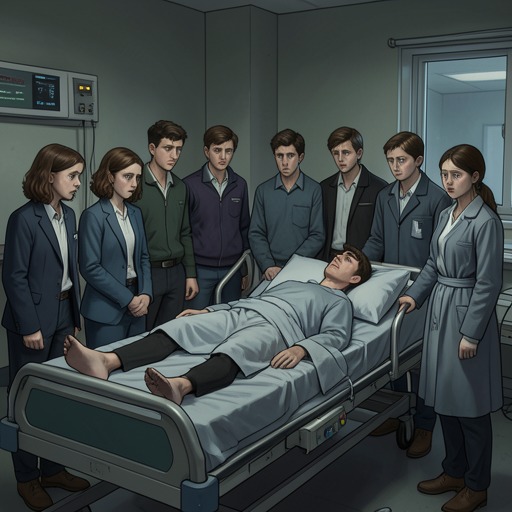
Takuya's Death After Bullying
Bullet TrainTakuya’s death is revealed not in a direct depiction of his final act but in a frightened confession by the schoolboys involved in his bullying. The disclosure turns Kimura’s accidental intervention in another student’s punishment into a confrontation with the lethal consequences of the Prince’s rule: the boys say they meant to bring Takuya to the brink of suicide, not to cause his death, but the distinction offers no escape from what happened.
The disclosure
Later that day, after taking his parents to the station, Kimura walks back through an old shopping arcade and a residential neighborhood with Wataru. Near an alley beside a closed-down gas station, Wataru notices someone crying. Kimura, distracted by his father’s warning that alcohol dependency has no cure and that he can never drink again, initially dismisses the scene as older boys acting out. Only after Wataru draws his attention does Kimura see four students in uniform: two are holding another boy by the arms, while a fourth faces them. The captive student pleads for them to stop.
The schoolboys’ conversation makes clear that this is not an isolated quarrel. They discuss an electric shock as a punishment and pressure the boy to accept it, arguing that otherwise the whole group will be shocked and will blame him for it. Their proposed bargain—take the punishment now and the others will be grateful—makes coercion sound like a choice. One boy suggests pretending that he received the shock instead, but another doubts that the Prince would believe the lie. The Prince’s authority reaches into the alley even when he is not present.
From bullying to death
The boys connect the present punishment to Takuya, whose name Kimura recalls from something he heard in a train toilet. Kimura taunts the students about their earlier fear that Takuya would be punished for disobeying the Prince. The boy with the round face then says quietly that Takuya is dead. The others turn on him for telling a stranger, their faces drained of color; the sudden reaction marks the statement as a dangerous truth they had meant to keep among themselves.
When Kimura asks whether the death is literal, the round-faced boy explains that Takuya jumped because they had overdone it. Another student says that even before he posted the video online, Takuya had been saying that he wished he were dead. The boys’ account therefore links repeated bullying and public humiliation to the circumstances preceding Takuya’s death. It does not present a full account of the jump or establish details beyond what the students disclose, but it makes clear that Takuya had expressed suicidal thoughts before the video appeared and that the bullying continued around him.
The Prince’s order and the boys’ complicity
The students describe their intended limit with chilling precision: they were supposed to push Takuya to the point of suicide, but not actually make him do it. The Prince is said to be angry because that limit was crossed. Their explanation exposes a hierarchy in which the Prince sets the terms of punishment and the students enforce them, while also showing that the boys are not merely following a harmless ritual. They participated in bullying Takuya and in posting a video; their claim that they did not mean for him to die sits beside their own account of deliberately driving him toward suicide.
That contradiction is central to the event’s force. The boys speak as though the boundary between intended pressure and actual death should distinguish what they meant to do from what happened. Yet their stated plan already treated Takuya’s despair as something to be deliberately produced. The present boy being held is being made to face a similar forced choice: take the shock, or be blamed for exposing everyone else to it. Takuya’s death gives that threat a consequence the boys can no longer keep abstract, even as they continue to enact the same logic against another student.
Kimura’s response and the scene’s turn
Kimura initially tries to treat the situation as childish posturing, and when he hears that Takuya is dead he answers with taunts about other things people call dead. His mockery is a way of avoiding the fear prompted by the students’ admission; it cannot make the disclosure figurative. He then acknowledges that when someone dies, they are gone. Wataru continues tugging at his hand, and Kimura turns to leave, recognizing that he may have become involved in something dangerous.
The boys’ response changes the encounter. They call after Kimura to help them, and all four plead at once. Their voices overlap without having planned to speak together; their composure breaks as they reach out to an adult. The appeal does not erase their part in Takuya’s bullying, but it reveals that the Prince’s system has made them both instruments of punishment and frightened subjects of it. Takuya’s death is thus disclosed at the point where the boys’ effort to contain the secret collapses, while another student remains physically trapped in the same coercive pattern.