There’s no such thing as a simple job
Bullet Train“There’s no such thing as a simple job” is Nanao’s hard-won answer to Maria’s confidence that a task can be reduced to an easy instruction. The phrase begins as a complaint about work that repeatedly breaks its promised limits; when Nanao says it again after the Wolf’s accidental death, the refrain carries the weight of a fresh catastrophe.
From reassurance to rebuttal
Maria argues that trouble is part of their dangerous line of work, but Nanao rejects the idea that each assignment brings only an ordinary amount of it. He recalls being sent to photograph a politician having an affair in a hotel. Maria had described the job as simple, but a mass shooting at the hotel made that assurance absurd. The episode gives the expression its central distinction: a task may sound uncomplicated in outline while remaining exposed to consequences no outline can contain.
A later assignment supplies a smaller, more comic version of the same mismatch. Nanao was told to hide money in a restaurant toilet; instead, his socks were soaked, and he nearly had to eat a hamburger drowned in mustard. The mishap is not on the scale of a mass shooting, but it belongs to the same pattern: Maria names the job by its intended action, while Nanao judges it by what actually happens. His claim is not that every task is complicated in advance, but that simplicity cannot be guaranteed by a brief description.
The Shinkansen assignment
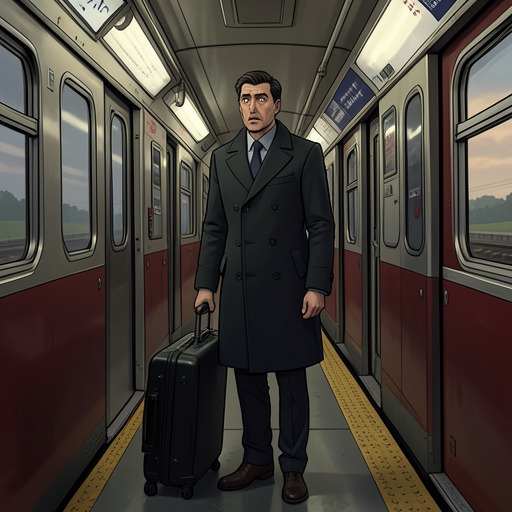
That disagreement shapes Nanao’s response to the suitcase job. Maria describes it as stealing a suitcase and getting off the train. Nanao points out that she has not told him where the bag is or whose it is, and that getting off at Ueno Station, only minutes after the train leaves Tokyo, leaves little time. Maria offers the opposite logic: if she withholds details, the job must be simple enough not to require advance planning. Nanao calls this sideways reasoning and refuses the reassurance.
The phrase therefore also marks a conflict over how risk is understood. Maria treats limited instructions as evidence of an uncomplicated task; Nanao sees the missing information as a reason not to trust that judgment. The reader soon sees the assignment exceed even that wary expectation: while still aboard the Shinkansen with the suitcase, Nanao has fallen with his arm around the Wolf’s head, breaking the Wolf’s neck. As he gets to his feet and struggles to balance the body like a giant puppet, he repeats that there is no such thing as a simple job.
Refrain and consequence
The recurrence turns the expression from a joke about soaked socks and mustard into a bleak commentary on Nanao’s work. The Wolf’s death does not prove that Nanao foresaw this particular outcome; it makes the familiar warning newly grave. His words arrive beside the body and the suitcase, while Maria is demanding to know why he has not called and whether he has reached Ueno Station. Nanao answers that he is still on the train. The gap between the short assignment Maria gave him and the scene he now faces is the refrain’s sharpest meaning: a job’s apparent simplicity says little about what it may set in motion.