Thomas and Friends stickers
Bullet TrainThe Thomas and Friends stickers are a small, crumpled sheet found in Lemon’s jacket, but they become more than a keepsake when Tangerine uses their missing pieces to test the Prince’s account of how he came there. The sheet connects Lemon’s affection for the series to a precise habit of giving stickers, then turns that habit into evidence: a green train recalls an earlier encounter, while a Diesel sticker unexpectedly found on the Prince’s blazer points back to Lemon. The object’s significance lies in this shift from familiar plaything to a physical record of contact that the Prince cannot easily explain away.
The sheet and its missing pieces
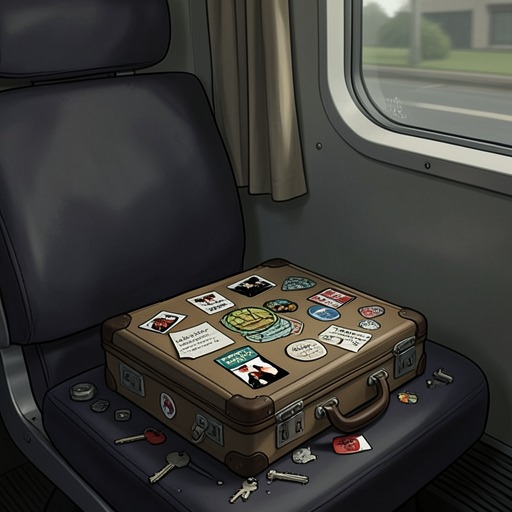
Tangerine produces the colourful sheet during his conversation with the Prince and asks whether he has seen it before. The Prince recognizes the characters as belonging to Thomas and Friends. When Tangerine says he found the sheet in Lemon’s jacket pocket, the stickers cease to be an unidentified possession and acquire a direct connection to Lemon. The Prince already knows that Lemon liked Thomas; he also indicates that the subject could become tiresome. That familiarity helps make the sheet a clue grounded in Lemon’s ordinary enthusiasms rather than an object introduced without context.
The sheet is crumpled, and two stickers are missing, leaving empty white spaces that Tangerine points out. Those absences give the conversation its structure. Instead of relying only on the Prince’s explanation, Tangerine asks him to account for individual stickers and the characters they depicted. The sheet thus functions as a partial inventory: what remains can be compared with what is gone, and the blanks invite the question of where the missing pieces went. Its damaged, incomplete state makes it useful precisely because it preserves traces of prior handling and distribution.
Lemon’s way of giving
The Prince remembers one specific earlier moment. When Lemon was down, he pressed a sticker to the ground; the Prince later peeled it off and threw it away. The image on that sticker was a green train. This memory supplies a concrete link between the sheet and the Prince, although he initially has to decide whether to disclose it. Tangerine’s questions make a discarded sticker newly consequential: a small act that had seemed finished now provides a test of the Prince’s knowledge.
Tangerine explains why a recipient should remember more than the sticker’s appearance. Lemon, he says, always wanted people to learn the names of Thomas’s friends. Whenever he gave someone a sticker or toy, he named the character; he did not simply hand over an object. Tangerine describes this as an unfailing habit, not an occasional flourish. His account turns Lemon’s repeated way of giving into a standard against which the Prince’s answers can be judged. The sticker carries two kinds of information at once: which character it depicts and the name Lemon would have spoken while giving it.
On the basis of the empty spaces, Tangerine guesses that the missing green sticker is the one Lemon gave the Prince. The Prince recognizes the guess as correct and tentatively supplies the name Percy. Tangerine confirms it, including Lemon’s affection for the character. The exchange establishes both the sticker’s identity and the personal history attached to it; Percy is not merely a green train selected at random but the subject of a remembered gift and one of Lemon’s favourites.
The Diesel sticker on the Prince
Tangerine then asks about the other missing sticker. The Prince claims to know which character it was, but Tangerine grabs him by the lapel and releases him suddenly. A black train with a square face is on Tangerine’s finger: the missing sticker has been found stuck to the Prince’s jacket. The Prince is taken by surprise, though he tries not to show it. The object’s movement from Lemon’s possession to the Prince’s clothing makes the sheet a physical link between the two men, not simply a prompt for recollection.
Tangerine identifies the character as Diesel. He associates Diesel with malice and spite, and recalls that Lemon warned him never to trust that character because Diesel lies and forgets people’s names. Tangerine contrasts this with Lemon’s own insistence on naming every character he gave away. The meaning of the sticker therefore depends on more than its image: it carries Lemon’s remembered judgment of Diesel as well as the evidence that this particular sticker passed through Lemon’s hands.
The Prince tries to explain that the sticker must have got there somehow, but the scene supplies a more specific possibility. When Lemon grabbed him, Lemon must have stuck it to the Prince’s blazer; the Prince had not noticed. The narrative presents this as Lemon’s last act. The sticker’s presence is thus a trace left in the course of their physical contact, one that survives even though the Prince did not register it at the time. What had been hidden on his clothing becomes visible to Tangerine and changes the balance of their exchange.
Evidence, memory, and exposure
The sheet works as a modest but unusually exact record. Its two blank spaces prompt Tangerine’s questions; the Prince’s memory identifies the green train; Lemon’s naming habit supplies a way to test the answer; and the second sticker, found on the Prince himself, brings the trail into the present. No single clue carries the whole case. Their force comes from the fit between the missing images, Tangerine’s knowledge of Lemon, and the Prince’s contact with the stickers.
For the Prince, the objects turn familiar cultural details into a problem of concealment. He has reason to recognize the green train and can confirm Percy, but the Diesel sticker exposes a connection he did not know was visible. His brief attempt to recover his composure does not remove the physical clue or the history behind it. For Tangerine, remembering Lemon’s enthusiasm for Thomas and Friends is practical knowledge: it allows him to interpret an incomplete sheet and question the Prince with increasing precision. The stickers consequently preserve two sides of Lemon at once—the everyday pleasure he took in the characters and the final, consequential trace he left on the Prince’s blazer.