Ueno Station
Bullet TrainUeno Station is the intended endpoint of Nanao’s apparently simple Shinkansen theft, but it becomes the point where the plan breaks open. Nanao reaches the doors with the suitcase in hand and the station in view; before he can get off, the Wolf boards and knocks him back. The train pulls away, turning the planned escape into a continuing journey and leaving Nanao to pursue the job’s missing information and uncertain outcome aboard the train.
The planned stop
Ueno Station matters first as a narrow window in Maria’s instructions. Nanao has been told to steal a suitcase and get off, but he objects that the plan gives him neither the bag’s location nor its owner. Ueno, he points out, comes only a couple of minutes after the train leaves Tokyo Station. With so little time to locate and retrieve the luggage, he doubts that he could make the exit. His concern is practical rather than abstract: the timetable itself threatens to make the job impossible before he knows what he is meant to find.
Maria presents the lack of advance detail as evidence that the assignment will be simple. Nanao rejects that reasoning, drawing on an earlier job that was also described as straightforward but left his socks soaked and nearly ended with him eating a hamburger drowning in mustard. His insistence that there is no such thing as a simple job establishes the expectation against which Ueno’s brief, crowded operation will turn. The station is supposed to be a clean point of departure; in practice, it concentrates the risks that the instructions have left unexplained.
The approach and retrieval
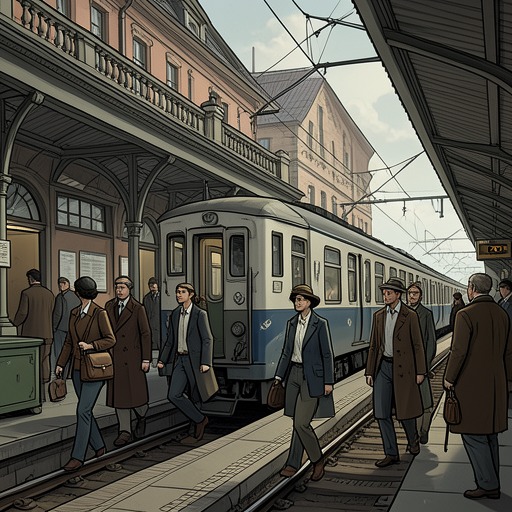
As the Shinkansen slows for Ueno, the station appears beyond the train window. Nanao sees people on the platform already receding from view, along with stairwells, benches, and digital displays. The scene is mediated by the approaching train: the platform is visible in fragments and for only a short time, while Nanao watches for anyone coming up behind him. He worries that the bag’s owner, or another person, may challenge him and complicate the theft.
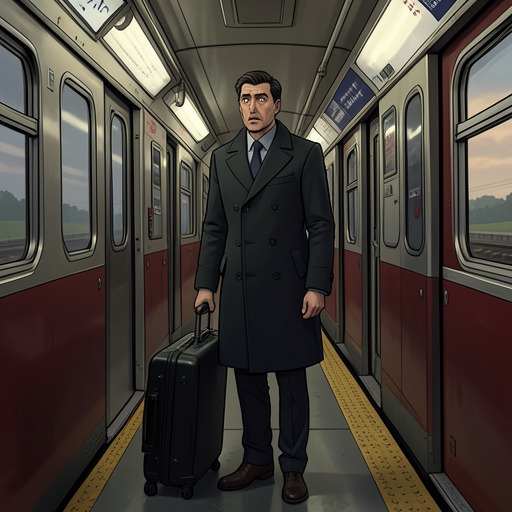
The immediate retrieval has gone smoothly. With five minutes remaining before Ueno, Nanao finds the luggage storage without difficulty and locates the black, hard-sided suitcase. It is mid-sized, has wheels, and bears a sticker by its handle; he cannot tell what material it is made from. He lifts it from the rack quietly, checks the time, and returns through car four, taking regular, even steps. There are four minutes until the train arrives. No one appears to be paying attention to him, and for a moment the job seems to be proceeding according to plan.
Nanao continues through car five and stops in the gangway between cars five and six. He has worried that something at the door might hold him up: people blocking the way, an argument pulling him into someone else’s business, or some other everyday obstruction. The imagined complications are mundane, but the pressure is real because the stop is so near. Ueno gives him little margin to recover from even a small delay.
The missed exit
At the door, Nanao catches his reflection in the window and thinks of his reputation for bad luck. Former girlfriends had blamed their lost wallets, mistakes, or worsening skin on being with him; he had denied responsibility but suspected that his misfortune might rub off on others. As the Shinkansen slows, he watches the station approach and thinks of a roulette wheel losing speed, each possible stopping place seeming newly consequential. The comparison makes the arrival feel less like a routine stop than a moment in which chance is about to settle on one outcome.
A small man in a flat cap stands on the other side of the door. The resemblance to the Wolf is so striking that Nanao initially identifies him through memory: the Wolf is a fellow operator in dangerous back-alley work, known for boastful claims and for a nickname that Nanao regards as derisive. Nanao recalls having kicked him in the head; the Wolf left promising revenge, and they had not met again. The arrival at Ueno brings that old grievance directly to the exit Nanao needs to use.
When the doors open, Nanao recognizes that the man is indeed the Wolf. Nanao tries to get off, but the Wolf charges into the train and knocks him backwards. The doors then close, and the Shinkansen pulls away. Maria’s earlier reassurance that the job would be simple returns to Nanao’s mind as frustration: the suitcase is in his possession, but the escape on which the assignment depends has failed. Ueno is therefore not merely where the train stops; it is where the job’s central assumption—that Nanao can take the bag and leave—collides with an unforeseen opponent.
After the departure
The failed exit shapes what follows aboard the train. Later, Maria tells Nanao that she has informed the client that her star player has the bag but could not get off at Ueno. She says that she does not consider the subsequent exit at Omiya a major problem, while admitting that she contacted the client to keep him informed. The client’s reported reaction is alarm: Maria says he went white. The missed stop has thus already reached the person whose property and expectations govern the assignment, even though Nanao cannot see the client himself.
Nanao also wonders whether the person who supplied the bag’s location may still be aboard. Maria had received word, just after the train left Tokyo Station, that the suitcase was in the storage area between cars three and four. Nanao reasons that the source of that information might be an ally on the theft team. Maria cautions that the person’s task may have ended with confirming the location and calling her, and that they probably got off at Ueno. The station becomes an uncertain boundary between the people who remain involved and the people who may already have left the train.
When the suitcase later goes missing, Nanao has to decide whether to leave at Omiya or remain aboard. He recognizes two possibilities: whoever took the bag might still be on the Shinkansen, or might have taken it off at Omiya. He stays because searching the train could give him a chance to catch a thief who cannot immediately leave, whereas looking for someone who has already reached the streets would offer less certainty. He briefly gets off to scan the platform, swivelling his head to look for anyone fleeing with the suitcase, but cannot see the entire length of the train and platform. In retrospect, the contrast with Ueno is pointed: the earlier stop was lost to the Wolf’s sudden arrival, while at Omiya Nanao makes a conscious calculation about whether to leave or continue the search.
Narrative significance
Ueno Station is the hinge between a job imagined as a quick theft and the extended chain of complications that follows. Its short interval after Tokyo Station explains Nanao’s initial objection; the luggage rack, narrow passage through the cars, and closing doors give that time pressure physical form. The station is also where a past conflict unexpectedly returns: the Wolf appears not in some remote hiding place but at the precise door through which Nanao intends to escape.
The sequence reverses the apparent meaning of possession. Nanao has successfully found and taken the suitcase, yet those actions do not amount to completing the assignment, because the exit is as essential as the theft. Once the Shinkansen departs, Ueno remains present in the story as a lost opportunity and a point of uncertainty—where the client was told Nanao had failed to get off, and where the unidentified informant may have left. Its importance lies less in a description of the station as a whole than in the compressed choices and missed possibilities that gather around one departing train.